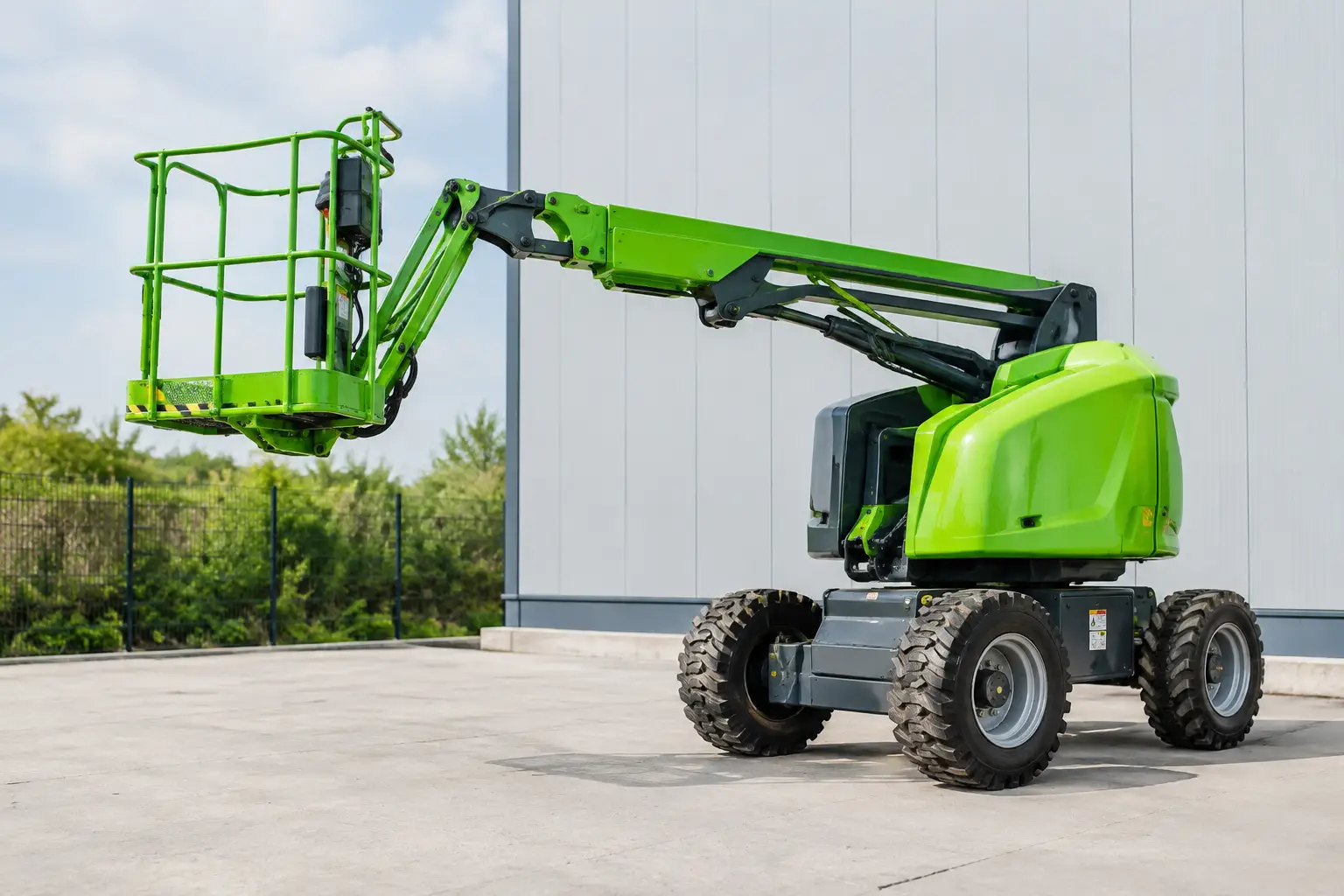
The Dingli BA16 review starts with a practical question: can this articulated boom get productive in the places where a larger machine simply cannot work? For contractors dealing with confined external areas, building elevations, maintenance programmes and mixed ground conditions, that matters more than headline working height alone. The BA16 sits in the useful middle ground where compact transport and set-up requirements meet genuine outreach and up-and-over capability.
It is not a machine to buy purely because it reaches around 16 metres. The right decision depends on the exact BA16 variant, the ground conditions, the route into site and whether the work calls for electric operation, diesel rough-terrain performance or both. For the right buyer, however, it is a seriously capable compact boom format.
Dingli BA16 review: what the machine is built for
The Dingli BA16 is an articulated boom lift designed to give operators working height with the flexibility to reach over obstacles. Unlike a straight telescopic boom, the articulated boom arrangement is valuable where the basket needs to pass above a low roof, wall, canopy, plant room or landscaping before positioning at the job.
In practical terms, this makes the BA16 well suited to building maintenance, cladding and façade work, steelwork, industrial estates, facilities management and certain arboricultural or external installation tasks. It can also make a strong case for hire fleets that need a versatile mid-height boom rather than a machine built for one very narrow application.
The BA16 designation covers variants, so buyers should not assume every machine has identical dimensions, powertrain or capability. Figures such as working height, horizontal outreach, stowed height, machine width, platform capacity and gradeability must be confirmed against the specification of the machine being quoted. This is particularly relevant when comparing electric and rough-terrain versions, where the operating character can be quite different.
Reach is only useful if the site layout works
A typical BA16-class articulated boom provides a working height of roughly 16 metres, with useful horizontal outreach and an articulating jib to improve final basket positioning. On site, that combination can save repeated repositioning. An operator can approach a façade from a safe, sensible distance, clear an obstruction and then fine-tune the basket to the workface.
That is the key advantage over a scissor lift. A scissor may offer a larger platform and straightforward vertical access, but it cannot usually solve a job where the machine must work over a fixed obstacle. Conversely, a straight boom may deliver greater outreach for its size, yet can be less accommodating where up-and-over access is the deciding factor.
Buyers should map the work, not just measure the height. Consider where the chassis can stand, where the basket must finish, the height of any obstruction and whether there is space for the boom to slew. A machine can have the stated reach on paper but still be a poor fit if gates, parked vehicles, racking, roof lines or service yards restrict its working envelope.
Basket capacity and working practice
Platform capacity should be assessed honestly. For one operative carrying hand tools, a standard boom basket capacity may be entirely adequate. For two people, heavy materials, glazing equipment, cable drums or specialist tools, capacity becomes a much bigger part of the buying decision.
It is also worth separating occasional material handling from the way the platform will be used every day. Continually operating at maximum basket load can limit flexibility and affect productivity. A larger platform or higher-capacity machine may cost more initially but be the more efficient choice over a contract cycle.
Compact dimensions are a genuine buying advantage
The appeal of the BA16 is not simply that it is smaller than a 20-metre boom. Compact width and a manageable overall footprint can make the difference between accessing a job directly and losing time on labour-intensive alternatives. Restricted service roads, narrow gateways, internal yards and established commercial sites all expose the value of a compact chassis.
Before committing, measure the tightest point in the journey: not the entrance to the site, but the actual pinch point. That may be a gate post, a turn between buildings, a loading-bay barrier, a ramp, a covered access route or the space needed to manoeuvre once through the gate. Check stowed height too, especially for workshops, warehouses and covered plant areas.
Transport weight deserves the same attention. A BA16 may be easier to move than a larger boom, but it still needs suitable transport and proper load planning. Buyers using their own lorry or trailer arrangement should confirm gross weight, tie-down positions, loading angle and any access limitations at both ends of the journey. A convenient machine is one that can be deployed without creating a separate transport problem.
Electric or rough-terrain: choose for the ground, not the brochure
An electric BA16-style boom is often the sensible answer for indoor work, warehousing, manufacturing sites, covered areas and noise-sensitive locations. It brings low-emission operation at point of use and avoids the fumes associated with diesel machinery. For planned facilities work on firm, level surfaces, electric power can be a very strong fit.
The trade-off is that electric does not automatically mean suitable for every site. Surface condition, gradient, drainage channels, loose stone and wet ground still matter. Battery charging routines also need to suit the way the machine is used. If the platform works hard across long shifts without dependable charging time, confirm battery type, charger arrangement and realistic duty cycle before purchase.
A rough-terrain BA16 variant is aimed at more demanding external ground. Four-wheel drive, oscillating axle arrangements, foam-filled or rough-terrain tyres and stronger gradeability can all help keep a job moving where a slab-only machine would struggle. But rough-terrain capability should not be confused with permission to work anywhere. Soft ground, deep ruts, side slopes and unstable made-up surfaces require proper assessment, along with the manufacturer’s operating limits.
The best choice depends on where the machine earns its keep most often. A contractor with 80 per cent external, uneven-ground work should not compromise for the occasional indoor task. Equally, a facilities team operating mainly on finished floors may find a diesel rough-terrain boom unnecessarily costly and inconvenient.
Controls, stability and day-to-day ownership
A boom lift is only productive if operators can position it confidently and consistently. Proportional controls, clear ground and platform controls, smooth drive response and precise jib movement all have a direct effect on output. These details are difficult to judge from a specification sheet, which is why a demonstration or thorough handover has real value.
The BA16 should be assessed as a working asset rather than a one-off purchase. Ask how easily routine checks can be completed, whether service points are accessible, what local parts support is available and how diagnostic systems are handled. A machine that is economical to buy but difficult to support can soon become expensive through downtime.
For pre-owned examples, inspection matters even more. Check the service history, operating hours, battery condition on electric units, tyre wear, structural condition of the boom and basket, slew bearing performance, hydraulic leaks, emergency-lowering functions and all safety systems. A current thorough examination record is useful, but it should not replace a proper condition assessment before sale.
A note on used-machine value
A well-maintained used BA16 can be a sensible route into articulated-boom capability, particularly for an owner-operator or business adding capacity for a confirmed workload. The saving needs to be weighed against remaining warranty, condition, expected maintenance and resale prospects.
New equipment has the advantage of known history, warranty cover and the ability to specify the machine around the job. Used equipment can offer faster value where the specification is right and the machine has been properly maintained. Neither route is automatically better. The productive machine is the one that fits the work and can be supported throughout ownership.
Who should consider the Dingli BA16?
The Dingli BA16 makes most sense for buyers needing a compact articulated boom with enough reach for regular mid-height work and enough agility to deal with obstructions. It is a credible option for maintenance contractors, industrial operators, roofing and building firms, access specialists and hire companies building a flexible fleet.
It may not be the best answer if the job is predominantly vertical access on clean, level slabs, where a scissor lift could provide a larger workspace at a lower cost. Nor is it automatically the answer for long-reach work across wide setbacks, where a larger telescopic boom could be more efficient. The BA16 earns its place where compact access and articulated positioning are regular site realities.
A proper Dingli BA16 review should end at the job-site plan: measure the access route, identify the obstruction, confirm the required basket position and match the power option to the ground. Once those points are clear, the right machine becomes far easier to buy with confidence – and far more likely to work hard from its first day on site.