A quoted working height can look straightforward on a specification sheet, but choosing a platform on that figure alone is how jobs end up slower, tighter and more expensive than planned. An access platform working height calculator gives you a sensible starting point: identify the highest point the operative must work at, allow for safe positioning, then check whether the machine can physically get there and work effectively once it arrives.
For UK contractors, facilities teams, arborists and access specialists, the aim is not simply to reach the top of a building. It is to put the right person, tools and materials in the right place, with adequate clearance, stable ground and a practical route into site.
What working height actually means
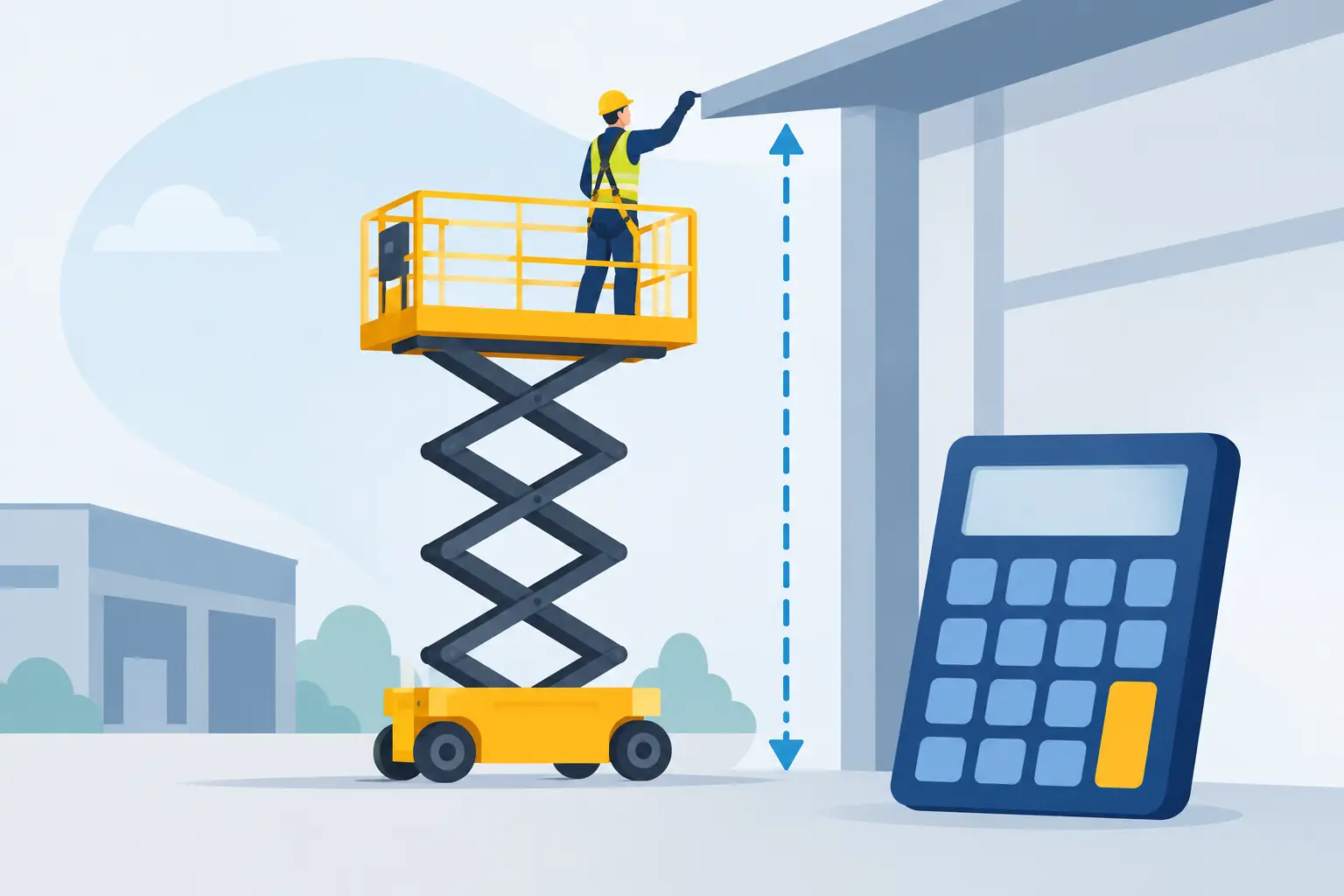
Working height is normally the maximum height an operative can reach while standing in the platform basket. Manufacturers generally calculate it by adding around 2 metres to the maximum platform floor height. So, a machine with a 10-metre platform height will commonly be advertised with a 12-metre working height.
That convention is useful for comparing machines, but it is not a guarantee that a 12-metre job can be completed by every 12-metre platform. The operative may need to work below a parapet, over a roof edge, around pipework or alongside a façade. Basket position, outreach and the approach angle can matter more than the headline number.
Treat working height as a machine-selection figure, not a substitute for a site assessment or safe system of work. The required height should be measured from the machine’s actual operating level, not from the pavement outside the gate or the highest point on a sloping driveway.
How to use an access platform working height calculator
The basic calculation is simple:
Required working height = highest work point above operating ground level + allowance for the task
In many cases, the working point itself is the figure to start with. If a gutter line is 9.5 metres above the ground where the platform will stand, a machine with 11.5 metres of working height may look sufficient under the standard 2-metre allowance. In reality, that choice depends on whether the basket can be positioned beside the gutter without putting the operative at full stretch or forcing the boom into an awkward angle.
A practical calculator should capture four site facts:
- the height of the work point from the true operating surface;
- the horizontal distance between the platform and the work area;
- obstructions such as canopies, roofs, branches, services or parked plant; and
- the ground condition, access route and available set-up space.
The height calculation gets you into the correct class of machine. The other checks determine whether that machine will do the job properly.
Start from the point of work, not the building height
A roof may be 12 metres high, yet the actual task could be at a 9-metre soffit or on signage at 10.5 metres. Equally, a 10-metre wall can require more than a 12-metre working-height machine if the platform must stand back from the façade to clear a basement lightwell, planted area or pavement obstruction.
Measure the point where hands, tools or materials need to be used. For inspection work, that may be a window head, ducting connection or telecoms bracket. For tree work, it may be the branch union rather than the overall canopy height. This sounds obvious, but it prevents paying for capacity that never gets used or arriving with a platform that is only just tall enough on paper.
Add a sensible operating margin
Avoid selecting a machine that puts the basket at its absolute maximum height for every lift. A modest margin gives the operative a more comfortable, productive working position and allows for minor differences between survey dimensions and site reality.
How much margin is appropriate depends on the job. A quick inspection of a level façade may need little extra capacity. Repetitive installation work, work with long materials, or tasks around uneven surfaces usually benefit from more room. The answer is not automatically to choose the tallest machine. Extra height can bring extra weight, width, transport cost and restricted manoeuvrability.
Check platform height separately
If the specification gives both figures, confirm them. Working height is the reach allowance; platform height tells you where the basket floor can physically sit. Where an operative needs to step across a level threshold, work through an opening or align materials at a precise level, platform height can be the more useful figure.
This distinction is particularly relevant on internal maintenance jobs and industrial sites. A scissor lift might provide the correct working height, but its platform floor level and vertical-only travel may not suit an obstruction below the task.
Height alone does not choose the platform
Once the calculator produces a likely working-height range, match the machine to the site. Access equipment is a set of compromises, and the best specification is the one that removes the real constraints on the day.
Reach and clearance around obstacles
A boom lift may reach a work point that a scissor lift cannot because it can provide horizontal outreach. However, boom geometry varies. A conventional articulated boom can work up and over some obstacles, while a telescopic boom may deliver greater direct reach. A tracked spider lift can be a strong choice where narrow access, low ground pressure and flexible boom movement are more valuable than high travel speed.
Do not estimate outreach by eye from a product photograph. Check the working envelope and ask whether the stated horizontal reach applies at the required platform height. As the boom rises, usable outreach can reduce. Stabiliser position, basket load and machine configuration can also affect what is available.
Ground level and stabilisation
The calculator should use the level where the machine will operate. On a slope, that can change the answer materially. A platform set lower down a driveway may gain height to the building, but it may lose safe set-up options or exceed permitted slope limits.
Rough-terrain boom lifts with stabilisers are designed for demanding ground conditions, but stabilisers are not a licence to ignore ground bearing pressure, voids, services or gradients. Auto-stabilisation supports efficient set-up where conditions permit; it does not replace a competent check of the area beneath each outrigger.
For soft ground, landscaped areas or uneven access, consider whether a lightweight tracked platform can reach the work area with less disruption. For hardstanding with repeated façade work, a self-propelled boom may offer faster repositioning and stronger daily output.
Width, weight and transport
A machine can have the right height and still be wrong for the property. Check gate width, turns, headroom, bridge limits, floor loading and the delivery route before committing. Road-towable access platforms reduce transport complexity for some teams, but the towing vehicle, licence position, site set-up space and duty cycle all need consideration.
Compact access equipment often earns its place before it lifts a single person. A narrow machine that passes through a side entrance or travels along a restricted service route can remove the cost and delay of dismantling fencing, closing access roads or hiring additional equipment.
Worked example: choosing for a 10-metre façade task
Assume a maintenance team needs to inspect and repair cladding at a maximum point 10 metres above a level service yard. On a basic calculation, a 12-metre working-height platform appears suitable because it provides about 10 metres of platform height plus the standard 2-metre operative allowance.
Now add the site details. The machine must stand 2 metres away from the façade due to drainage channels, and a projecting canopy sits at 4 metres. A compact scissor lift may have enough vertical height but cannot pass the canopy or bridge the gap. A small articulated boom with suitable up-and-over clearance and enough usable outreach is likely the better fit.
If access to the yard is through a 1-metre pedestrian gate, that decision changes again. A narrow tracked spider lift may be the practical answer, provided its stabiliser footprint can be accommodated once inside. The calculated height has not changed. The platform category has.
Common calculator mistakes to avoid
The most frequent mistake is using the advertised working height as the exact maximum task height with no allowance for basket position or job movement. The next is measuring from the wrong level, particularly where the platform will sit on a ramp, kerb line or lower yard.
It is also easy to overlook non-working dimensions. Check stowed height for entranceways, overall width for access, machine weight for suspended slabs and carrier suitability for delivery. On used equipment, confirm that the available configuration, battery condition, tyre choice and any optional equipment match the work you have priced.
Finally, do not make a height decision without considering people and materials. Basket capacity may be adequate for one operative and hand tools but not for two operatives, glazing equipment or repeated material handling. A bigger basket is not always the answer, but the limitation needs to be identified before the machine reaches site.
Turn the calculation into a confident buying decision
Use the access platform working height calculator as the first filter, then compare platform height, outreach, width, weight, power source, terrain capability and stabilisation against the actual job. A few accurate dimensions and site photographs can make the selection process far more decisive than a broad description such as “around 12 metres”.
Pure Platforms can help turn those details into a machine shortlist, whether the requirement is a compact spider lift for a restricted garden, a road-towable platform for mobile maintenance or a stabilised boom for uneven commercial ground. The right platform should give your team room to work, not leave them working at the edge of its limits.