A boom lift can have the reach, basket capacity and rough-terrain tyres your job demands, but none of that matters if the machine cannot establish a stable working position. Hydraulic stabilisers give access platforms a secure footing on uneven or sloping ground, helping operators work at height with greater confidence and keeping projects moving where a standard self-propelled machine may be limited.
For contractors, arborists, facilities teams and hire fleets, stabilisation is not an optional extra to glance over on a specification sheet. It affects where the platform can be used, how quickly it can be set up and whether the machine is suitable for the site at all.
What hydraulic stabilisers do
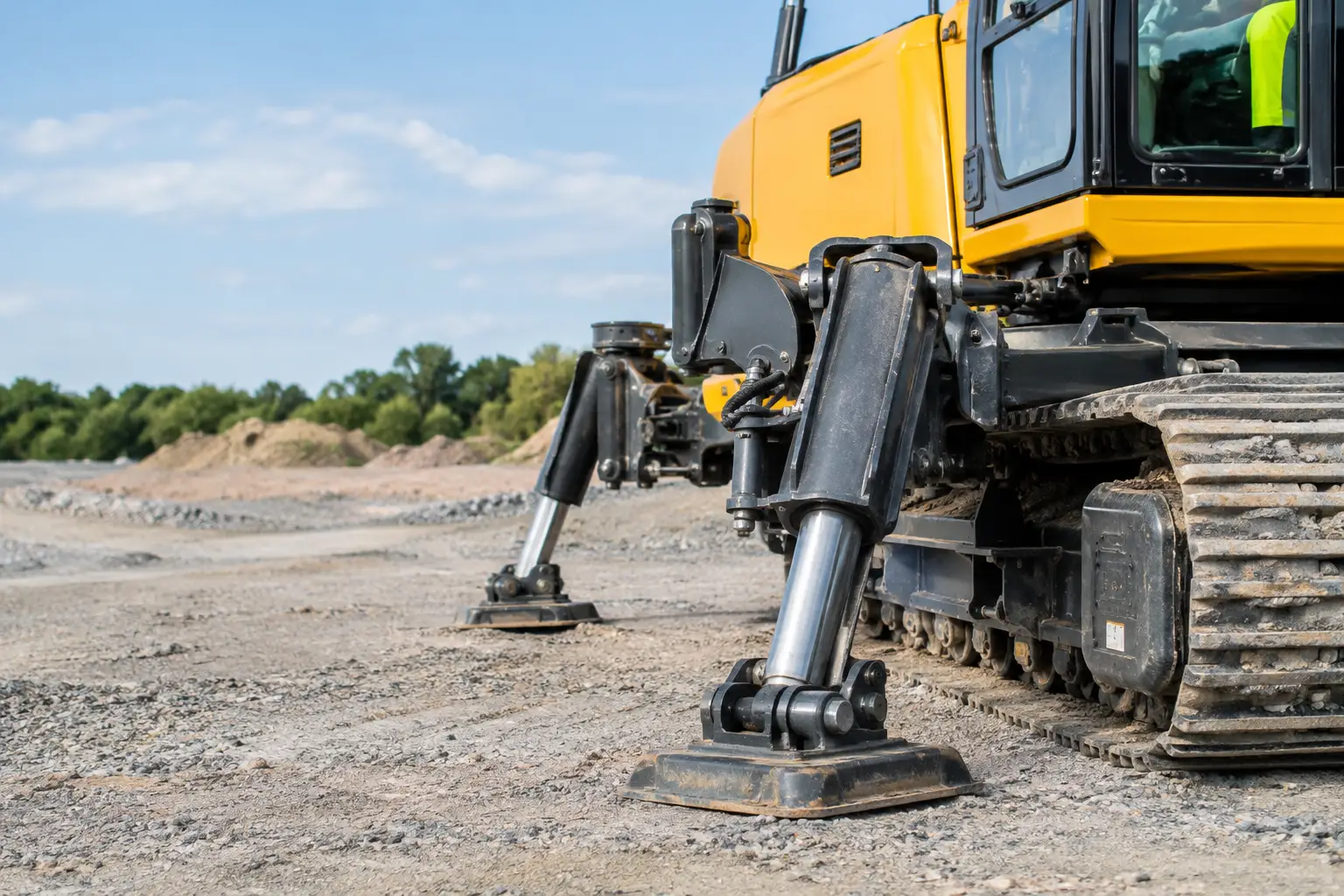
Hydraulic stabilisers are powered support legs fitted to selected access platforms, including rough-terrain boom lifts, spider lifts and road-towable machines. Once the machine is in position, the legs extend outward and down to transfer part of the machine load directly into the ground.
The result is a larger, more stable footprint than the wheels or tracks alone can provide. On many machines, the stabilisers can level the chassis within the manufacturer’s stated limits before the boom is raised. This is especially valuable on sites with broken ground, cambers, gradients, soft verges or unfinished surfaces.
Stabilisers are not a substitute for good site assessment. They do not make unsafe ground safe, and they cannot overcome poor bearing capacity, hidden voids or steep slopes beyond the machine’s rating. Their job is to support the machine within its designed operating parameters, not to stretch those parameters.
Stability starts at ground level
A platform’s stability depends on more than whether it looks level. The ground must carry the force applied through each stabiliser foot, particularly when the boom is elevated and working at outreach. A small foot can apply considerable point loading, and soft or recently disturbed ground can compress without obvious warning.
Operators should inspect for drainage channels, service covers, trenches, cellars, made-up ground and edge conditions. Suitable spreader pads may be required to distribute loads, but they must be correctly sized, strong enough for the task and approved for use with the machine. Timber offcuts, loose blocks and improvised packing are not a safe answer.
Where hydraulic stabilisers earn their keep
The clearest benefit is on terrain that rules out a conventional wheeled boom lift. A stabilised rough-terrain boom can be a practical choice for construction plots, rural estates, industrial yards, rail-side work areas and external maintenance locations where ground conditions change across the site.
They are also useful where reach is needed over an obstacle. Once correctly set up, a machine with stabilisers can deliver controlled working height and outreach without relying solely on tyre contact. This can help with cladding, steelwork, roofline maintenance, tree work and building repairs where the best lifting position is not a flat, finished surface.
Compact tracked spider lifts take the same principle into tighter spaces. Their narrow transport width and low ground pressure can suit courtyards, gardens, side access routes and sensitive surfaces. Once in the work area, their outriggers provide the stable base needed for high-level access. The trade-off is that setup space around the machine becomes critical. A compact platform may pass through a narrow opening, but its stabilisers need room to deploy.
Road-towable platforms are another strong fit. They offer straightforward transport between jobs and can be stabilised at the point of work, making them useful for property maintenance, signage, facilities work and local authority applications. They are not always the quickest option on a large site with repeated moves, but for lower-utilisation or multi-location work they can be commercially sensible.
Auto-levelling versus manual setup
Many modern machines offer auto-levelling or auto-stabilisation. The operator selects the function and the machine deploys its legs to establish a level working position, subject to its stated limits. This can reduce setup time, improve consistency and take pressure off operators working through a busy shift.
That does not mean the operator can simply press a button and carry on. Auto-levelling still relies on sound ground, sufficient clearance and correct positioning. The operator must check that each foot has made proper contact, that pads are used where required and that the machine has not exceeded its allowable slope or levelling range.
Manual stabiliser controls can offer more flexibility in awkward locations, especially where one side of the machine needs careful placement. However, they demand closer attention and a clear understanding of the machine’s indicators and operating instructions. The best system depends on the work. For repeated setup on varied terrain, auto-stabilisation can save valuable time. For highly constrained sites, manual control may give the operator more precise placement.
Choosing a stabilised access platform
Working height is normally the first figure buyers compare, but it should not be the only one. The right machine must also fit the route to site, the available setup area and the ground it will work on.
Start with the actual job rather than the maximum height on the tender. Measure the access route, gate widths, turning areas and the space around the proposed working position. Check whether the platform needs to cross soft ground, travel up a slope or be moved regularly while elevated. A machine that performs well once stabilised may not be the most efficient choice if the job involves frequent repositioning across a large, flat site.
Consider these factors together:
- Working height and outreach: Reach over roofs, canopies, machinery or landscaping can matter more than headline height.
- Stabiliser footprint: Confirm the deployed width and length, including clearance required around the legs and pads.
- Levelling capability: Check the manufacturer’s permitted slope and do not confuse it with the machine’s travel gradeability.
- Ground pressure and point loading: Tracks, tyres and stabiliser feet place load into the ground differently. Match this to the site condition.
- Machine weight and transport: Confirm gross vehicle weight, trailer or lorry requirements, loading arrangements and access restrictions.
- Power source: Diesel, petrol, battery and hybrid options each suit different environments, including indoor work and low-emission sites.
A stabilised rough-terrain boom may be ideal for a demanding external build, while a spider lift may be the better answer for a narrow route and restricted setup area. There is no universal winner. The productive machine is the one that can reach the work safely without creating a transport, access or ground-condition problem elsewhere.
The operating checks that cannot be skipped
Hydraulic stabilisers need the same disciplined pre-use attention as the rest of the platform. Before work begins, inspect legs, cylinders, hoses, fittings, footpads and retaining hardware for damage, leaks or excessive wear. Check that warning decals and controls are legible and that any interlocks or levelling indicators function as intended.
Once positioned, establish an exclusion zone. Stabilisers extend beyond the chassis and can create a crush risk for anyone nearby. Keep the area clear during deployment, do not place hands or feet near moving components and watch for underground hazards before selecting the final position.
The platform should only be operated in accordance with the manufacturer’s instructions, with planned inspections and thorough examinations kept up to date. In the UK, that means considering your duties under LOLER and PUWER alongside site-specific risk assessments and operator competence requirements. A well-specced machine is only part of the safety picture.
Wind is another factor that cannot be solved by stabilisation. Outriggers help establish a stable base on suitable ground, but they do not change the platform’s rated wind limit. If site conditions exceed the permitted limit, stop work and lower the platform.
Buying used machines with hydraulic stabilisers
A pre-owned access platform can represent strong value, particularly when its specification closely matches a known workload. With hydraulic stabilisers, condition and service history deserve particular attention because the system is central to safe operation.
Look beyond cosmetic presentation. Ask about inspection records, hydraulic maintenance, hose replacement, cylinder condition, footpad wear and the operation of any automatic levelling system. Check that stabilisers deploy smoothly, hold position correctly and retract fully. Any signs of hydraulic leakage, damaged legs or inconsistent control response should be investigated before purchase.
It is also worth checking whether the previous application resembles yours. A machine used carefully for facilities maintenance may have had a different life from one working daily on demolition or heavy construction projects. Neither is automatically unsuitable, but the condition, maintenance evidence and price should reflect its working history.
At Pure Platforms, the practical conversation starts with the job, the route in and the ground under the machine. If you are comparing new and pre-owned options, bring measurements, site photos and the expected scope of work. That gives you a far better chance of selecting a platform whose hydraulic stabilisers support productive, safe work from the first day on site.