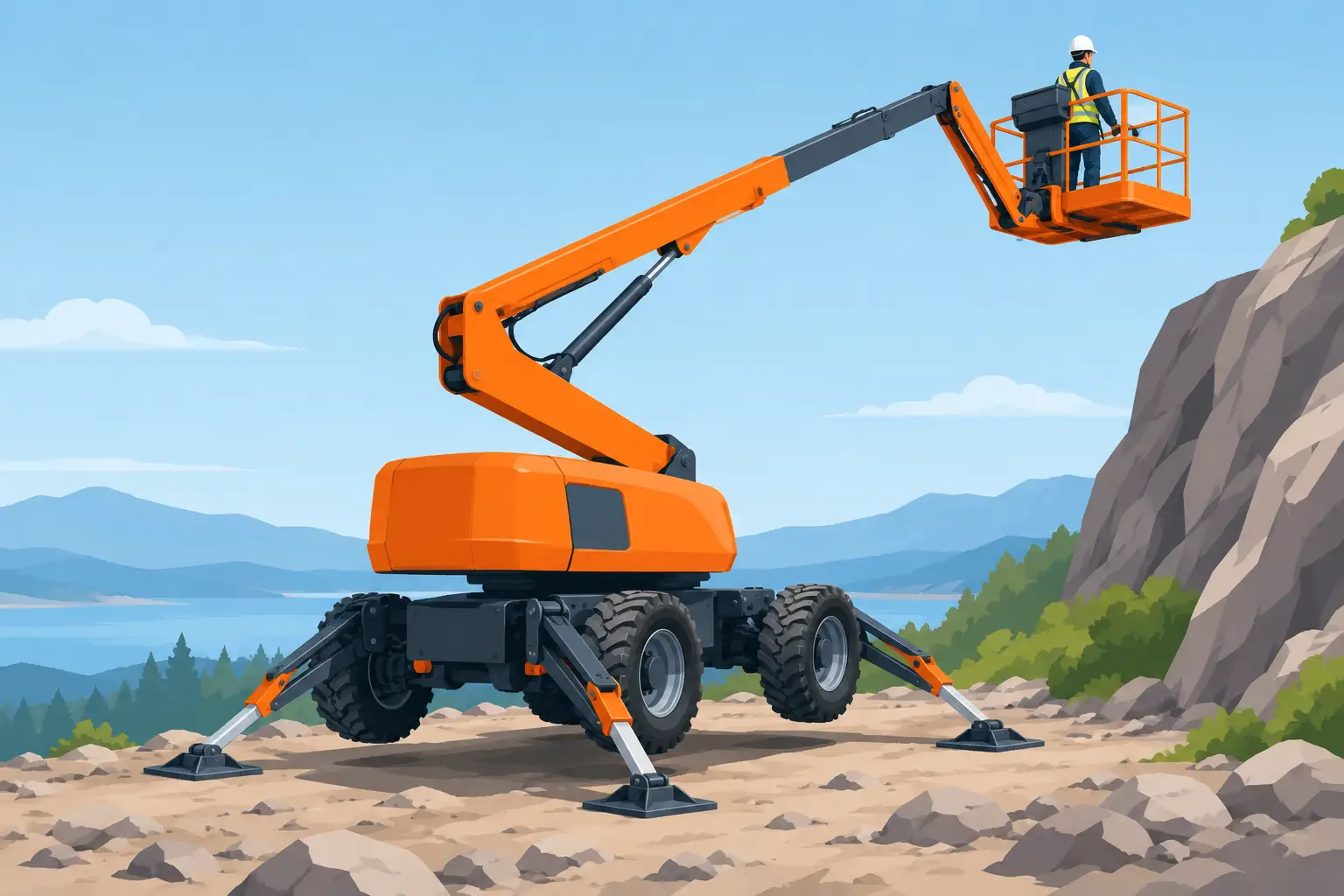
A rough terrain boom lift with stabilisers earns its place where a standard self-propelled boom is being asked to do too much. On a sloping construction plot, soft verge, uneven yard or difficult external maintenance site, getting the basket to height is only half the job. The machine must also be correctly positioned, safely supported and capable of reaching the work without repeated moves.
For contractors, facilities teams and hire fleets, stabilised rough-terrain booms can turn awkward access into a workable plan. But they are not the automatic answer to every uneven site. The right choice depends on ground conditions, required outreach, available set-up area, transport arrangements and how often the machine will need to reposition during the shift.
When a stabilised rough-terrain boom is the right tool
A conventional rough-terrain boom lift is designed to travel over challenging ground, often with four-wheel drive, oscillating axles and tyres suited to unfinished surfaces. That makes it productive when operators need to cover ground and work at multiple locations. A model with stabilisers adds another layer of capability: outriggers can be deployed to level and support the machine before elevation.
This matters when the work position is on a gradient or where the ground varies across the footprint. Stabilisation can allow operators to establish a safe working base where the chassis alone would be outside its permitted operating limits. It can also support higher working positions and useful horizontal outreach from a compact footprint, depending on the machine design.
Typical applications include steel erection, cladding, roofing, external building maintenance, tree work, utilities and work around industrial sites. It is particularly valuable where access routes are rough but the final working position needs controlled, precise set-up.
The trade-off is pace. If a task involves moving every few metres along a façade, a driveable boom may be quicker than a machine that needs its stabilisers stowed and reset at each location. If the task is concentrated in one or two challenging positions, the extra set-up time can be repaid many times over in reach and confidence.
What stabilisers change on site
Stabilisers are not simply legs that make a boom lift feel more secure. They change the machine’s operating footprint, ground loading and set-up procedure. That should shape the site plan before the platform arrives.
Levelling ability and working envelope
Many machines offer automatic levelling or assisted stabiliser deployment. This reduces set-up time and helps the operator establish the chassis within the manufacturer’s permitted limits. It does not remove the need for a competent operator, sound ground assessment or compliance with the machine’s operating instructions.
Once stabilised, the working envelope may be stronger than it would be on wheels alone. The useful question is not just, “What is the working height?” It is, “What horizontal reach is available at the height we actually need, from the position we can safely use?” A 21-metre working height figure has limited value if the building edge, trench, fence line or soft ground prevents the machine sitting in the ideal place.
Check basket capacity too. Two people, tools, materials and a cable management plan can quickly turn a nominally suitable platform into the wrong specification. Capacity limits, restricted-envelope modes and wind ratings all need to be understood before work starts.
Ground bearing pressure
Stabilisers concentrate load through their pads. On firm concrete or engineered hardstanding this may be straightforward. On made ground, paving, grass, blockwork, backfilled trenches or suspended surfaces, it requires much more care.
A site assessment should consider what lies below the surface as well as what can be seen. Covers, drains, cellars, service runs and recently disturbed ground can all present a risk. Spreader pads may be required to distribute load, but they are not a cure for unsuitable ground. The correct pad size and ground condition must be assessed for the specific machine and job.
This is one reason specialist access planning matters. A platform that can physically reach the work is not necessarily one that can be safely supported there.
Set-up space and exclusion zones
Outriggers increase the working footprint, sometimes significantly. Measure the available width with stabilisers deployed, not just the machine’s travelling width. Tight access between buildings, alongside a live road, in a loading yard or inside a fenced compound can rule out an otherwise capable model.
Allow space for the boom’s slew, basket travel and an exclusion zone below overhead work. On public-facing or busy operational sites, this needs practical coordination with pedestrians, vehicles and other trades. A compact stabilised boom may be the better choice than a larger machine if it can get into position without disrupting the whole site.
Choosing the specification that protects productivity
The best machine is rarely the tallest one on the quotation. It is the one that meets the job requirement without creating avoidable transport, access or operating costs.
Start with the height to the actual work area, then allow for safe basket positioning. Next, map the required outreach. Obstructions such as roof edges, plant rooms, canopies and landscaped areas frequently make outreach more critical than vertical height.
Machine width and stowed height determine whether the platform can pass through gates, between structures or beneath restricted openings. Weight matters for lorry selection, delivery access and the bearing capacity of the site. A lighter compact platform can be a major advantage on sensitive ground, but it may involve compromises in cage capacity, outreach or rough-ground travel performance.
Power configuration also deserves a realistic look. Diesel power suits many outdoor construction and industrial applications, particularly where sustained rough-terrain travel is required. Hybrid or electric options can be more suitable where noise, emissions or indoor use are part of the working pattern. Avoid choosing solely on the fuel type – consider daily duty cycle, charging access and whether the machine will spend most of its time travelling or elevated on stabilisers.
For a used machine, condition should be assessed as carefully as the published specification. Examine stabiliser functions, pads, hoses, controls, tyres, boom wear points and service history. Ask whether statutory inspection documentation, manuals and maintenance records are available. A well-maintained pre-owned platform can be a commercially strong purchase, while a low initial price can lose its appeal quickly if downtime follows.
Questions to answer before requesting a quotation
Give the supplier a clear picture of the job. The most useful brief includes the required working height and outreach, the ground surface and slope, the narrowest access point, whether stabilisers can be deployed fully, the number of people and tools in the basket, and any power or emissions restrictions.
It also helps to explain how the machine will be moved. Will it stay on one project for months, travel between small jobs, or be delivered to changing sites? Delivery cost, transport weight and lead time can affect the total purchase decision as much as the headline machine price.
If you are replacing an existing platform, a part-exchange valuation can make the numbers clearer. If the requirement is unusual, machine sourcing may be more sensible than compromising on a stock model that does not genuinely fit the work.
Safe operation starts before the platform is elevated
A rough terrain boom lift with stabilisers should be planned as a lifting operation, not treated as a vehicle that happens to reach height. Only trained, authorised operators should use it, with pre-use checks completed and the manufacturer’s guidance followed. The site team must identify overhead hazards, ground risks, wind exposure and nearby traffic before deployment.
Do not use stabilisers to compensate for poor planning, poor ground or an unsuitable machine. They are a performance feature when used within the machine’s limits and a risk when treated as an afterthought.
At Pure Platforms, the practical starting point is a conversation about the site, not just a model number. Bring the measurements, photographs and job constraints to the enquiry. The right platform should make the work easier from delivery through to the final descent – and keep earning its place long after the first project is complete.