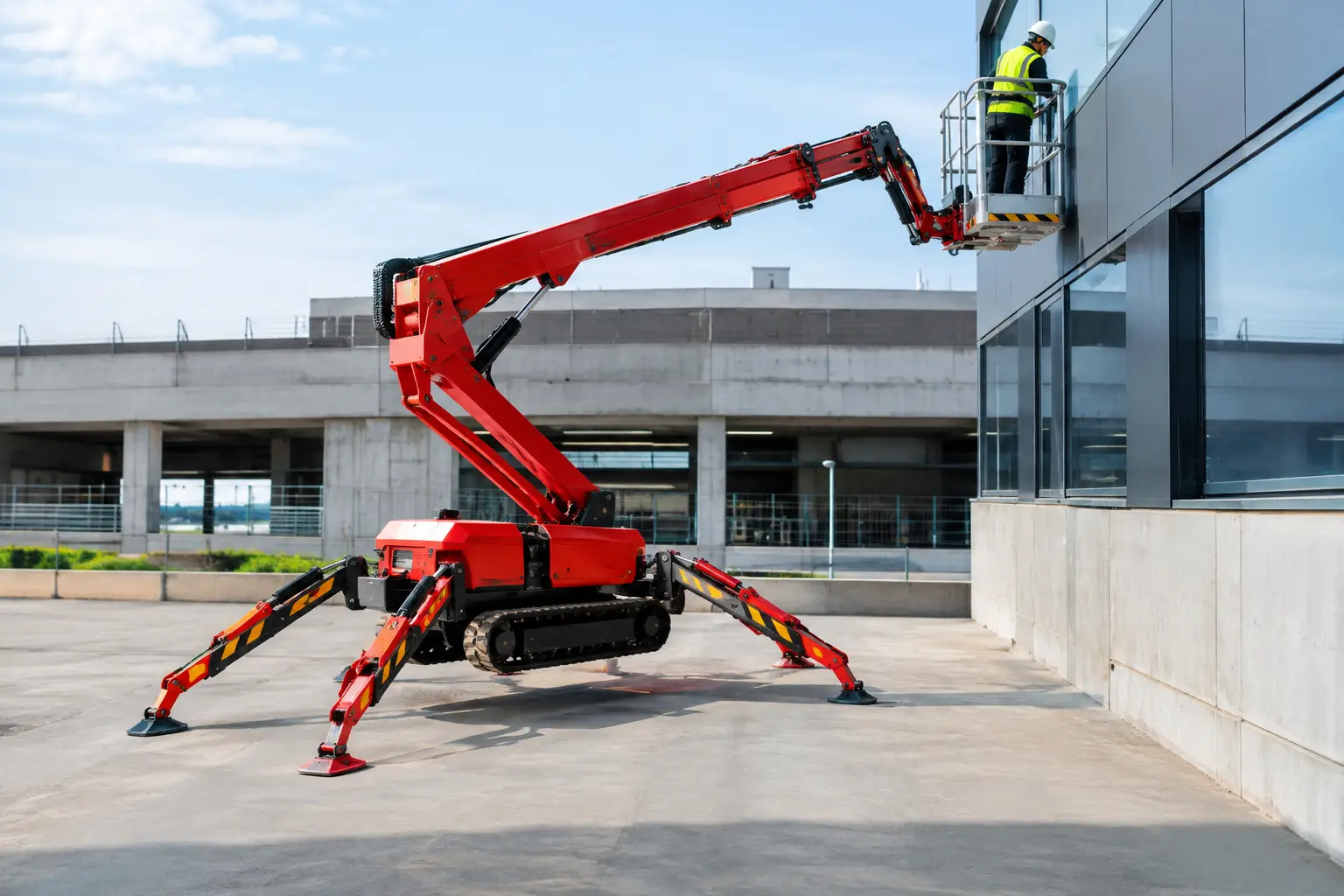
A spider lift can look like the obvious answer when access is tight, but the wrong compact machine can still lose hours at the gate, on the approach or at the work face. Effective compact spiderlift selection starts with the site restrictions that cannot be changed, then works back to the working height and outreach you genuinely need.
For arborists, facilities teams, roofers and specialist contractors, the appeal is clear: narrow tracking width, low ground pressure, stabiliser support and useful basket positioning where a conventional boom will not fit. Yet compact does not automatically mean suitable. A machine that passes through a side gate may not have the outreach required over a conservatory. Another may reach the job perfectly but exceed the transport weight of the towing vehicle or trailer arrangement.
Start compact spiderlift selection at the access point
Measure the complete route, not only the narrowest gate. This means checking gateway width, turns, archways, door openings, ramps, overhead obstructions and the final route across the site. A tracked spider lift may have an impressive stowed width, but handrails, basket position, track profile and the practical clearance needed for uneven ground all matter.
Height restrictions deserve the same attention. Low branches, soffits, covered walkways and car-park barriers can prevent access even where width is available. If a machine must be loaded onto a trailer, confirm its stowed height alongside the total transport height. It is far better to identify that limitation before arranging delivery than to discover it at a customer’s premises.
Ground conditions come next. Tracks spread machine weight more effectively than tyres, but they do not make soft ground, underground services or steep slopes irrelevant. Consider the route after rain, whether the ground is landscaped, and whether there is adequate space to deploy stabilisers safely. On delicate surfaces, ground protection may still be needed.
Think about the working position, not just travel
Once the lift is in place, it needs room to set up. Spider lifts use outriggers to create a stable working base, and the footprint can be much wider than the machine’s tracked width. A narrow courtyard may admit the platform but leave insufficient room for full stabiliser deployment.
Check whether variable or multi-position stabilisation is available and understand the corresponding working envelope. Some machines can work with outriggers set within a reduced footprint, but outreach may be restricted in that mode. This is useful where space is limited, provided the job plan accounts for the reduced capability.
Match working height to the actual task
Working height is a starting figure, not a buying decision on its own. Establish the highest point at which the operator must work, then allow for the platform floor height and normal working posture. Buying too close to the requirement often leads to poor basket positioning, awkward reach and unnecessary repositioning.
More height is not always better. Greater working height can increase machine weight, transport demands and cost. On a recurring maintenance contract where the work is consistently below 15 metres, a lighter compact platform may offer a better return than a larger unit bought for the occasional higher job.
Outreach is often the deciding specification. For tree work, building maintenance and roof-edge access, the ability to reach sideways over obstacles can be more valuable than an extra few metres of vertical height. Ask where the basket must sit, what is beneath it, and whether the boom has to clear a wall, roof, hedge or machinery.
Also assess up-and-over capability. A platform may show a strong maximum outreach figure, but that figure may apply at a particular height and basket load. The working envelope chart shows the real answer. It should be read with the expected people, tools and materials in the basket, not with an empty platform in ideal conditions.
Choose power for the site and the working day
Electric, diesel and hybrid power options all have a place. The correct choice depends on where the platform will work, how long it will operate and what support facilities are available.
An electric spider lift suits indoor work, sensitive sites and low-noise applications. It avoids local exhaust emissions and can be a practical choice for hospitals, schools, warehouses and public-facing properties. Battery condition, charging time and access to a suitable power supply must be factored into the day’s programme.
Diesel power remains useful for remote outdoor work, challenging terrain and longer shifts away from a charging point. It can be the more straightforward option for forestry, infrastructure and construction environments, although site emissions rules and noise restrictions may limit its use.
Hybrid or bi-energy configurations can offer useful flexibility. The machine can travel and work outdoors using its engine, then operate electrically where emissions or noise are a concern. The trade-off is usually higher purchase cost and more components to understand, but for contractors moving between varied environments, that flexibility can prevent hiring a second type of platform.
Do not overlook basket capacity and usable controls
A compact spider lift is frequently selected for constrained access, but the basket still has to carry the operator and the equipment needed to finish the task. Check rated basket capacity and consider the real load: two operatives, saws, tools, fittings, cable, cleaning equipment or small materials can soon use the allowance.
Controls affect productivity too. Proportional operation, clear ground controls, basket controls and stable, predictable movement make a difference over a long shift. For hire fleets and multi-operator businesses, straightforward controls reduce familiarisation time and help operators use the machine confidently within its limits.
Transport weight changes the purchase decision
A compact machine can be easy to get into a site but still difficult to move between jobs. Verify the gross vehicle weight, trailer capacity, towing vehicle limit, driving licence requirements and load restraint arrangement before committing to a model.
Road-towable options can make sense for owner-operators and maintenance teams with frequent local work. They reduce the need for a separate transport lorry, provided the towing combination is legal and suited to the routes involved. Tracked self-propelled spider lifts may need a plant trailer or delivery vehicle, but can reward that extra planning with better access and terrain performance on site.
It is worth costing transport over the expected life of the machine rather than treating delivery as a one-off expense. If the lift will move several times a week, the difference between towing it in-house and booking transport can materially affect operating cost. Conversely, a larger or heavier machine that wins higher-value work may justify specialist delivery.
New, used or sourced to specification?
The best compact spiderlift selection is not always a new machine. A well-maintained pre-owned platform can be a sensible route when budget, availability or a defined short-to-medium-term workload drives the decision. Condition and service history matter more than a low headline price.
For a used machine, look closely at inspection records, operating hours, battery performance where applicable, track condition, hydraulic hoses, stabiliser operation, boom wear and safety-system functionality. Confirm that the machine has the documentation needed for ongoing inspection and safe operation. A proper assessment should identify whether early maintenance costs are likely to follow the purchase.
New equipment can bring current technology, warranty cover and a specification built around your operation. That is particularly valuable where low weight, narrow width, hybrid power or a precise outreach requirement is non-negotiable. It may also support a more predictable ownership plan for a hire fleet or a contractor with long-term framework work.
Pure Platforms can help compare new and pre-owned options, source commercially available machines and assess part-exchange value, so the decision is based on operational fit rather than whichever unit happens to be immediately available.
Build the decision around the jobs you want next
Buying solely for the current job can leave a machine under-specified within months. Review the work you complete most often, the contracts you are pursuing and the sites that currently force you to hire in equipment. If narrow domestic access is routine but occasional commercial work needs extra reach, decide whether one flexible machine covers both profitably or whether hiring for the exceptional job remains the better commercial choice.
Before requesting a quotation, have a clear brief: minimum access width and height, maximum working height, outreach at the required height, ground type, power preference, basket load, transport method and budget. Add any site-specific restrictions such as low-emission rules, indoor use or sensitive ground.
The right platform should make difficult work straightforward without adding avoidable weight, cost or transport burden. Measure the route, read the working envelope and be honest about the jobs the machine must earn its keep on. That approach gives you a compact spider lift that arrives ready to work, rather than one that needs a workaround before the shift has begun.