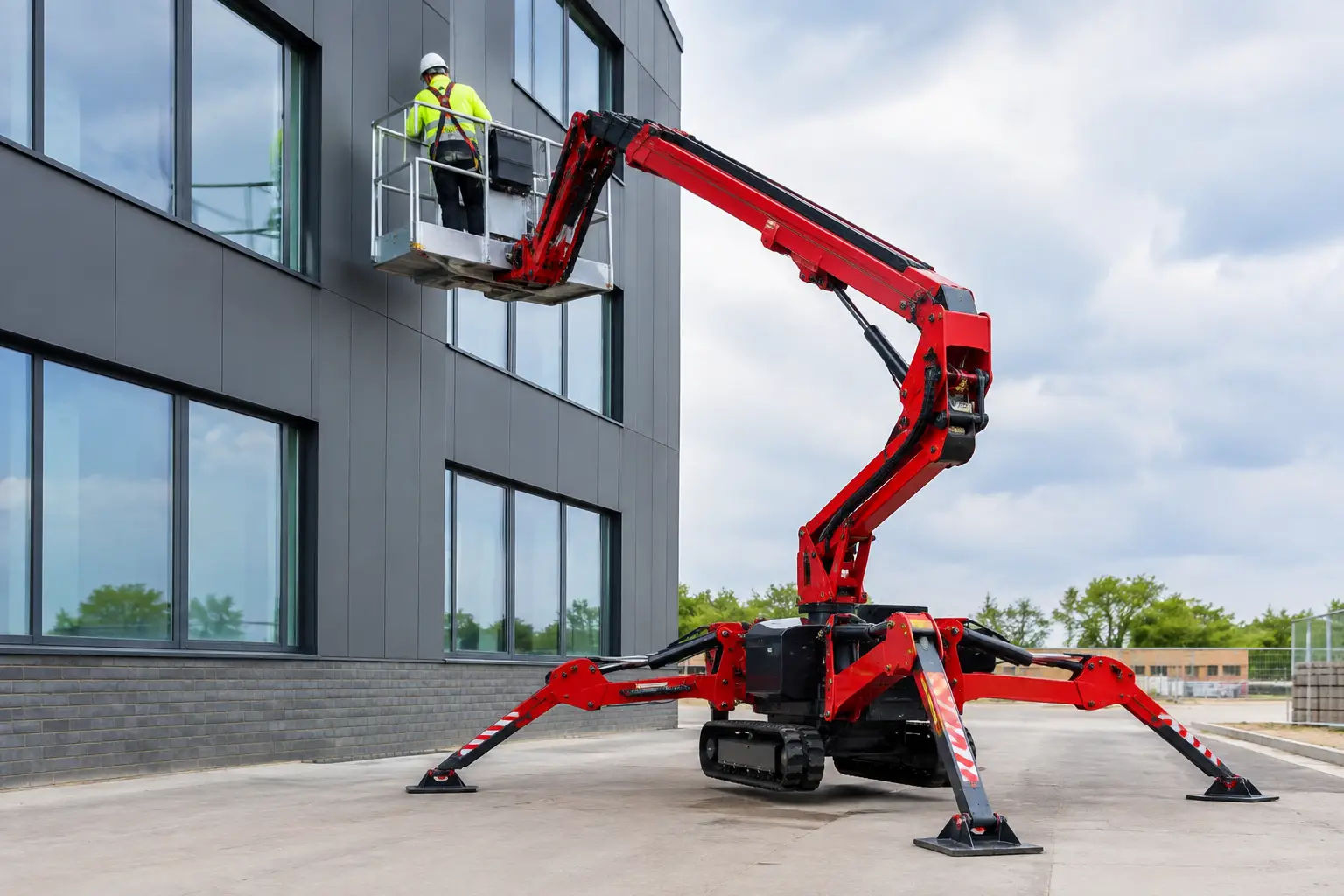
A narrow side passage, a soft lawn, a steep driveway and a high branch over a glass roof can rule out conventional access equipment before the job has even started. Spider lifts are built for precisely these situations: compact tracked platforms that travel through restricted access, set up on difficult ground and provide controlled working height where a larger boom or scissor lift may not fit.
For arborists, roofing teams, facilities managers and specialist contractors, the appeal is obvious. The right machine can replace slower ladder work, reduce the need for costly scaffolding and put operators in a more stable working position. But a spider lift is not simply a small boom lift on tracks. Outreach, outrigger footprint, ground pressure, power supply and transport weight all affect whether it will work efficiently on your sites.
What makes spider lifts different?
Spider lifts are tracked, articulated access platforms with stabilising outriggers. Their tracks allow them to travel across uneven ground and, on appropriate surfaces, negotiate terrain that would stop wheeled machines. The articulated boom gives useful up-and-over reach, so operators can work above roofs, conservatories, machinery or other obstacles without placing the machine directly beneath the task.
Their compact dimensions are often the deciding factor. Many models are designed to pass through standard gates, narrow paths and restricted entrances, then open their outriggers once in position. This makes them particularly effective in gardens, courtyards, schools, estates, churches and occupied commercial premises where access is limited and disruption matters.
The trade-off is setup. A self-propelled boom lift may cover a wide area quickly once on site, whereas a spider lift needs a suitable levelled and stabilised position before work begins. If the job requires frequent repositioning over a large open site, a conventional boom could be the more productive choice. If reaching the work area is the challenge, a tracked spider is often the machine that changes the plan from impractical to achievable.
Choosing spider lifts by the job, not the headline height
Working height is the first specification many buyers see, but it should not be the first decision. A 21-metre machine is not automatically the right answer if it cannot pass through the access route, fit on the transport vehicle or establish safely where the work is taking place.
Start with the route to the work area
Measure the tightest point, not the entrance you hope to use. Check gate widths, side passages, turns, overhead restrictions and surface changes. A machine’s stowed width and height matter, but so do the dimensions with baskets, controls and any attachments in place.
Ground conditions need the same attention. Tracks distribute weight differently from wheels, but they do not make every surface suitable. Wet grass, recently landscaped areas, cellar voids, drainage covers, paving and sloping ground all need assessment. Consider where the delivery lorry can unload, how the machine will travel to the work area and whether ground protection is needed.
Check outreach and up-and-over geometry
Vertical height gets an operator to a level. Horizontal outreach gets them to the task. For tree work, façade maintenance and roof repairs, outreach can be more valuable than another metre of height. Look at the point where the basket needs to be, the obstacle below it and the clearance required for safe movement.
Articulated boom geometry also varies between machines. Some give better clearance over a roof edge or conservatory, while others offer stronger reach close to the ground. Ask for the working envelope rather than relying on a single maximum figure. It shows where the basket can actually work at a given height and load.
Treat outrigger setup as a working dimension
A narrow machine does not necessarily have a narrow setup footprint. Spider lifts gain their stability from outriggers, and these may extend substantially beyond the track width. On a confined site, that can be the difference between a safe setup and no setup at all.
Check whether the machine offers variable or multi-position outrigger deployment, and what its capabilities are in each position. Reduced outrigger spread can be useful in tight spaces, but it may alter available working envelope, basket capacity or permitted outreach. The platform’s control system and load chart must always govern the operation.
Power, terrain and transport are commercial decisions
The best spider lift is the one that reaches the job without creating an expensive logistics problem. That means looking beyond the platform itself.
For indoor work or sites with strict noise and emissions requirements, battery or hybrid power can make a real difference. Electric operation suits many facilities and maintenance applications, while diesel power remains useful where long duty cycles, remote sites and demanding terrain are part of the day. Hybrid machines can offer valuable flexibility, but only if the added cost and weight suit your workload.
Transport is equally important. Consider gross vehicle weight, the trailer or lorry needed, driver licensing requirements and how often the machine will move between sites. A road-towable platform may make sense for frequent short jobs with straightforward ground conditions. A tracked lift may justify specialist transport when access and terrain are the primary constraints.
For hire fleets and contractors, utilisation should guide the decision. A more compact machine may win more work because it can access a wider range of sites. A larger model may command stronger rates when its height and outreach are regularly needed. Buying capacity that is rarely used ties up capital, but buying too small can lead to subcontracting work you could otherwise complete in-house.
Safety starts before the machine arrives
Spider lifts offer impressive access, but they still require disciplined planning and competent operation. The stability system is a major advantage, not a substitute for checking the ground beneath each outrigger.
Before deployment, assess bearing capacity, slopes, hidden services, voids and changes in surface level. Use suitable spreader pads where required and keep the platform within manufacturer limits. Site teams also need a clear exclusion zone, awareness of overhead services, and a rescue plan suited to the work location.
Operators should be familiar with the specific machine, including emergency lowering controls, basket loading limits and any restrictions that apply when outriggers are in a reduced-width position. On complex jobs, a short pre-start discussion between the operator, site manager and ground crew prevents avoidable delays once the lift is in place.
Maintenance matters too, particularly on used equipment. Tracks, hydraulic hoses, outrigger pads, basket controls, emergency systems and battery condition all deserve close inspection. Service history, thorough examination records and proof of routine care provide a better picture than cosmetic appearance alone.
New or pre-owned: choose the ownership route that fits
A new spider lift offers current specification, warranty support and the confidence of a known starting point. It can be the right route for businesses building a long-term fleet, working in regulated environments or needing a precise configuration.
A quality pre-owned machine can be a sound commercial alternative, especially where annual use is steady but not constant. The key is condition, history and suitability, not simply age or hours. A low-hour machine that has stood unused may need more attention than a higher-hour platform with consistent servicing and careful ownership.
When comparing options, ask practical questions. Has the lift worked in a hire fleet or owner-operated environment? What is included with the sale? Are delivery costs, finance options and part-exchange value clear from the outset? Can the supplier help source a specific make or model if the right machine is not currently in stock?
At Pure Platforms, the aim is to make that buying process straightforward, whether the requirement is a compact tracked lift for narrow access or a larger platform for demanding commercial work. The right conversation should cover the job, site conditions, transport and ownership plan, not just the sticker price.
A machine that earns its place on site
Spider lifts are at their best when access is awkward, ground is uneven and the work cannot wait for a more complicated solution. They are not the automatic answer for every elevated task, but they can give teams a safer, more capable route to work that would otherwise be slow, disruptive or out of reach.
Bring your measurements, typical job photos, transport arrangements and expected workload to the buying conversation. Those details will point to a machine that does more than reach the required height – it will earn its place on site, job after job.