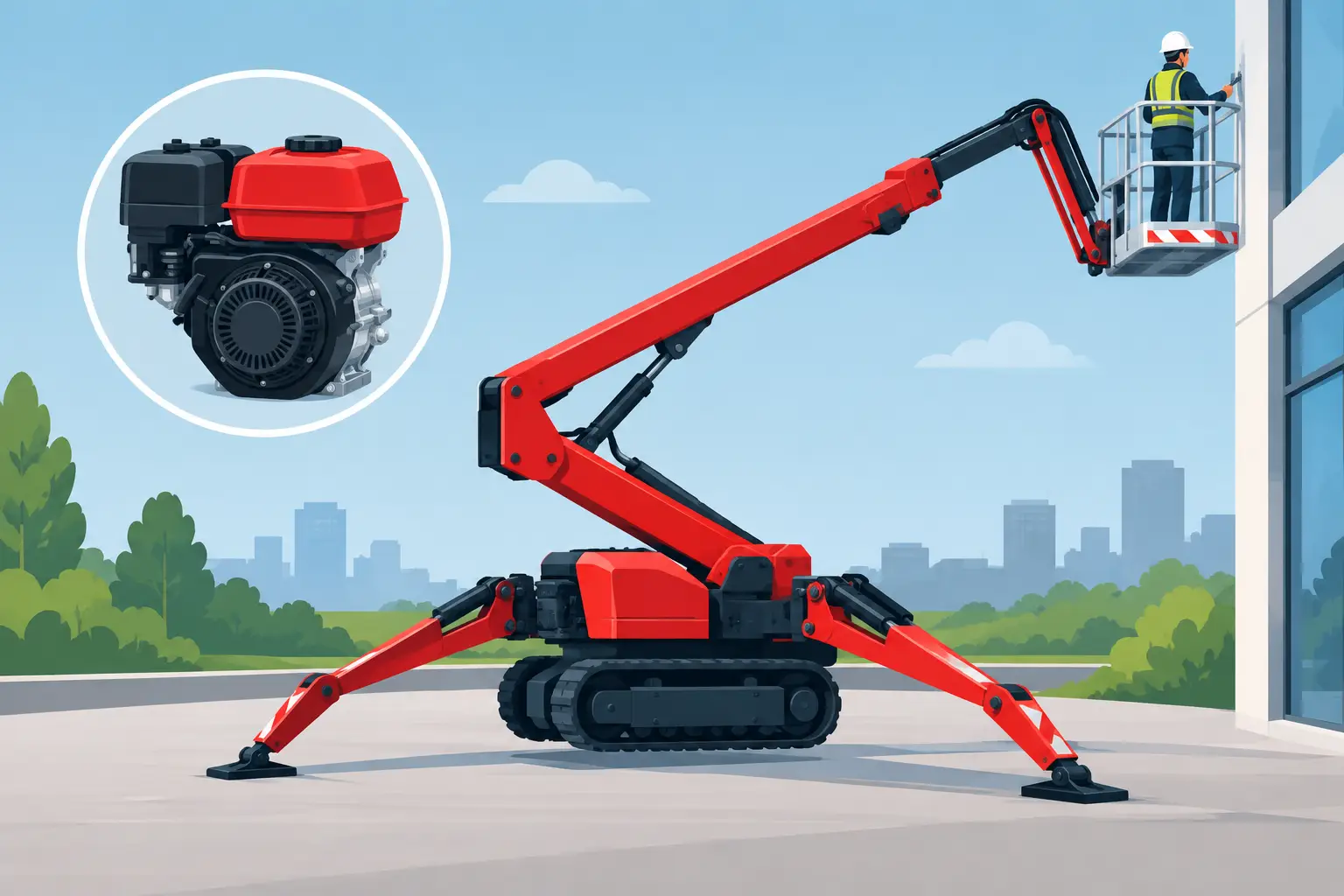
A narrow gate, soft grass and branches above the work area can turn a straightforward access job into a difficult plant decision. A Honda-powered spider lift gives outdoor teams a compact, track-mounted platform with dependable petrol power, useful where mains supply is unavailable and where a conventional boom lift cannot physically reach the work zone.
For arborists, roofing contractors, facilities teams and specialist access businesses, the attraction is clear: get a capable working platform through restricted access, set it securely on uneven ground and reach height without bringing in a much larger machine. The right choice still comes down to more than engine badge or maximum working height. Access width, transport weight, outreach, stabiliser footprint and the nature of the site all matter.
Why choose a Honda-powered spider lift?
Honda petrol engines are widely recognised across professional compact plant for their familiar controls, accessible servicing and proven performance. On a spider lift, petrol power is particularly relevant for outdoor work in remote locations, on estates, construction plots, industrial yards and tree work where charging infrastructure or a site power supply is not realistic.
A tracked spider lift spreads its machine weight differently from a wheeled access platform and can travel over ground that would stop road-towable or slab-scissor equipment. Tracks also help when the route includes gravel, grass, slopes or rough approaches. That does not mean any tracked machine can be driven anywhere. Ground bearing pressure, gradient, drainage, hidden voids and overhead clearance must be assessed before the machine moves.
The compact chassis is often the deciding factor. Many spider lifts are designed to pass through narrow gateways, between buildings or alongside properties where a self-propelled boom would be too wide. Once in position, outriggers create a wider, stable working base for elevated operation. This combination of narrow travel width and larger stabilised footprint is what makes the category so useful – and why set-up space must be considered as carefully as access width.
Match the lift to the job, not just the height
Working height is usually the first figure buyers ask for, but it only tells part of the story. A 21-metre machine may be the right answer for one façade or canopy job, while a smaller, lighter lift could deliver better daily productivity on domestic access, estate work or multi-location maintenance.
Start with the actual point of work. Consider the height to the task, not simply the height of the building. Then look at horizontal outreach at the required platform height. A lift can have enough vertical reach yet be unable to clear an extension, roof edge, hedge line or lower-level obstruction. Platform capacity matters too, especially if the operator needs to carry tools, materials or arboricultural equipment.
Travel dimensions should be checked against the tightest part of the route, including turns, gate posts, archways and side passages. Measure height as well as width. Low branches, garage openings and soffits regularly catch out a machine choice that looked suitable on paper. If the lift needs to travel on a trailer or lorry, gross vehicle weight, tie-down arrangements and the available towing or transport capacity should be confirmed early.
Stabilisation and ground conditions
Spider lifts earn their place on difficult ground because their outriggers can level the chassis across uneven terrain within the manufacturer’s stated limits. Auto-stabilisation can speed up repeat set-ups and provide useful operational confidence, but it does not replace a proper ground check.
Look at where each outrigger will land. Soft lawns, block paving, drainage covers, cellar voids and freshly disturbed ground may require suitable spreader pads or an alternative machine position. The stabilised footprint can be considerably wider than the stowed machine, so leave room for pads, barriers and a safe exclusion zone.
For work on slopes, ask what gradient the machine can travel on and what levelling range is available once it is set up. These are separate figures. A platform that can negotiate part of an approach may still need a level, adequately supported location to operate safely.
Petrol power: the benefits and the limits
A Honda-powered spider lift is a practical option where outdoor flexibility matters. Petrol refuelling is quick, engine-powered operation suits long shifts away from electrical supply, and the familiar engine format can make routine maintenance straightforward for businesses already running petrol plant.
There are trade-offs. Petrol engines produce exhaust emissions and noise, making them unsuitable for enclosed or poorly ventilated spaces. A project that moves between external grounds work and internal facilities maintenance may be better served by a bi-energy or battery-powered platform, depending on the specific machine and duty cycle. Noise restrictions, client environmental requirements and low-emission policies should be discussed before purchase rather than discovered on site.
Fuel handling is another operational consideration. Your team needs an appropriate refuelling process, safe storage and daily checks for fuel, oil and fluid levels. In return, a petrol unit can keep working on remote sites without waiting for charging windows or relying on a generator.
New or used: where value really sits
A new machine may suit a buyer who needs a defined specification, current controls, warranty support and a predictable ownership plan. It is also a sensible route when a compact access platform is becoming a core part of the fleet rather than an occasional requirement.
A pre-owned Honda-powered spider lift can offer excellent value, particularly for owner-operators, smaller contractors or fleets adding capacity for a specific type of work. Condition matters more than age alone. Ask about service history, recorded hours, inspection records, track condition, basket controls, hydraulic hoses, outrigger operation and any signs of damage from transport or site use.
The best-value machine is not always the lowest-priced machine. Downtime, transport complications and a lift that cannot access the majority of your work quickly erode a saving. A realistic comparison includes delivery, finance, planned servicing, operator familiarisation, inspection requirements and likely resale value. If an existing platform is no longer earning its place, a part-exchange valuation can also make the upgrade route clearer.
Plan for safe, productive ownership
Buying the machine is only the start of the job. Operators need familiarisation on the specific platform and must work within the manufacturer’s instructions. Before each shift, carry out pre-use checks and inspect the route, work area, weather and overhead hazards. Wind limits are not an optional detail: basket work must stop when site conditions exceed the machine’s stated operating limit.
UK users should also account for LOLER inspection requirements, maintenance planning and a rescue plan that is suitable for the location. A rescue plan should not rely on vague assumptions that another machine will be nearby. Think through how a stranded operator would be recovered if a fault, illness or site obstruction prevents normal descent.
Keep the operating area controlled, especially where the boom can pass over footpaths, service yards or public-facing grounds. Good machine choice improves productivity, but disciplined set-up, trained operation and regular care protect that productivity over the full ownership period.
Make the specification work for your sites
A Honda-powered spider lift is at its best when compact access, outdoor autonomy and stabilised reach are the real constraints on the job. For repeated work through narrow entrances, across awkward ground and around obstacles, it can give a professional team a practical route to safer access at height.
Before committing, share the tightest access measurements, typical terrain, target working height, required outreach and transport method with an access specialist. Pure Platforms can help buyers compare new and pre-owned options, consider delivery and finance, and focus the conversation on the machine that will keep earning once it arrives on site.