A narrow side passage, soft ground behind a property and a difficult reach over a conservatory can turn a straightforward job into an access problem. That is where new tracked spider lifts for sale earn their place. They are built to travel where conventional booms and larger MEWPs cannot, then provide stable, controlled working height once positioned.
For arborists, maintenance teams, roofing contractors, facilities managers and specialist hire fleets, the right machine is not simply the one with the greatest headline reach. It is the lift that gets through the gate, works safely on the ground conditions present, carries the required personnel and tools, and can be transported without creating a costly logistics exercise.
Why buy a new tracked spider lift?
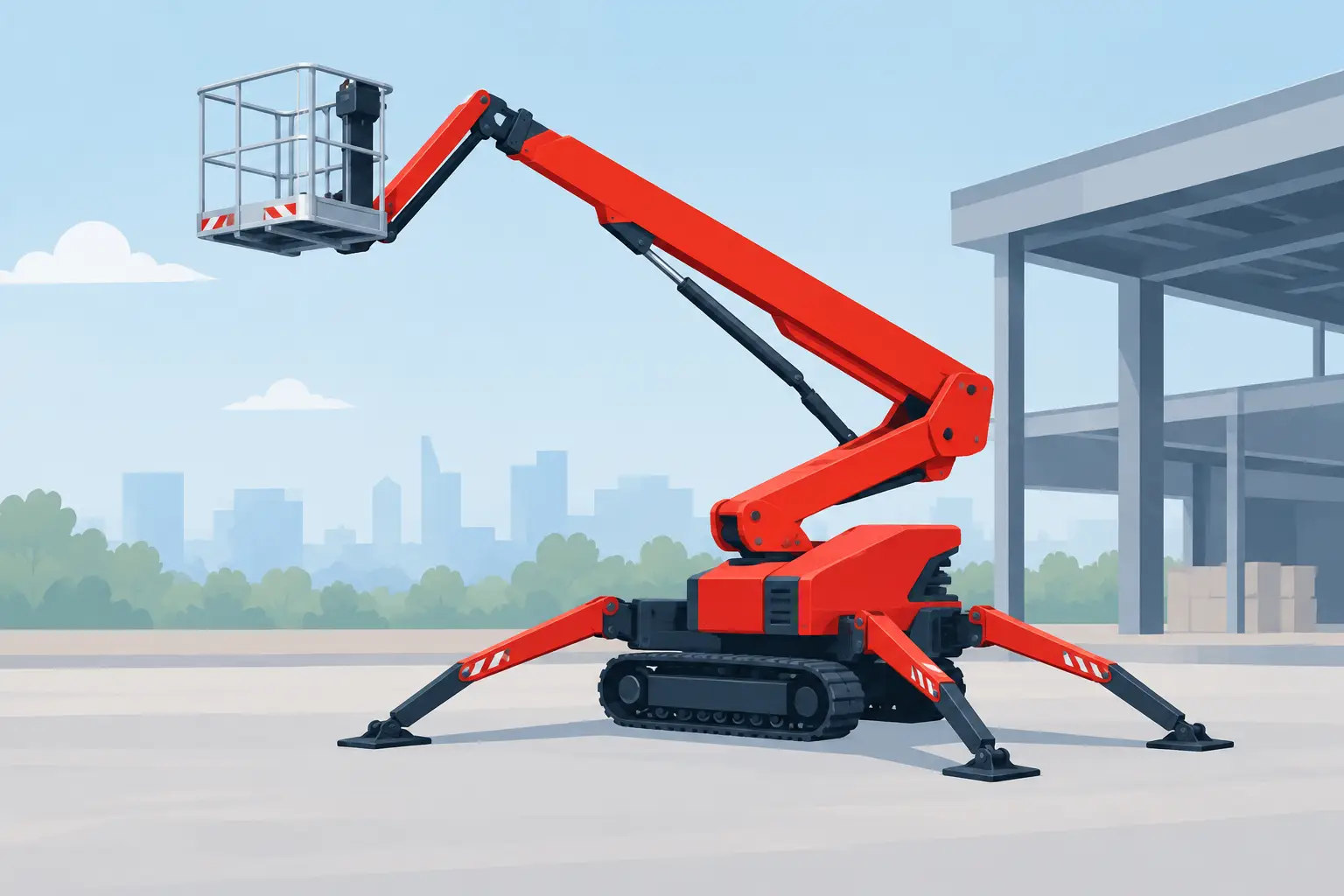
A tracked spider lift combines compact travel dimensions with articulated or telescopic outreach and stabilisers. Rubber tracks spread ground pressure and give useful traction across grass, loose ground and uneven approaches. Once in position, outriggers level and stabilise the machine for work at height.
Buying new gives an operator or fleet manager a known starting point. You know the machine’s specification, warranty position and service history from day one. That matters when the platform will be used regularly on commercial work, placed on hire, or operated by several members of staff. New equipment also gives buyers access to current control systems, efficient power options and, on selected models, features such as automatic stabilisation.
That said, new is not automatically the right answer for every business. If utilisation is occasional, a quality pre-owned machine or hired platform may make stronger commercial sense. The decision comes down to workload, cash flow, expected ownership period and the cost of losing access to a machine when work is booked in.
Start with the site, not the brochure
The best specification starts with the jobs your team actually carries out. A working-height figure alone does not tell you whether a lift will reach the work safely. Consider where the basket needs to sit, what is beneath the work area, and whether the boom needs to clear an obstruction before descending to the point of work.
Working height is usually calculated from platform height plus an allowance for the operator. It is useful for comparing machines, but platform height, horizontal outreach and up-and-over capability are often more relevant on site. Tree work beside buildings, façade maintenance above a lower roof, and internal atrium work all place different demands on the boom geometry.
Also measure the route in. Check narrow gateways, archways, side returns, height restrictions, slopes and turning points. A machine that is suitably narrow on paper can still be impractical if it cannot turn through a tight approach or if its transport height conflicts with a low opening. Ground conditions should be assessed before delivery too. Tracks improve access, but they do not remove the need for competent planning around soft ground, underground services, gradients and outrigger bearing pressure.
Width, weight and transport are commercial decisions
Compact width is a major reason to choose a spider lift. For domestic and estate work, a machine capable of passing through a standard-style garden gate can open up jobs that would otherwise need scaffolding, rope access or more disruptive arrangements. But the narrowest unit is not always the most productive unit. Higher working height, greater outreach and increased basket capacity can add weight and alter transport requirements.
Ask early how the machine will be moved. Will it travel on a trailer behind an appropriate towing vehicle, be carried on a plant trailer, or require transport by lorry? Gross vehicle weight, trailer capacity, towing limits and driver licensing all need to stack up. A lower purchase price can quickly lose its appeal if each movement requires outsourced transport that was not included in the job cost.
For hire companies, transport weight and loading speed affect fleet return just as much as reach figures. For owner-operators, a practical package that can be moved without complication may be the better long-term earner.
Choosing the right power configuration
New spider lifts are available with different power arrangements, commonly petrol, diesel, mains electric, lithium battery or hybrid configurations. The right choice depends on where the machine works and how long it will stay there.
Petrol and diesel power can suit remote locations and outdoor work where charging is unavailable. Diesel may be preferred for demanding terrain and extended duty cycles, subject to emissions requirements and the operating environment. Electric or battery-powered operation is a strong option for indoor work, sensitive sites and areas where noise and exhaust emissions are a concern. Hybrid machines can provide useful flexibility for contractors moving between outdoor and indoor tasks, although the added versatility should be weighed against purchase cost and maintenance needs.
Do not select a power source only because it sounds more versatile. Consider the reality of your work. If most jobs involve long days on remote sites, dependable refuelling may be more valuable than an electric-only specification. If the lift regularly enters public buildings, hospitals, warehouses or finished interiors, quiet zero-emission operation at point of use can be the deciding factor.
Stabilisation is where productivity becomes safe access
Tracked travel gets the lift to the work area. Stabilisation determines whether it can operate there safely and efficiently. Outrigger design, levelling range and footprint all deserve close attention, particularly on slopes, restricted plots and landscaped ground.
A machine with automatic levelling can speed up set-up and help reduce operator error, but it does not replace a proper pre-use assessment. Operators must still understand ground bearing conditions, safe outrigger placement, exclusion zones and the machine’s limits. Spreader pads may be required to protect surfaces and distribute loads, while uneven sites may call for more preparation than a specification sheet suggests.
Look at how the stabilisers affect the available working envelope. Some machines can work with variable outrigger positions, allowing a reduced footprint where space is limited. This can be highly useful, but reduced stabilisation can also reduce outreach in certain directions. That is not a weakness – it is a design trade-off that needs to match the jobs you price.
Compare specification in the order it affects the job
When reviewing new tracked spider lifts for sale, it helps to compare like for like. Begin with the access route and working position, then assess the lift’s capability from there. A practical comparison should cover working height, platform height, maximum outreach, basket capacity, stowed width, travel height, overall weight, gradeability, outrigger footprint and available power options.
Basket capacity deserves more attention than it often receives. Two people, saws, materials or maintenance equipment can soon approach the safe working load. Choosing a platform with insufficient capacity may force slower working practices or create an unsuitable operating plan. Equally, paying for a large basket capacity that is never needed may add cost and weight without delivering a return.
Controls and operator usability matter too. Clear ground and platform controls, proportional movement, emergency lowering arrangements and straightforward daily checks help crews work with confidence. For businesses operating a mixed fleet, commonality in controls and servicing can reduce familiarisation time and simplify maintenance planning.
Look beyond the delivery date
The right supplier should help you assess more than a product listing. Delivery cost, lead time, warranty coverage, finance illustrations, part-exchange value and the availability of future support all affect the real buying decision. A machine can be technically right and still be commercially wrong if its delivery timing misses a committed contract or its ownership costs are unclear.
At Pure Platforms, the conversation should begin with the access problem, the working environment and the transport plan. From there, buyers can compare new and pre-owned routes, request a no-obligation quotation, discuss finance support or explore a part-exchange against existing equipment. If a particular make or model is not immediately available, machine sourcing can also be a sensible route rather than compromising on the specification.
New equipment should arrive ready to become part of a safe operating system, not simply parked in the yard. Plan familiarisation, daily inspection routines, maintenance responsibilities and thorough examination requirements before the first job. Keep records, make sure operators are trained and authorised for the machine, and build realistic set-up time into quotations.
A tracked spider lift is at its best when it removes friction from difficult work: getting through the restricted entrance, reaching the awkward elevation and leaving the site with minimum disruption. Choose the machine around those moments, and it will keep earning its place long after the first delivery.