A platform that reaches the required height is only half the answer. If it cannot get through the gate, crosses a finished lawn poorly, or loses productive time repositioning around a congested site, it is the wrong machine. When comparing tracked versus wheeled access platforms, the practical question is not which category is best overall. It is which one keeps your team safe, productive and commercially efficient on the jobs you actually win.
For UK contractors, arborists, facilities teams and hire fleets, the decision often comes down to ground conditions, access route, frequency of travel around site and how the machine will be transported. Both types can provide excellent working height and outreach. Their strengths show up in very different places.
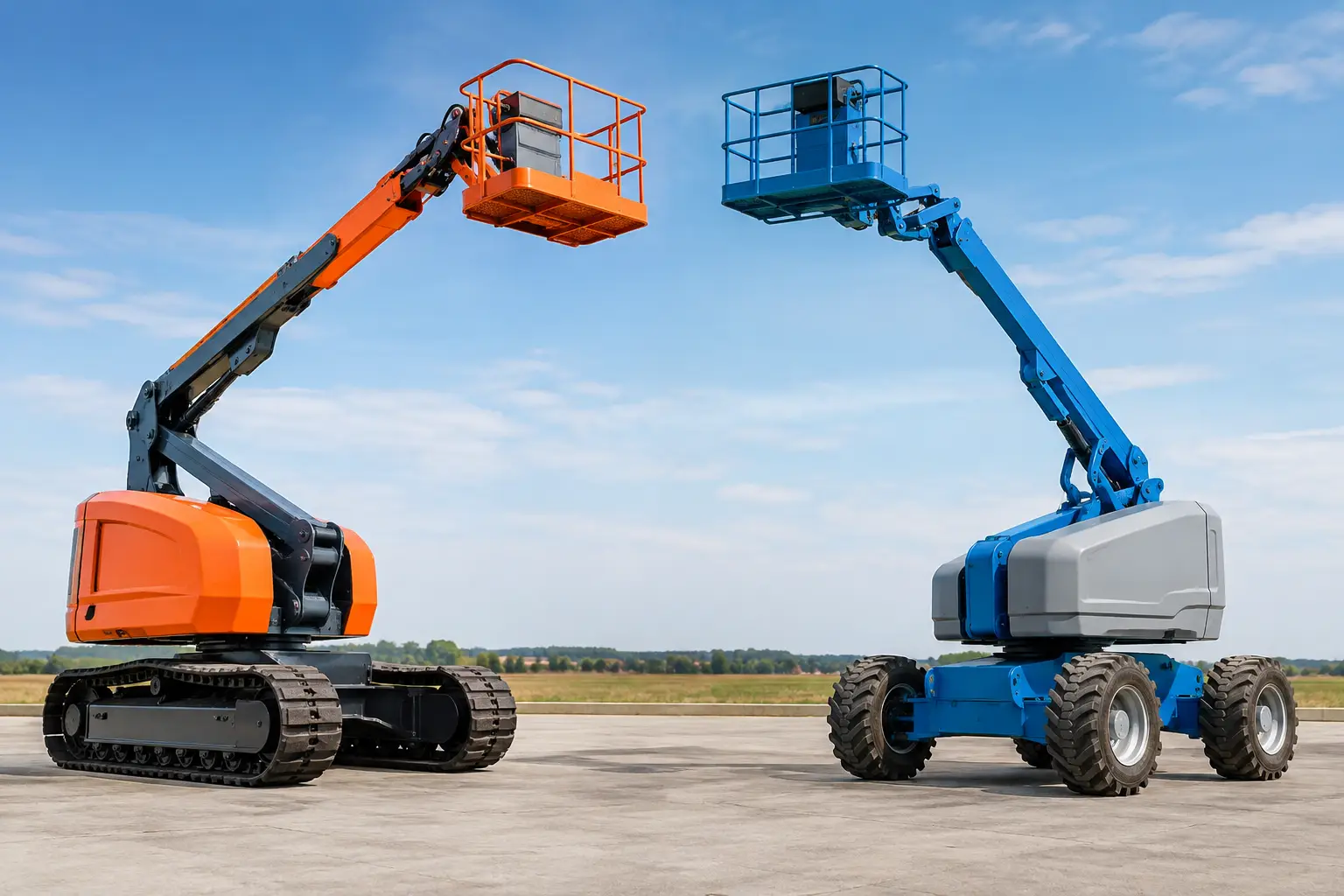
Tracked versus wheeled access platforms at a glance
Tracked access platforms, often called spider lifts, spread their weight across rubber tracks. This gives them a low ground pressure and useful traction on soft, loose or uneven surfaces. Many compact models also work with stabilisers, allowing the machine to level itself and work securely where a conventional wheeled lift may struggle.
Wheeled access platforms cover a wider group, including self-propelled booms, scissor lifts and road-towable machines. On firm, prepared ground, wheels are generally faster and simpler. A driveable boom lift can cover distance efficiently, reposition between work faces and, on suitable machines, travel at full working height within its specified limits.
The distinction matters because a machine’s travel system affects far more than mobility. It influences surface damage, loading arrangements, daily output, maintenance requirements and the type of work you can confidently price for.
When a tracked platform earns its keep
A tracked spider lift is usually at its strongest where access is tight and the ground is less forgiving. Think narrow side passages, estate grounds, sloping gardens, woodland work, churchyards, rural properties and sites where a heavy wheeled machine could rut turf or sink into soft ground.
Low ground pressure for sensitive surfaces
Tracks distribute machine weight over a larger contact area than tyres. That does not mean a tracked platform is incapable of marking a surface – turning sharply, wet ground and poor site preparation can still cause damage – but it substantially improves the odds where lawns, soil or landscaped areas are involved.
This is a major consideration for arborists and building-maintenance contractors working on domestic or prestige sites. Carrying out high-level work without turning the access route into a reinstatement job protects both margin and reputation.
Narrow access and compact dimensions
Many tracked platforms are designed to pass through gateways and tight routes that rule out larger self-propelled booms. Their compact stowed width, low overall weight and ability to climb gradients make them a practical choice when the work location is behind the property rather than beside the lorry.
Check the full route, not only the entrance width. Measure gates, corners, overhead branches, archways, changes in level and the ground beneath any ramps. A platform may fit through a gate but still be unsuitable if the route has a soft, steep or sharply cambered section.
Stabilisation on uneven ground
Spider lifts typically use outriggers to create a level, stable working base. Auto-stabilisation can reduce set-up time and help operators establish a safe position, though it is not a substitute for a proper ground assessment. Outrigger loads are concentrated, so mats may be needed to protect paving, spread load and prevent settlement.
The trade-off is that every move requires the machine to be lowered, stowed and re-set. On a site with many short tasks spread across a large area, that repeated set-up can affect productivity.
Where wheeled access platforms take the lead
On firm yards, industrial estates, construction compounds, warehouses and prepared external works, a wheeled platform can be the more productive choice. Tyres roll efficiently, and self-propelled machines are built for regular movement between work areas.
Faster repositioning on firm ground
If operatives are installing services across a façade, carrying out planned maintenance or working around a large commercial building, travelling from one bay to the next matters. A wheeled boom lift can often be driven and repositioned far more quickly than a stabilised tracked machine.
For work requiring significant horizontal outreach, rough-terrain boom lifts are particularly valuable. Models with oscillating axles, four-wheel drive and stabilisers can bring useful capability to mixed ground, provided the site remains within the manufacturer’s operating limits. They are not a shortcut around poor ground investigation, but they can reduce downtime on demanding construction and industrial sites.
Better fit for repeated, high-output work
Wheeled scissor lifts are effective where the task needs a large platform and vertical access rather than reach over an obstacle. They suit internal fit-out, warehouse maintenance and flat, controlled external areas. Conventional articulated or telescopic booms make more sense where obstacles, roof edges or plant need to be reached over.
Road-towable access platforms sit slightly apart from the self-propelled category. They can be a sensible option for contractors who need a compact machine at multiple locations but do not require frequent travel once on site. The key benefit is transport flexibility, not cross-site speed.
Ground conditions should decide more than budget
A lower purchase price can become expensive if the platform is poorly matched to the terrain. Before comparing quotations, establish whether the ground is paved, compacted, loose, wet, sloping, landscaped or subject to underground service restrictions. Ask who is responsible for confirming bearing capacity and whether the work will take place after prolonged rainfall.
Tracked machines are often the safer commercial choice where conditions vary from job to job. Wheeled machines tend to win where surfaces are predictable and travel distances are longer. There is overlap, especially with rough-terrain wheeled booms, but the machine should be selected for its normal workload rather than the occasional exceptional job.
A useful test is to look back at the last 20 jobs. If most involved gateways, lawns, banks, unstable ground or restricted rear access, a tracked platform has a strong case. If most involved broad, solid sites with constant movement around buildings, wheeled access is likely to return more productive hours.
Transport, weight and site logistics
Transport is often where an apparently ideal platform becomes inconvenient. Compact tracked lifts can have low enough gross weight for practical trailer transport, but this depends on the exact machine, trailer, towing vehicle and licence entitlement. A machine’s stated weight is not the whole calculation – include fuel, attachments, ramps, trailer payload and securing equipment.
Larger wheeled booms and scissor lifts commonly require delivery by lorry or a dedicated transport arrangement. That can be entirely suitable for longer projects, but it changes the cost and planning for short-duration work. Confirm delivery access, turning space, unloading area and the need for a recovery plan before the machine arrives.
For owner-operators, road-towable platforms can offer a useful middle ground. They keep transport under your control while providing stable working height once set up. The compromise is that they are not designed to be driven around site like a self-propelled boom.
Look beyond reach charts and working height
Working height, platform capacity and outreach are essential figures, but they should be read alongside the operating envelope. An articulated boom may clear an obstacle that a straight boom cannot. A spider lift may pass through access that neither can reach. A scissor lift may give two operatives and materials the platform space that makes the job quicker.
Also consider power. Diesel suits many outdoor sites and demanding terrain. Electric or hybrid power can be preferable where indoor use, emissions restrictions or noise are a concern. Some buyers benefit from a fleet mix rather than forcing one platform to cover every application.
For pre-owned equipment, condition is as important as specification. Service history, hour meter reading, track or tyre condition, battery health, hydraulic leaks, safety-system function and evidence of thorough examination should all inform the decision. The right used platform can offer excellent value, but only when its condition and remaining working life match the price.
Choose for the work you do repeatedly
There is no blanket winner in the tracked versus wheeled access platforms debate. A tracked spider lift is built for difficult routes, sensitive surfaces and uneven ground. A wheeled boom, scissor or towable platform may be quicker, simpler and more economical on firm, open sites.
Bring your typical site photos, access measurements, required working height and transport arrangements into the buying conversation. A practical machine assessment before purchase is far cheaper than discovering, on the first job, that the platform cannot get where the work is.