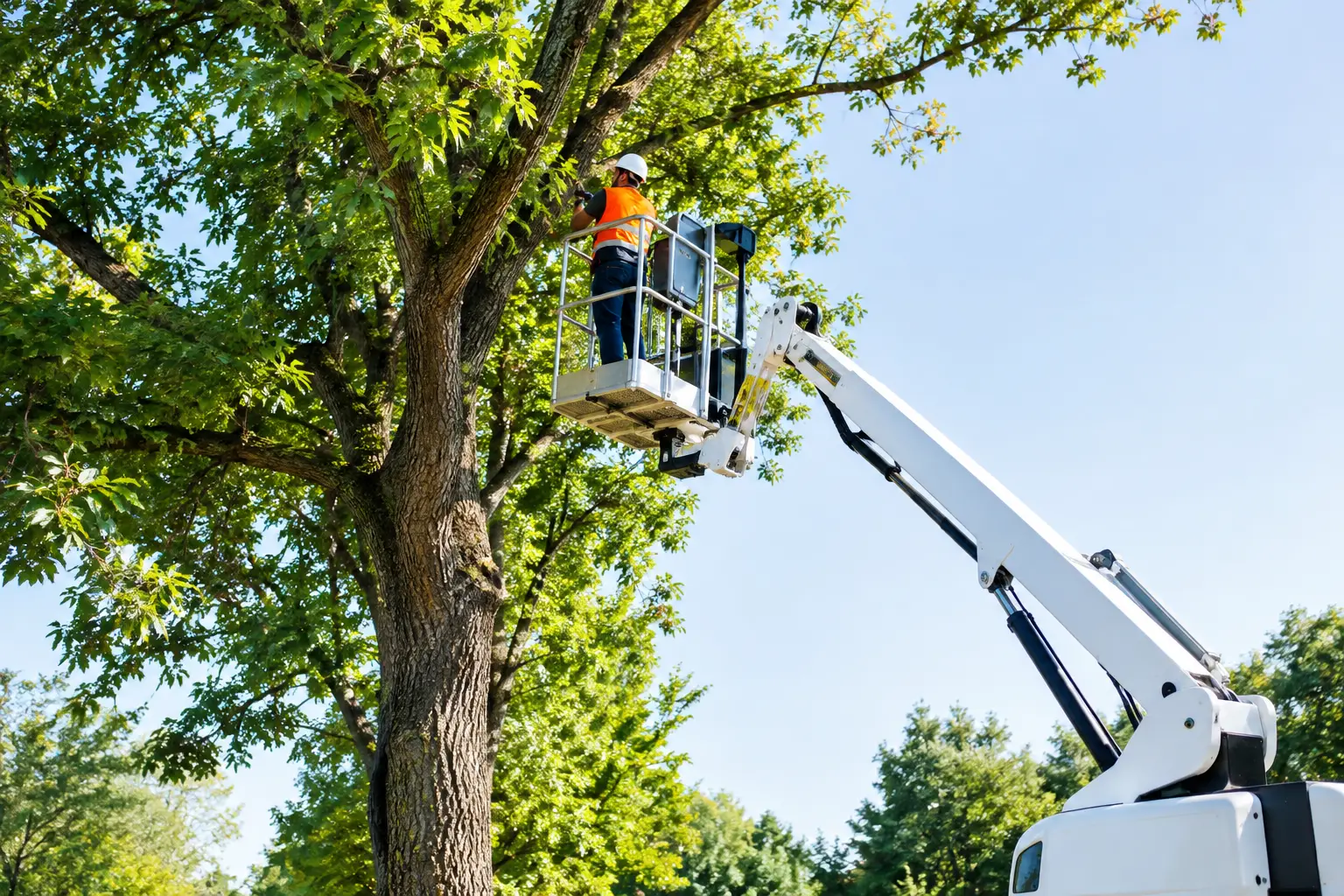
A difficult tree is rarely difficult because of its height alone. It is difficult because the access route is narrow, the ground is soft, the canopy sits over a greenhouse or boundary fence, and the team needs to keep moving without compromising safety. The right tree work lifts turn that problem into a planned operation, giving arborists and grounds teams a stable working position where ladders, climbing or oversized machinery are not the best fit.
The best platform is not necessarily the one with the greatest working height. For commercial tree work, machine width, outreach, ground pressure, set-up space, basket capacity and transport arrangement often decide whether a lift earns its place on site. Choosing well means looking at the whole job, from the first gate to the final clean-up.
Why an MEWP can change the job
A mobile elevating work platform can provide controlled access for crown reduction, deadwood removal, sectional dismantling, inspections and vegetation clearance. It gives the operator a guarded basket, predictable positioning and the ability to work with tools and materials close at hand. On repeat maintenance contracts, that can make a major difference to output and fatigue.
That does not mean a platform replaces climbing on every job. Dense woodland, severely restricted access, steep banks and complex dismantles can still call for rope access and a skilled climbing team. Equally, a lift must never be positioned beneath unstable limbs or within an uncontrolled drop zone. The right choice depends on the tree, the work method, the site and the rescue plan.
For many contractors, the value lies in having another reliable option. A suitable platform can reduce time spent installing climbing systems, improve access to awkward lateral growth and help teams carry out lower-risk maintenance with a consistent working method.
Tree work lifts start with the site approach
Before comparing model names or maximum heights, assess how the machine will get to the tree. Measure the narrowest point on the route, including gates, alleys, archways and turns between parked vehicles. Check for low branches, overhead lines, weak paving, drains, tree roots and gradients. A machine that fits through the entrance still needs enough clearance to turn, travel and deploy safely.
Ground conditions deserve the same attention. Wet grass, made ground and sloping estates can make an apparently simple job more complicated. Tracked spider lifts spread weight well and can travel across sensitive or uneven ground, but they still need a proper assessment of bearing capacity. Outriggers concentrate loads into specific points, so suitable spreader pads and a firm set-up area are essential.
Also consider where arisings, chippers and vehicles will sit. A platform needs a protected operating area, not a space squeezed between the tree crew and passing traffic. On roadside work, traffic management and pedestrian segregation may be the deciding factor before the machine specification is even discussed.
Working height is only the starting point
Working height is useful for shortlisting machines, but it is a headline figure rather than the full answer. The basket floor height will be lower, and the operator’s position, cutting technique and required stand-off from the canopy all affect real reach. Buying a platform that only just reaches the intended point can leave no room to work safely or efficiently.
Outreach is often more valuable. A tree growing over a lawn, garage, watercourse or protected border may require the basket to reach sideways from a safe set-up position. Check the working envelope carefully, especially how much lateral outreach remains available at height and with the intended basket load. Some machines offer impressive maximum figures but have a more restricted envelope when carrying two people or heavier equipment.
Basket capacity matters for the same reason. An operator, a second person, chainsaw, fuel or battery equipment, rigging accessories and cut material can add up quickly. Never treat the rated capacity as a target. It is a hard operating limit, and the basket should be used only in line with the manufacturer’s instructions and the agreed method of work.
Choosing between tracked, towable and boom platforms
Tracked spider lifts are a strong fit for specialist arboricultural access. Their narrow travel width can help them pass through garden gates and restricted side access, while articulating booms and stabilisers offer useful reach around obstacles. Hybrid, petrol and battery power options can also suit different environments, from remote estates to noise-sensitive grounds.
Their trade-off is set-up time. The team needs room to deploy outriggers correctly, level the machine and manage the area around it. On soft or sloping ground, preparation is not optional. A tracked lift can be exceptionally capable, but only when the chosen position supports its stabiliser loads and operating envelope.
Road-towable access platforms suit contractors moving between smaller jobs. They are practical where a suitable towing vehicle is already part of the fleet and can reduce the need for a larger transport arrangement. For routine estate maintenance, churchyard work or domestic and commercial pruning, a towable machine can be a cost-effective route to elevated access.
The limitation is site access after arrival. Towing is straightforward only where the entrance, turning area and parking arrangement allow it. A compact tracked platform may be the better choice if the machine must travel far beyond the roadside or through a narrow property.
Self-propelled rough-terrain boom lifts with stabilisers come into their own on larger sites. They can offer substantial outreach, a generous basket and the ability to cover ground efficiently where space allows. Industrial estates, major landscaping projects, parks and development sites can suit this format well, particularly where several trees need attention across one area.
However, their size and weight demand careful logistics. Transport may require a lorry rather than a trailer, ground bearing pressures may be higher, and their physical dimensions can rule them out before the job begins. Bigger is useful only when the site can genuinely use it.
Build safety into the purchase decision
A tree work platform is part of a work system, not a stand-alone solution. The employer or contractor must ensure that risk assessments, method statements, operator competence, daily checks, rescue arrangements and maintenance responsibilities are all in place. The precise legal duties will vary by operation, but planning must account for the Work at Height Regulations, PUWER and LOLER requirements where applicable.
Operator training should match the machine type and the task. Familiarity with a boom lift does not automatically translate to safe operation of a compact tracked spider lift on stabilisers. Controls, emergency lowering systems, ground controls, levelling procedures and travel characteristics all need to be understood before work starts.
Tree work adds hazards that ordinary access jobs may not. Falling timber, sawdust, swinging branches, unstable limbs and overhead utilities require a clear exclusion zone and close communication between the operator, ground crew and appointed person in charge. A platform must not be used as a crane, a rigging anchor or a place to rest cut sections unless the manufacturer specifically permits the activity and the method has been properly assessed.
New versus pre-owned equipment
A new lift offers known history, current specification and manufacturer warranty support. It can be the right call for businesses that need a particular width, power configuration or working envelope and expect to put the machine through regular use. Finance can also make a new machine more manageable where preserving cash flow matters.
A well-selected pre-owned platform can be commercially sensible, particularly for a contractor adding occasional access capability or replacing an older unit. Condition matters more than age alone. Service records, hours, inspection history, battery condition, track or tyre wear, hoses, controls, stabiliser operation and any signs of structural damage should all be reviewed carefully.
The cheapest advertised machine is not always the lowest-cost ownership choice. Consider transport, servicing, parts availability, likely downtime and resale value. A platform that is easy to support in the UK and right for your typical work may deliver more value than a bargain that is awkward to move or difficult to maintain.
Ask questions before you commit
A useful buying conversation should be based on real jobs, not just a desired height. Bring measurements, site photographs, access details, typical ground conditions and the kind of work your crew carries out most often. Explain whether you need to tow the machine, carry it on a trailer, use it indoors occasionally or work around sensitive surfaces.
At Pure Platforms, that practical detail helps match buyers with new or pre-owned access equipment that fits the work rather than merely looking capable on a specification sheet. It can also inform delivery planning, finance options, part-exchange value and sourcing where a particular machine is required.
The strongest investment is the lift that your team can transport, position, operate and maintain with confidence. Get those fundamentals right, and better canopy access becomes a productive part of the working day rather than another obstacle to manage.