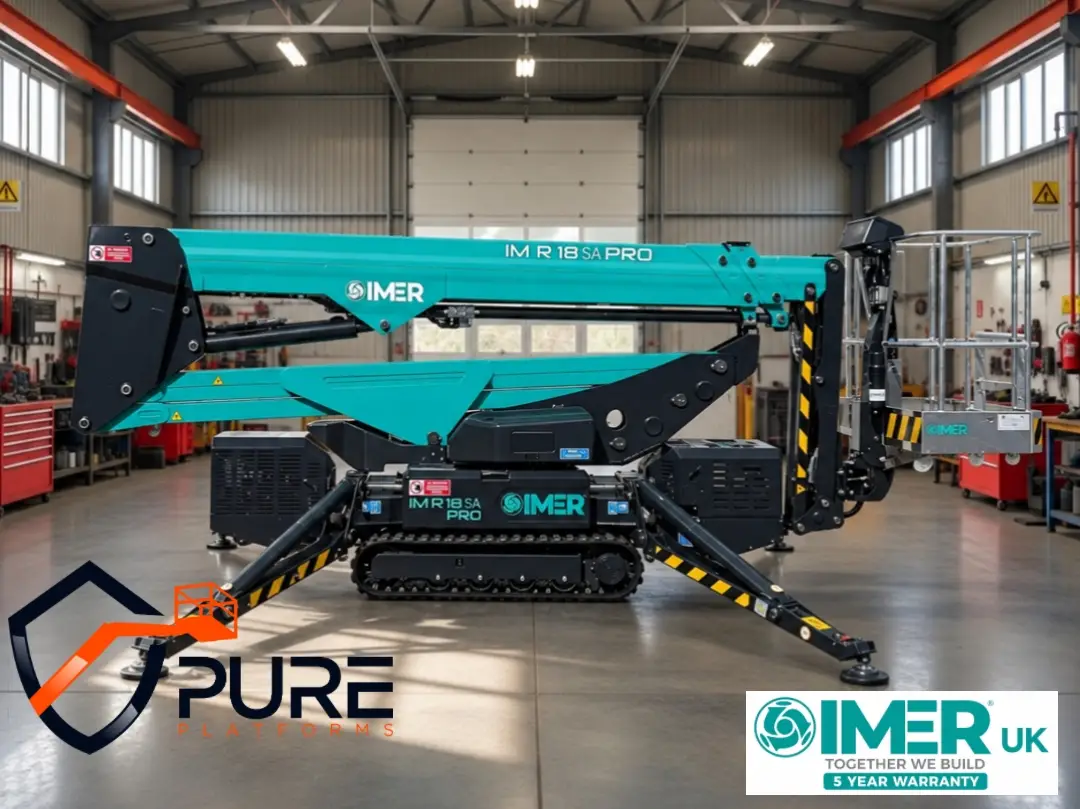
A tight rear garden, a sloping estate, a narrow gateway or a sensitive finished floor can rule out a conventional boom lift before the job has even started. IMER tracked spiderlifts UK by Pure Platforms are aimed at exactly these access challenges: getting a capable working platform to the point where height is needed, without making transport, ground conditions or restricted width an afterthought.
For arborists, facilities teams, contractors and specialist access businesses, the appeal is clear. A tracked spider lift combines a compact travelling footprint with articulated outreach and stabiliser-supported working. But the right machine is not simply the one with the highest number on the working-height chart. It must fit the route in, set up safely where the work is, and deliver useful outreach with the people, tools and materials that will actually be in the basket.
Why IMER tracked spiderlifts suit difficult UK sites
Tracked spider lifts are built for sites where access is as much of a challenge as the task at height. Their tracked undercarriage helps them travel over ground that would be unsuitable for wheeled access platforms, while their compact dimensions can make a meaningful difference at gates, paths, courtyards and between buildings.
Once positioned, the machine is supported on stabilisers. This gives the boom a stable operating base and allows the platform to work across uneven ground within the manufacturer’s stated limits. For tree work, building maintenance and property-management tasks, that can reduce the need for more disruptive access arrangements.
The practical benefit is not just that the machine can reach high. It can often reach where a larger machine cannot be placed. That distinction matters on sites with limited room for outriggers, difficult approach routes, soft verges, landscaped areas or obstacles that restrict the best set-up position.
There is a trade-off. Tracked machines are specialist access equipment, not a replacement for every boom or scissor lift. Travel speed, basket capacity, ground pressure, set-up time and transport arrangements all need proper consideration. On a wide, firm site with repeated long-distance travel, a self-propelled boom may be more productive. Where the route is narrow and the ground is awkward, a spider lift can be the stronger commercial choice.
Choosing an IMER tracked spiderlift in the UK
Start with the jobsite rather than the brochure. A working-height figure is useful, but it is only one part of the decision. A disciplined assessment before requesting a quotation avoids buying a machine that looks right on paper but causes problems at the gate, on the slope or at the working position.
Measure the whole access route
Record the narrowest point from delivery point to work area, including gates, side passages, turns, overhanging branches and doorway heights. Check the machine’s stowed width and height, but also consider the practical clearance needed for safe travelling. A quoted width that technically fits is not always enough if the route has uneven edges or protruding services.
Ground conditions need the same attention. Tracks can provide useful traction, but they do not remove the need for competent site assessment. Consider wet grass, loose aggregate, buried services, drainage covers, gradients and the bearing capacity beneath each stabiliser. On delicate surfaces, suitable protection or a different access method may still be required.
Look beyond maximum working height
Working height is normally based on platform-floor height plus an allowance for the operator. For machine selection, platform height and horizontal outreach are often more revealing. A job at the top of a façade may be straightforward vertically, yet difficult if a conservatory, roof extension, hedge or drainage run prevents close positioning.
Ask where the basket needs to be, not simply how high it needs to go. Then assess whether the machine can reach that point from a legal, stable set-up position. Articulation can help operators work over obstacles and around features, but the usable envelope changes with boom position, basket load and stabiliser configuration.
Basket capacity deserves equal attention. Two operatives, saws, tools, fixings and materials soon add up. Selecting a machine solely for reach can lead to avoidable restrictions during the job. Always work to the rated platform capacity and the manufacturer’s operating instructions.
Match the power arrangement to the work
Power choice affects where and when the platform can operate. Electric operation can be well suited to indoor work, enclosed areas and locations where reduced noise and emissions are priorities. Petrol, diesel or hybrid arrangements may better suit outdoor work, longer duty cycles or sites without a convenient power supply.
The best option depends on the job mix. A facilities contractor working regularly in public-facing buildings may value quiet electric use. An arborist or roofing contractor travelling between remote sites may place more weight on autonomous outdoor operation. It is worth considering future work as well as the next contract, particularly when buying rather than hiring.
Stabilisation is the foundation of safe access
A spider lift earns its versatility through its stabilisers, but those stabilisers need space and suitable ground. Before purchase, establish the footprint required in the intended set-up modes and compare it with the real working areas on site. A compact tracked chassis does not always mean a compact stabilised footprint.
Automatic levelling and stabilisation features can speed up set-up and support consistency, but they do not replace operator checks. The operator remains responsible for selecting an appropriate location, following the machine instructions, observing ground conditions and maintaining a safe exclusion area.
For regular work on slopes or irregular terrain, discuss the likely conditions in detail when specifying the machine. Photos, site measurements and a clear description of the task can make a significant difference to the quality of a recommendation. It also helps identify when ground mats, additional planning or a different machine category is the sensible route.
Transport, ownership and lifecycle cost
A platform that reaches the job but cannot be moved efficiently between jobs will soon affect margin. Check the machine’s transport weight, dimensions and loading requirements against the vehicles and trailers available to your business. Factor in ramps, payload, securing points and who will be responsible for loading and unloading.
For some buyers, a compact spider lift may create opportunities to complete more work with an in-house team instead of arranging specialist access on every job. For others, the stronger case is improved response time for maintenance work or a machine that can serve several divisions. The financial case depends on utilisation, not simply purchase price.
New and pre-owned machines both have a place. A new platform offers known specification, current features and warranty support. A used machine can be a sensible way to acquire specialist capability at a lower initial outlay, provided its condition, service history, inspection status and suitability are properly assessed. The cheapest platform is rarely the cheapest ownership decision if it brings downtime, unsuitable reach or unexpected transport complications.
When comparing quotations, consider delivery cost, finance options, trade-in value and the availability of support after the machine arrives. A sale is only the start of ownership. Good advice before purchase should make operation, maintenance planning and eventual resale easier as well.
Questions worth answering before you buy
Before committing to an IMER tracked spider lift, be ready to provide the proposed working height, required outreach, narrowest access width, ground type, gradient, power preference and expected basket load. Include the type of work being completed and how frequently the machine will be used. These details turn a broad enquiry into a recommendation that is relevant to your operation.
It is also useful to be honest about the difficult sites, not just the easy ones. If a machine will regularly work behind terraced properties, on estate grounds or around live commercial premises, those conditions should shape the specification from the beginning.
The right access platform should make difficult work more controlled, more productive and easier to plan. Measure the route, assess the set-up area and choose the machine around the jobs that earn the work – then the platform has every chance of becoming a dependable part of the fleet.