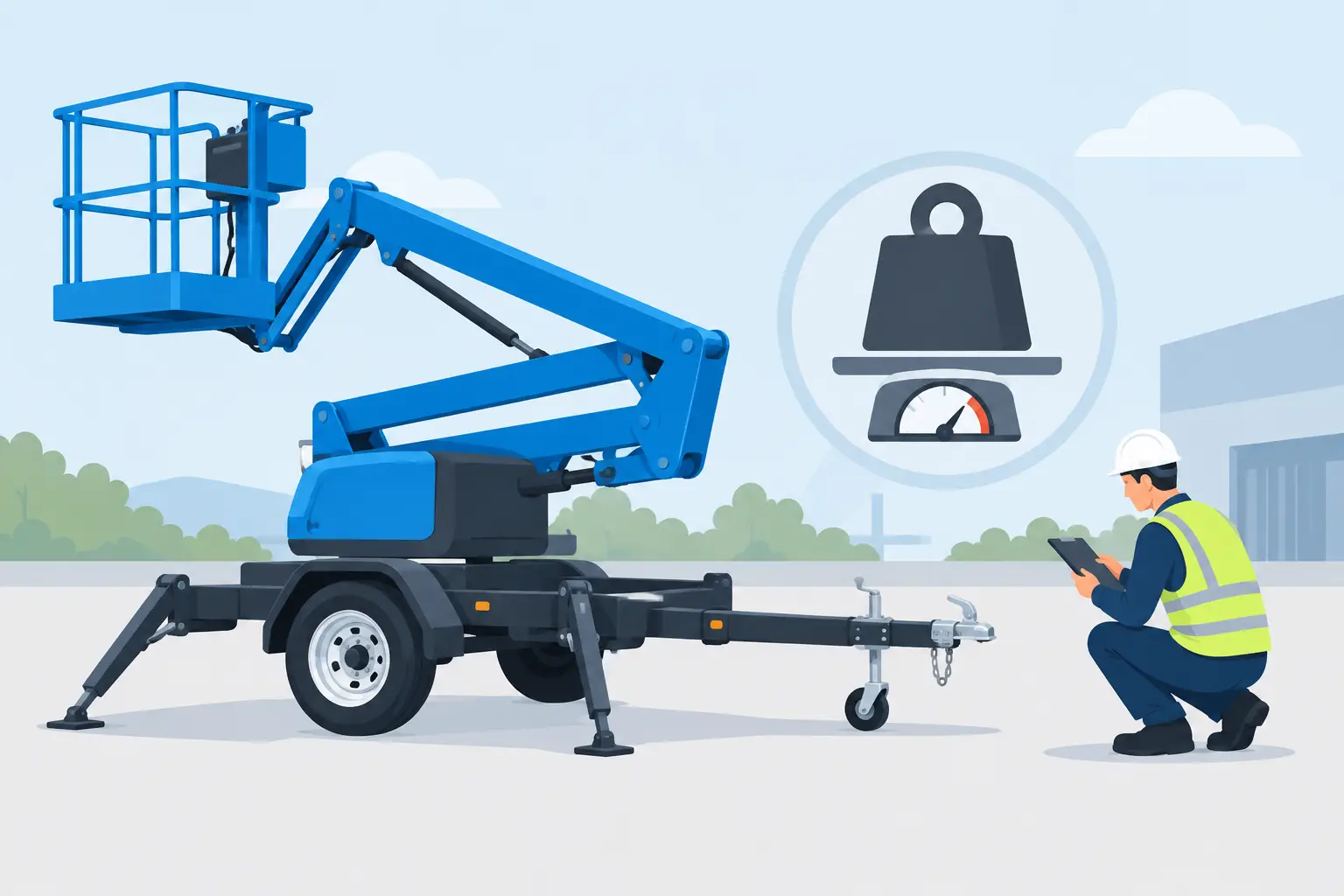
A road-towable lift only saves time and money if the towing vehicle, operator and destination can all handle it. Towable access platform weight is therefore more than a figure on a specification sheet. It affects what can legally tow the machine, whether the route is practical, how easily it enters site, and whether the platform is the right fit for the work in the first place.
For arborists, roofing teams, maintenance contractors and hire fleets, a towable platform can remove the need for a delivery lorry or a larger self-propelled machine. But choosing on working height alone can create problems later. A machine that reaches 21 metres may be an excellent access solution, yet still be a poor fleet decision if it regularly pushes the towing vehicle beyond its plated limits or cannot be positioned on the customer’s driveway, estate road or soft ground.
What does towable access platform weight mean?
When comparing road-towable access platforms, the most useful figure is normally the machine’s gross vehicle weight (GVW), sometimes shown as gross weight, maximum authorised mass (MAM) or permissible laden mass. This is the maximum legal weight of the trailer-platform combination when travelling on the road.
It is not always the same as the machine’s empty or unladen weight. The quoted travelling weight can be affected by fuel, batteries, optional extras, baskets, spare wheels, generators and other fitted equipment. If you are comparing two similar platforms, ask which weight is being stated and obtain the exact specification for the machine offered.
The key point is simple: the trailer’s GVW must sit within the towing vehicle’s permitted braked towing capacity, while the full vehicle-and-trailer combination must remain within the vehicle’s gross train weight. Neither figure should be treated as a target to work up to. A sensible margin makes day-to-day towing safer and gives you room for tools, accessories and real operating conditions.
Why towable access platform weight changes the buying decision
A lighter platform usually gives more flexibility. It may be towable behind a wider range of vans, pick-ups and 4x4s, consume less fuel in transport and be easier to manoeuvre into domestic or restricted sites. Compact low-weight models can be particularly effective for property maintenance, tree work and light construction where access changes every day.
That does not mean lighter is automatically better. More working height, greater outreach, a larger basket capacity and enhanced terrain capability all add value on the right job. They can also add mass. A larger road-towable platform may allow a team to complete work from fewer set-up positions, carry two operatives and tools, or reach over a conservatory, roofline or obstacle that a smaller machine cannot clear.
The right balance depends on the work. A contractor operating mainly on tight residential sites may prioritise a compact machine that can be towed by an existing vehicle. A facilities company covering larger commercial estates may accept more weight in return for outreach, basket capacity and faster, more stable operation. The purchase needs to work across the jobs you actually win, not just the occasional demanding application.
Match the machine to the towing vehicle
Start with the vehicle, not the brochure. Check its VIN plate and handbook for its maximum braked trailer weight and gross train weight. Do not assume that a large-looking van or pick-up can tow every 3,500kg platform. Payload, engine specification, drivetrain and model variant can all alter the permitted towing limit.
Also consider how the vehicle is used between jobs. A van carrying operators, fuel, tools, barriers and materials may be close to its own gross vehicle weight before it is connected to a trailer. Gross train weight is calculated using the actual loaded vehicle and trailer, so the entire working set-up matters.
A 3,500kg towable lift can be a practical choice for many professional fleets, but it demands a vehicle with suitable capacity and a disciplined loading routine. Conversely, a platform below that weight threshold may create more options, though the towing vehicle still needs adequate approved capacity. The trailer brakes, coupling, tyres, lighting and breakaway cable must also be maintained properly.
Check licences, training and operator responsibility
UK trailer rules have changed over time, and entitlement is only one part of legal towing. Drivers must have the appropriate licence entitlement for the combination they are using, but they also need to follow the limits shown on the towing vehicle and trailer plates. Company policy, insurer requirements and customer-site rules may be more restrictive than the basic legal position.
It is good practice to train drivers in coupling, uncoupling, daily trailer checks, load security, reversing and safe parking. A towable access platform is valuable equipment with a high centre of gravity and specialist controls. Poor hitching or an overlooked tyre defect can stop the job before the platform reaches site.
For commercial operations, transport regulations can be situation-specific. Whether requirements such as tachograph rules apply can depend on the vehicle, journey, use and available exemptions. If there is any uncertainty, take advice for your operation rather than relying on assumptions made for private towing.
Weight affects site access as well as the road journey
Transport weight is not the only concern. Once the platform arrives, the machine has to travel or be manoeuvred to its working position, then set up safely on appropriate ground. A towable lift may be narrow enough for a side entrance yet too heavy for a fragile driveway, paving, cellar cover or landscaped area.
Before committing to a machine, assess the usual access route. Look at gateway width, turning space, gradients, kerb drops, overhead branches, parked vehicles and the surface condition. Wet grass, loose stone and sloping ground all change what is practical. A stabilised platform can work effectively on uneven terrain when set up correctly, but outriggers need suitable ground bearing capacity and properly selected spreader pads where required.
Ground pressure is not identical to overall machine weight. The pressure at each outrigger can be much higher than the figure suggested by the platform’s GVW, particularly when the boom is elevated and working at outreach. This is why the manufacturer’s operating instructions, load charts and set-up guidance matter. Never use a machine’s transport weight as proof that a surface is safe for deployment.
Do not forget transport height and dimensions
Weight is usually the first towing question, but dimensions deserve equal attention. Check overall trailer length, drawbar length, transport width and stowed height. A compact towable platform can still be awkward in a narrow yard if the towing vehicle cannot turn it into position.
On the road, confirm the route includes practical fuel stops, parking and turning points. On site, think about where the vehicle and trailer will stand while the machine is in use. If the trailer must be disconnected before access is possible, make sure there is safe, level space to do it without obstructing traffic or pedestrians.
How to compare quoted weights properly
When requesting prices or reviewing used stock, compare like for like. Ask for the exact model, year, serial-specific configuration where available, stated GVW, unladen weight, working height, maximum outreach, basket capacity and overall transport dimensions. If a machine has optional battery power, a hybrid system, a generator, hydraulic basket rotation or upgraded tyres, establish whether these are included in the advertised figure.
For pre-owned machines, condition matters alongside specification. Tyre condition, brake performance, coupling wear, service history and evidence of inspection all influence how confidently the unit can be put straight into work. A cheaper machine can lose its advantage quickly if it needs tyres, brakes, batteries or remedial work before it can be towed safely.
A proper quotation should also account for the practical ownership picture: delivery cost if collection is not viable, finance options where relevant, part-exchange value and support in sourcing a machine where a listed model is not quite right. Pure Platforms can help buyers compare new and pre-owned options against the vehicle and job requirements they already have.
A weight-first buying conversation saves costly changes
The most productive first conversation is not simply, “What height do you need?” It is, “What work do you do, what vehicle will tow it, and where does the machine need to go?” Those answers narrow the choice quickly.
Bring the towing vehicle details, typical site photographs, gate measurements and the heaviest work basket load you expect to carry. With that information, it becomes much easier to identify whether a lighter compact platform will keep the fleet agile or whether the extra capability of a larger towable lift will repay its additional weight.
The best towable platform is the one your team can tow legally, position confidently and use productively on the jobs that keep your business moving. Get the weight right at the start, and the rest of the journey becomes far more straightforward.