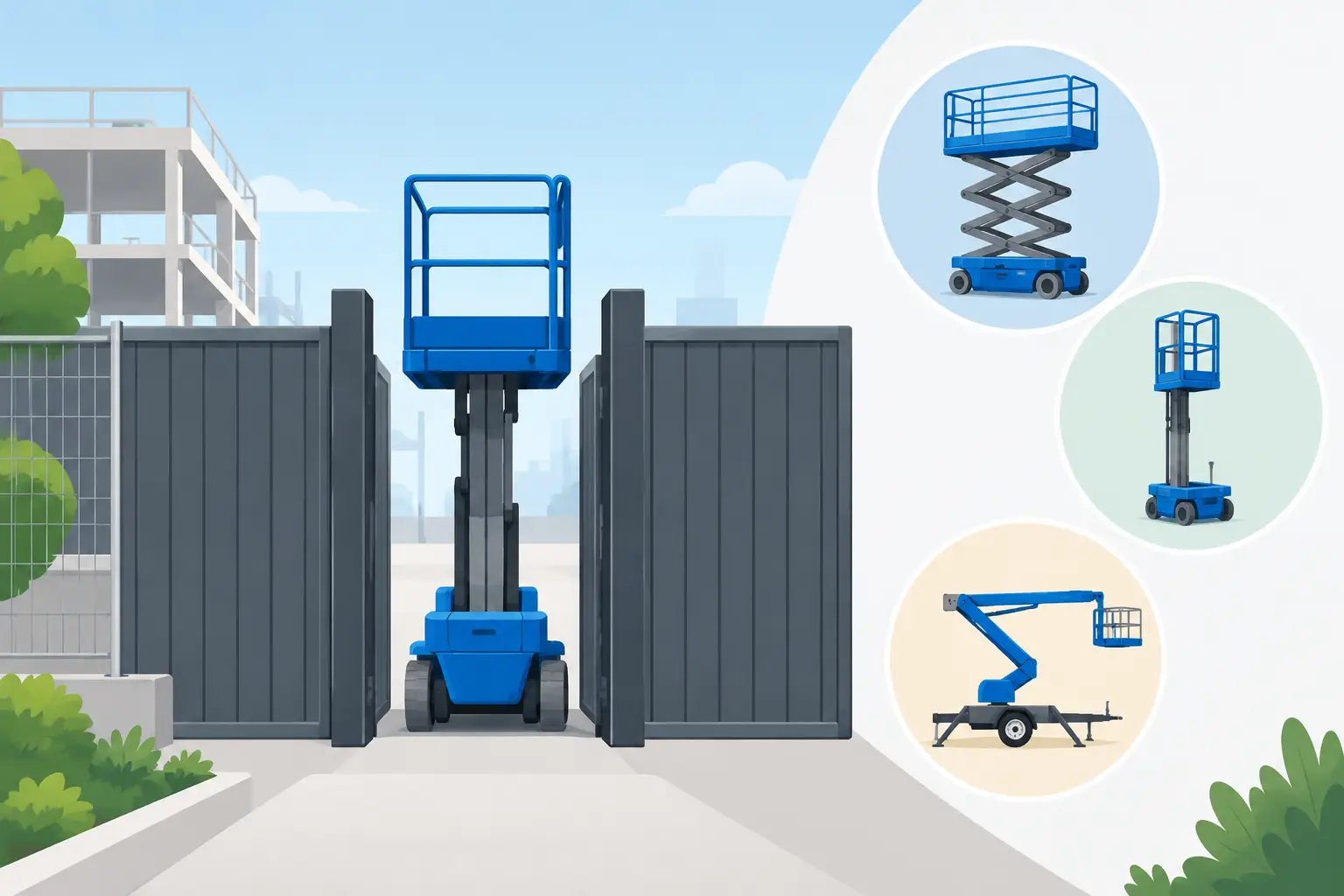
A gate that looks generous from the cab of a van can become the job’s biggest restriction once a platform arrives. When customers ask what access platform fits narrow gates, the answer is rarely just a machine width from a brochure. The right choice must pass through the opening with sensible clearance, travel safely to the work area and still deliver the working height, outreach and ground performance the job demands.
For many restricted-access sites, a compact tracked spider lift is the strongest starting point. That said, a road-towable platform, compact boom or small scissor lift can be the better commercial decision where the ground, route and work position suit it. Measure first, then match the platform to the whole site rather than the gate alone.
What access platform fits narrow gates?
A narrow-gate access platform is usually a compact machine designed to travel through restricted entrances, including side passages, rear gardens, courtyards, estates and industrial service areas. Tracked spider lifts are particularly well suited because many models have a narrow travelling width, low ground pressure and the ability to level on uneven ground using stabilisers.
The key word is travelling. A platform may be narrow enough with its boom stowed, yet require more room once stabilisers are deployed. It may also fit through the gate but be unable to make the turn immediately behind it. This is why the usable route matters more than a single entrance measurement.
Do not select a machine whose quoted width exactly matches the gate opening. Gates are often out of square, posts can project into the opening, hinges steal space and loose ground can move under tracks or wheels. Allow practical clearance for safe entry and exit, particularly where an operator cannot see both sides of the machine clearly.
Start with a proper site measure
Before requesting a quotation, record the clear width between the narrowest fixed points, not the distance between gate posts. Measure the height beneath any arch, canopy, branches or cables, then assess the route beyond the gate. A 900 mm gate may lead straight into an open lawn, or it may lead into a 90-degree turn between a wall and a shed.
Four measurements will make the specification conversation far more productive:
- clear gate width and available headroom
- narrowest point and tightest turn after the entrance
- distance from the unloading point to the work area
- ground slope, surface type and any soft or fragile areas
Also identify overhead constraints before the machine is delivered. A platform may clear a gate at ground level but be unable to raise its boom safely because of power lines, roofs, trees, balconies or steelwork. Safe operation needs room around the entire working envelope, not simply a route to site.
Why tracked spider lifts are often the narrow-gate answer
A tracked spider lift combines a narrow stowed profile with substantial working height and outreach. Rubber tracks spread machine weight over a larger area than conventional tyres, which can be helpful on grass, landscaped areas, loose ground and uneven construction sites. Once in position, stabilisers can level the platform and provide a secure working base.
This design suits arborists working behind domestic properties, roofing teams accessing rear elevations, facilities contractors working within estates and building-maintenance crews facing restricted service entrances. The machine can be driven through the gate, positioned close to the work and set up where a larger vehicle-mounted or self-propelled boom simply cannot go.
However, tracks are not a free pass across every surface. Decorative paving, internal floors, suspended slabs and delicate lawns may require protection or a different approach. Track grip can also create a false sense of security on a steep or wet site. Gradient limits, side-slope limits and ground bearing capacity must be checked against the specific machine and conditions.
Spider lifts also need a stabiliser plan. Outriggers may create a significantly wider footprint than the travel width, and each stabiliser needs firm support. On soft ground, suitable spreader pads may be required. On confined sites, make sure walls, fences, drains and underground services do not prevent safe deployment.
When a road-towable platform is the better fit
A road-towable access platform can be an efficient option for lower-volume work, multi-site contractors and businesses that want to move a machine without a dedicated low-loader. If the access route is firm, level and wide enough for the towing arrangement, a compact towable platform provides useful working height at a competitive ownership cost.
The trade-off is manoeuvrability beyond the gate. A towable machine is excellent where it can be reversed or pulled into a clear work position, but awkward turns, slopes, soft ground and long narrow routes can make it less practical than a self-propelled tracked platform. Consider how the unit will be disconnected, positioned and removed at the end of the job, not only how it arrives.
Compact booms and scissor lifts: where they fit
A compact self-propelled boom lift may work well through wider restricted entrances where the task needs outreach over obstacles. It is often the right choice on firm, reasonably level ground where the operator needs to move frequently at height. Rough-terrain boom lifts with stabilisers add strong capability for uneven external sites, though they are generally not the first choice for very narrow gates due to their transport dimensions and turning requirements.
Scissor lifts offer a straightforward vertical-access solution for slab work, racking, cladding and maintenance where the platform can be positioned directly below the task. Their limitations are equally clear: they provide little or no horizontal outreach, and many models need level, firm surfaces. A scissor lift that fits through the gate may still be unable to work productively if the obstruction is a conservatory, tree canopy or roof edge set away from the travel route.
For narrow access combined with awkward reach, an articulated spider lift usually has the advantage. Its boom can work up and over an obstacle while the machine remains in a safe position. The correct working envelope should always be checked at the required height, because maximum outreach is not available at every point in the machine’s operating range.
Choose by the job, not only by the width
Working height is naturally important, but it should not be the first number on the specification sheet. A 17-metre platform that reaches the gate but cannot achieve the required outreach is less useful than a 15-metre machine that can set up closer and work efficiently. Likewise, a heavier machine may offer more capacity but be unsuitable for a lawn, path or suspended floor.
Consider the materials and people going up with the operator. Platform capacity must cover the operative, tools and materials without compromising the machine’s rated limits. For regular maintenance work, battery power may suit low-noise sites or internal operation. For demanding outdoor work, diesel or hybrid configurations can offer longer duty cycles and better terrain performance. Ventilation requirements remain essential whenever combustion-powered equipment is considered near enclosed or partially enclosed spaces.
Transport deserves the same attention. A compact platform may fit the site perfectly but require a lorry, trailer capacity or delivery arrangement that changes the overall cost. Gross vehicle weight, trailer suitability, towing entitlement and loading access all affect the real buying decision. For a business moving equipment between jobs, the best platform is one that works at height and fits the daily logistics.
New or pre-owned equipment for restricted access
A new machine can give you a current specification, warranty support and a platform selected around your exact access requirements. It is particularly attractive where the machine will become a regular part of the fleet and where uptime, finance planning and long-term serviceability are central to the purchase.
A quality pre-owned platform can make sound commercial sense when the machine has the right dimensions and a clear inspection, service and ownership history. The condition of tracks or tyres, boom wear pads, hoses, batteries, controls, stabiliser functions and safety systems matters as much as the hour meter. Ask practical questions about its previous work, storage and maintenance rather than judging value on age alone.
Pure Platforms can help buyers compare new and used compact access equipment, source suitable machines beyond available stock and assess part-exchange options. The aim is to get the right machine to the right site, with fewer surprises once delivery day arrives.
The practical decision
If the gate is genuinely narrow, the route is uneven and the work needs height plus outreach, start by looking at compact tracked spider lifts. If access is open enough for towing and the working area is simple, a road-towable platform may offer better value. If the task is vertical and the ground is level, a narrow electric scissor can be the cleanest, most efficient answer.
The strongest specification starts with the gate measurement, but it finishes with the full journey: unloading, travelling, turning, stabilising, reaching, working and leaving site again. Get those details right before purchase, and restricted access becomes a planned part of the job rather than the reason it stops.