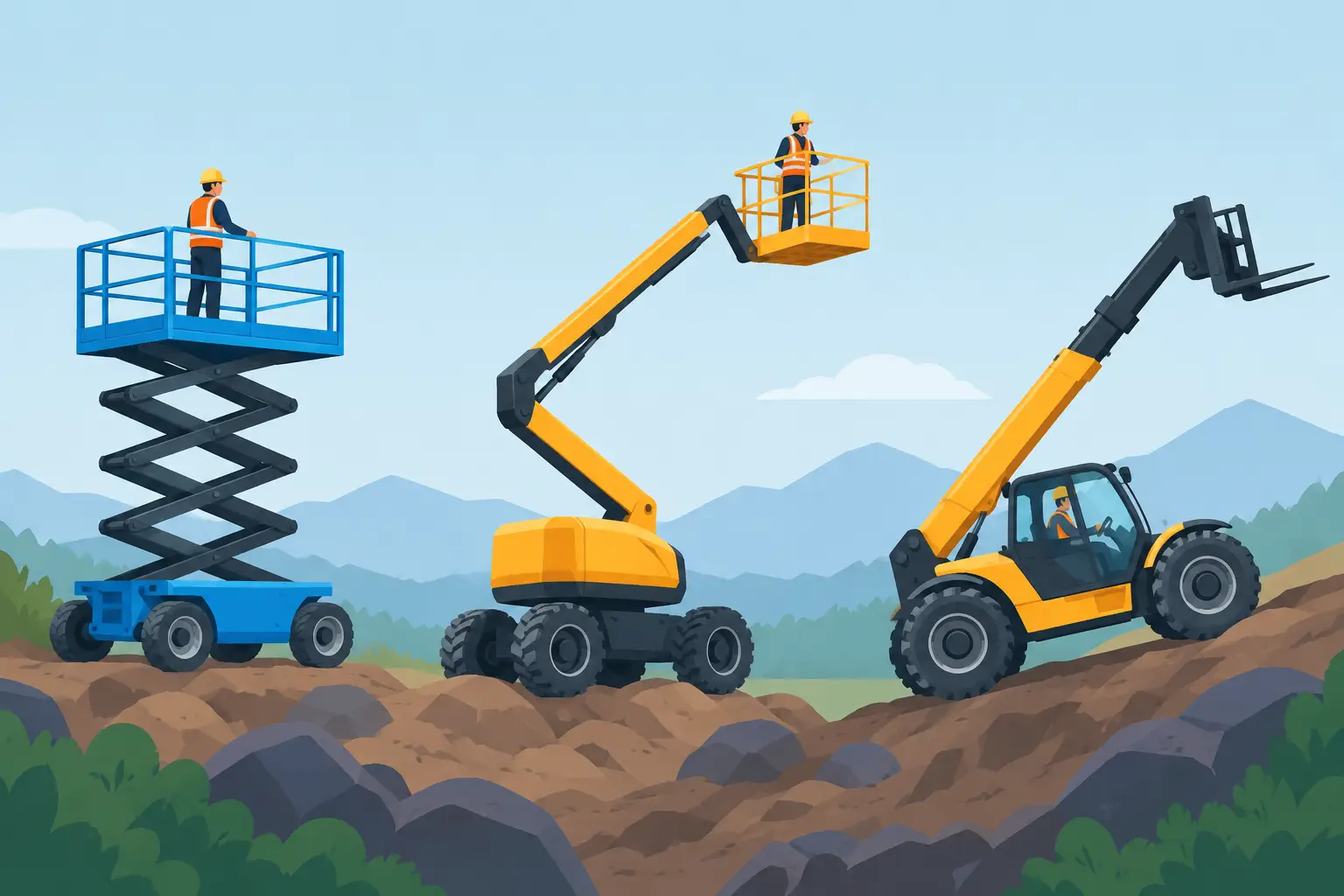
A sloping driveway, rutted construction plot or soft grass verge can turn a straightforward height-access job into a poor machine choice very quickly. The right access platform for uneven terrain must do more than reach the required working height. It needs to arrive at the work area safely, set up correctly, remain stable under load and give the operator useful outreach once the ground is no longer level.
For UK contractors, arborists, roofing teams and facilities operators, terrain is often the factor that decides whether work progresses or a machine spends the day parked at the gate. The answer is not always the largest rough-terrain boom. Site access, ground bearing capacity, slope, machine weight and the work itself all matter.
Start with the ground, not the platform
Before comparing working heights and basket capacities, look honestly at the site. Is the surface compacted stone, broken concrete, wet grass, loose aggregate, clay or a mix of all five? Is the route to the job level enough for a towing vehicle or lorry delivery? Are there kerbs, narrow gates, tree roots, drainage covers or steep transitions between surfaces?
Uneven terrain is not one condition. A firm but sloping yard creates a different challenge from a flat field that becomes soft after rain. A platform may be able to travel over rough ground yet still require levelled, adequately supported stabilisers before elevating. Equally, a compact tracked machine may cross sensitive ground well but have limitations on lateral reach compared with a larger boom.
Ground assessment should include the area beneath every wheel, track or outrigger. Never assume that a hard-looking surface will carry the point load of a stabiliser. Freshly backfilled trenches, service runs, cellars, drains and paving can all require special attention. If ground protection mats or spreader pads are needed, allow for them in the plan rather than treating them as an afterthought.
Choose the machine type around the job
Tracked spider lifts for restricted and sensitive access
Tracked spider lifts are a strong option where the route in is as challenging as the work at height. Their compact dimensions can help them pass through narrow gates, between buildings and around landscaped areas. Tracks can also provide useful traction and spread machine weight more widely than conventional tyres on certain surfaces.
Many spider lifts use stabilisers to level the machine on uneven ground before work begins. This gives a practical combination of compact access and controlled set-up, particularly for tree work, exterior maintenance and work around occupied premises. The trade-off is that stabiliser deployment needs space, and the final footprint can be much wider than the machine in travelling position.
Check the closed width, travelling height, overall weight and gradient capability, but do not stop there. Confirm the stabiliser spread, levelling range and whether the machine offers variable outrigger positioning. A narrow access route is of little value if the work area does not allow safe deployment.
Rough-terrain boom lifts for outreach and productivity
A self-propelled rough-terrain boom lift is often the productive choice for open construction, industrial and infrastructure sites. Four-wheel drive, oscillating axles and foam-filled or heavy-duty tyres can help the machine deal with ruts and loose surfaces. Articulated or telescopic booms then provide the horizontal outreach needed to reach over obstacles, roof edges or plant.
For uneven sites, models with stabilisers offer an extra level of confidence. Auto-stabilisation can help establish a level working base where site conditions allow, reducing set-up time and supporting work on variable ground. This is especially useful where a conventional boom can travel close to the work but cannot safely elevate from the natural slope.
Larger machines bring reach and capacity, but they also bring transport weight, delivery requirements and more demanding ground pressures. If the job needs a platform for several weeks across a wide site, the productivity may justify it. If it is a one-day maintenance task through a tight entrance, it may not.
Road-towable platforms for flexible deployment
Road-towable access platforms suit teams that need to move regularly between properties without arranging a separate low-loader for every job. They can be particularly practical for building maintenance, signage, tree work and roofing where the unit can be towed to site and set up close to the work zone.
Most towable machines rely on outriggers for safe operation, so they are not a substitute for checking levels and bearing capacity. They do, however, offer a sensible balance of working height, lower transport complexity and compact storage for owner-operators and smaller fleets. Confirm the gross vehicle weight, towing vehicle suitability and the access route at each location before committing.
Scissor lifts and conventional booms
Rough-terrain scissor lifts can be effective when the work is directly overhead and the priority is a larger deck for materials or multiple operatives. Their limitation is outreach. If the platform must work around a roof line, over a hedge or beyond a setback, a boom is usually the more practical tool.
Conventional boom lifts remain valuable where the ground is sufficiently prepared and the access route is clear. There is no benefit in paying for extreme terrain capability where a standard machine can operate safely and efficiently. The best specification is the one that fits the actual site, not the most impressive brochure figure.
Working height is only the first number
A stated 21-metre working height does not mean the machine will solve a 21-metre job. Working height is generally based on platform height plus an allowance for a person reaching upwards. The real questions are the required platform height, horizontal outreach, up-and-over clearance and basket capacity at the point of work.
Outreach can reduce as the platform rises, and some machines offer different load envelopes depending on whether one or two people are in the basket, or whether tools and materials are carried. Read the load chart and operating envelope for the exact configuration. A machine that reaches the roof edge with an empty basket may not do so with the required load.
Also consider where the operator needs to be positioned. For façade work, direct vertical reach may be enough. For tree pruning, guttering or industrial maintenance around pipework, articulation and controlled sideways reach are often more valuable than another metre of headline height.
Stabilisation is a system, not a button
Auto-levelling and automatic stabiliser functions are useful, but they do not remove the need for trained set-up and site checks. The machine must be positioned within its stated limits, outriggers must bear on suitable ground, and the area must remain clear while the platform operates.
Look for practical features such as individual outrigger control, variable stabiliser width, ground pressure information and clear levelling indication. These details affect whether the platform can be positioned beside a wall, within a fenced compound or on a restricted pavement area. They also affect set-up speed when the team moves between several work positions.
Slope limits deserve particular care. A machine may have one gradient rating for travelling, another for elevating and a separate limit for towing. These figures should never be treated as targets. Weather, loose material, side slopes and sudden changes in level can reduce the practical margin considerably.
Transport, weight and ownership costs
The right platform still has to get to site. A compact low-weight machine may be deliverable on a smaller vehicle, easier to position and less likely to create access issues. A heavier boom may need specialist transport but could save substantial time once on site. Factor delivery costs into the machine decision early, particularly for multi-site contracts.
For buyers, ownership is about more than purchase price. Consider inspection history on used equipment, battery or engine arrangement, tyre or track condition, parts support, routine maintenance and resale potential. A pre-owned platform with the right service record and specification can be excellent value. A cheaper machine with unsuitable dimensions or an uncertain maintenance background usually becomes expensive at the wrong moment.
Finance and part-exchange can also change the equation. Replacing an underused platform with a machine that better matches your regular work can improve utilisation without tying up unnecessary capital. Pure Platforms can support buyers with new and pre-owned machine options, delivery calculations, finance quotations and part-exchange valuations, so the decision can be based on the whole operating picture.
Questions to settle before requesting a quotation
Provide the working height and the horizontal reach you need, but add the details that make the recommendation accurate: site surface, maximum slope, access width and height, distance from set-up point to work face, likely basket load, power preference, transport constraints and job duration. Photographs and a simple site sketch are often more useful than a broad description of “rough ground”.
Ask whether the proposed machine can travel at the required gradient, whether it must be levelled before elevation, how much space stabilisers need and what ground protection may be appropriate. For used platforms, request clarity on age, operating hours, inspection and service information, condition, and any work completed before handover.
A platform earns its keep when it reaches the job without delaying the crew, gives the operator a stable and usable position, and leaves site as easily as it arrived. Start with the ground beneath the machine, then choose the reach, access and support arrangement that lets your team work hard with confidence.