A machine that reaches 21 metres is not automatically the right answer if it cannot get through the gate, travel across the site or position the operator where the work actually is. Cherry pickers are bought to solve an access problem, and the best machine is the one that removes delays without creating fresh transport, ground-condition or operating issues.
For contractors, arborists, facilities teams and hire fleets, that means looking beyond headline working height. Platform capacity, outreach, machine width, weight, power source and stabilisation all affect how productive a machine will be once it arrives on site.
What are cherry pickers?
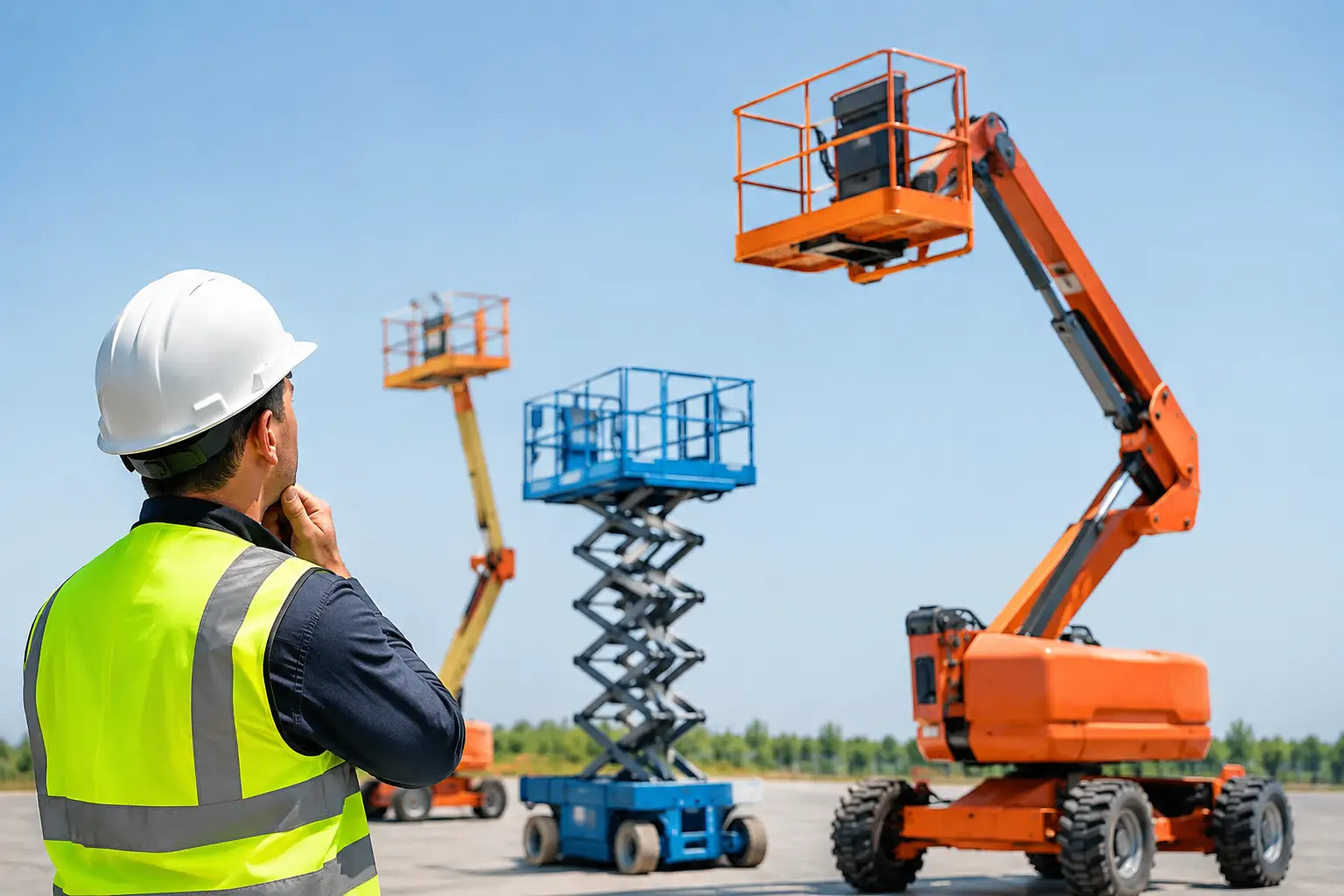
Cherry pickers are commonly used to describe mobile elevated work platforms with a boom and personnel basket. The term covers several machine types, including articulated boom lifts, telescopic boom lifts, tracked spider lifts and road-towable platforms. Each gives operators safe access to elevated work areas, but they do not perform in the same way.
A conventional self-propelled boom lift is often the practical choice for open construction, industrial and maintenance sites. It can travel around the site under its own power and, depending on the model, may be driveable at full working height. An articulated boom provides up-and-over access around rooflines, steelwork, trees or machinery, while a telescopic boom is generally suited to straightforward reach over distance.
Where access is tight or the ground is difficult, a tracked spider lift can make more commercial sense. These compact machines are built to pass through narrow entrances and work with stabilisers deployed on uneven terrain. A road-towable cherry picker, meanwhile, can be an efficient option for businesses moving between smaller jobs without a dedicated lorry and trailer fleet.
Start with the work, not the brochure
The first question is not, “How high do we need to go?” It is, “Where does the basket need to be?” Working height is useful for narrowing the search, but it does not tell you whether the platform can reach over a conservatory, clear an obstruction, sit close enough to a façade or access a tree canopy from a safe setup position.
Measure the maximum working height, then consider the horizontal outreach required at that height. On a building-maintenance job, a boom may need to reach across a pavement, planted area or roof projection. For arboricultural work, the operator may need articulation to work around branches rather than simply above them. In industrial settings, obstacles such as racking, pipework and production equipment can make a compact articulated machine far more useful than a larger straight boom.
It also pays to allow a sensible margin. Choosing a machine that only just meets the height requirement can restrict positioning and slow the job down. That said, extra reach brings extra cost, weight and transport considerations. The right specification is rarely the biggest specification.
Check platform capacity and basket layout
Platform capacity is sometimes treated as a secondary figure, but it has a direct bearing on how the machine can be used. Consider the operator, PPE, tools, materials and any equipment likely to be carried into the basket. A restricted capacity can lead to repeated trips or force teams to change their working method.
Basket dimensions and rotation matter too. A compact basket may be ideal for passing through restricted areas, while a larger platform can improve productivity for two-person maintenance tasks. The practical choice depends on the job mix rather than a single site requirement.
Match the machine to ground conditions
Ground conditions separate suitable cherry pickers from costly mistakes. A smooth warehouse floor, a sloping estate road, soft grass and a rough construction site demand very different machines.
For firm, level surfaces, electric scissor lifts and electric boom lifts can offer quiet, efficient access with no local exhaust emissions. They are well suited to warehouses, factories, retail premises and planned facilities work. However, they are not a substitute for rough-terrain equipment when the site surface is loose, undulating or wet.
Rough-terrain boom lifts with four-wheel drive, oscillating axles and stabilisers are designed for demanding external work. Stabilisation can provide confidence where the setup area is uneven, but it also requires space and a proper assessment of ground bearing pressure. A machine with outriggers may achieve excellent working performance, yet be unsuitable if the site cannot accommodate the footprint.
Tracked spider lifts offer a different balance. Their low ground pressure, compact width and stabilised working position can suit gardens, estates, narrow side access and sensitive ground conditions. The trade-off is that they are usually slower to reposition than a self-propelled boom, particularly across larger sites. For the right work, that compromise is more than worthwhile.
Transport and access can decide the purchase
Many access jobs are won or lost before the platform is even unloaded. Check the route from the road to the working area: gate widths, archways, side passages, gradients, kerbs, overhead restrictions and turning room all need to be considered.
Machine width is particularly important for property maintenance, arboriculture and urban projects. A narrow tracked platform may get through an opening that rules out a conventional boom lift altogether. Height and length in transport position matter as well, especially when loading onto a trailer or manoeuvring in a confined yard.
Gross vehicle weight should be checked early for road-towable equipment. The towing vehicle, trailer limits, licence entitlement and payload all need to work together. A towable platform can reduce delivery costs and give owner-operators greater flexibility, but only where the transport arrangement is legal, safe and realistic for the team using it.
For self-propelled machines, think about delivery, collection and how often the platform will move between sites. A larger unit may need specialist transport, while a lighter compact machine can be easier and less expensive to relocate. This is where whole-life cost becomes more useful than the initial purchase price alone.
Diesel, electric or hybrid power?
Power choice should follow the environment in which the platform will spend most of its time. Diesel remains a strong choice for outdoor rough-terrain work, offering the torque and endurance needed for demanding sites. Electric machines are increasingly attractive for indoor work, noise-sensitive locations and facilities contracts where clean operation is essential.
Hybrid or bi-energy options can be valuable for mixed-use fleets. They allow an operator to work electrically indoors and use engine power where charging is not practical. They can cost more at the outset, so the case is strongest where the machine genuinely moves between indoor and outdoor environments.
Battery condition deserves close attention when considering a pre-owned electric platform. Ask how the machine has been used, whether charging has been managed correctly and what inspection information is available. On any used cherry picker, service history, hours, tyre or track condition, controls, basket condition and safety systems should all form part of the buying decision.
New or pre-owned: choose on utilisation and risk
A new machine offers known specification, manufacturer warranty and the opportunity to configure the platform around the work you expect to win. For a business with regular utilisation, specialist requirements or a need for the latest controls and emissions standards, it can be the sensible long-term investment.
A quality pre-owned machine can deliver strong value where the specification is proven and the condition has been properly assessed. It may also allow a contractor to step into a larger working height or more capable machine than a new-equipment budget would permit. The key is to buy on condition and suitability, not age alone.
Before committing, establish who will operate the platform, where it will be stored, how inspections will be managed and what support is available when the machine needs parts or attention. A lower purchase price is quickly forgotten if downtime stops a job.
Make the buying process work harder
A productive platform purchase starts with accurate site information and an honest view of the work ahead. Share photos, dimensions, access details, ground conditions and the types of jobs the machine will cover. That gives the supplier a basis for recommending a machine that fits the work rather than simply offering the closest stock model.
At Pure Platforms, the conversation can also include new and pre-owned availability, machine sourcing, finance quotations, delivery-cost calculations and part-exchange value. That support matters when the best answer is not sitting neatly in a standard category.
The right cherry picker should make every visit to site more straightforward: get in, set up safely, reach the work and get on to the next job with less wasted time. That is the kind of machine worth putting to work.