A warehouse platform that cannot turn at the end of an aisle, pass beneath a doorway or work safely beside live racking is not a productivity tool. It is an expensive obstruction. The best access lifts for warehouses are chosen around the building and the job, not simply the highest working-height figure on a specification sheet.
For most warehouse teams, the recurring work is predictable: changing high-bay lighting, inspecting sprinkler heads, maintaining roller shutters, cleaning cladding, fitting signage or carrying out repairs above racking. That normally points towards compact, electric equipment with non-marking tyres, good manoeuvrability and enough platform capacity for two people and their tools. The right answer still depends on aisle geometry, slab loading, access routes and whether the machine must also work outdoors.
Start with the task, not the lift type
Write down what the platform needs to reach and what must go up with it. A working height is typically measured from the platform floor to the maximum point an operator can safely reach, so do not confuse it with platform height. If a light fitting sits at 8 metres, a 10-metre working-height machine may be appropriate, but confirm the actual task position and any obstruction below it.
Platform capacity matters just as much. A single operative replacing lamps may need little more than a compact vertical mast. Two engineers with toolboxes, cable reels or replacement components may need a larger scissor platform. Access equipment is for people, tools and materials within the manufacturer’s stated limits. It is not a substitute for a goods lift or an order-picking machine unless it has been designed and approved for that purpose.
Also consider where the work happens. Straight-up access in a clear aisle is different from reaching over conveyors, racking protection or a loading-bay canopy. This is where a boom can earn its keep, even when a scissor lift appears cheaper at first glance.
Best access lifts for warehouses by application
Electric scissor lifts for repeated indoor maintenance
Electric scissor lifts are often the practical starting point for warehouses with flat, sound concrete floors. They provide a broad platform, useful guardrail height and straightforward vertical access for routine planned maintenance. Their electric drive keeps noise and local emissions low, while non-marking tyres help protect finished floor surfaces.
A narrow electric scissor is particularly effective where the work is directly overhead and aisle widths are controlled. Check the stowed width, overall length, turning circle and machine weight against the tightest route, not the open space near the loading doors. A lift that fits through the first doorway may still struggle at an aisle end or between racking uprights.
The trade-off is outreach. Scissor lifts rise vertically, so they must be positioned directly beneath the task. If fixed machinery or stored stock prevents that position, an articulated boom may reduce set-up time and avoid repeated repositioning.
Vertical mast lifts for tight aisles and lighter duties
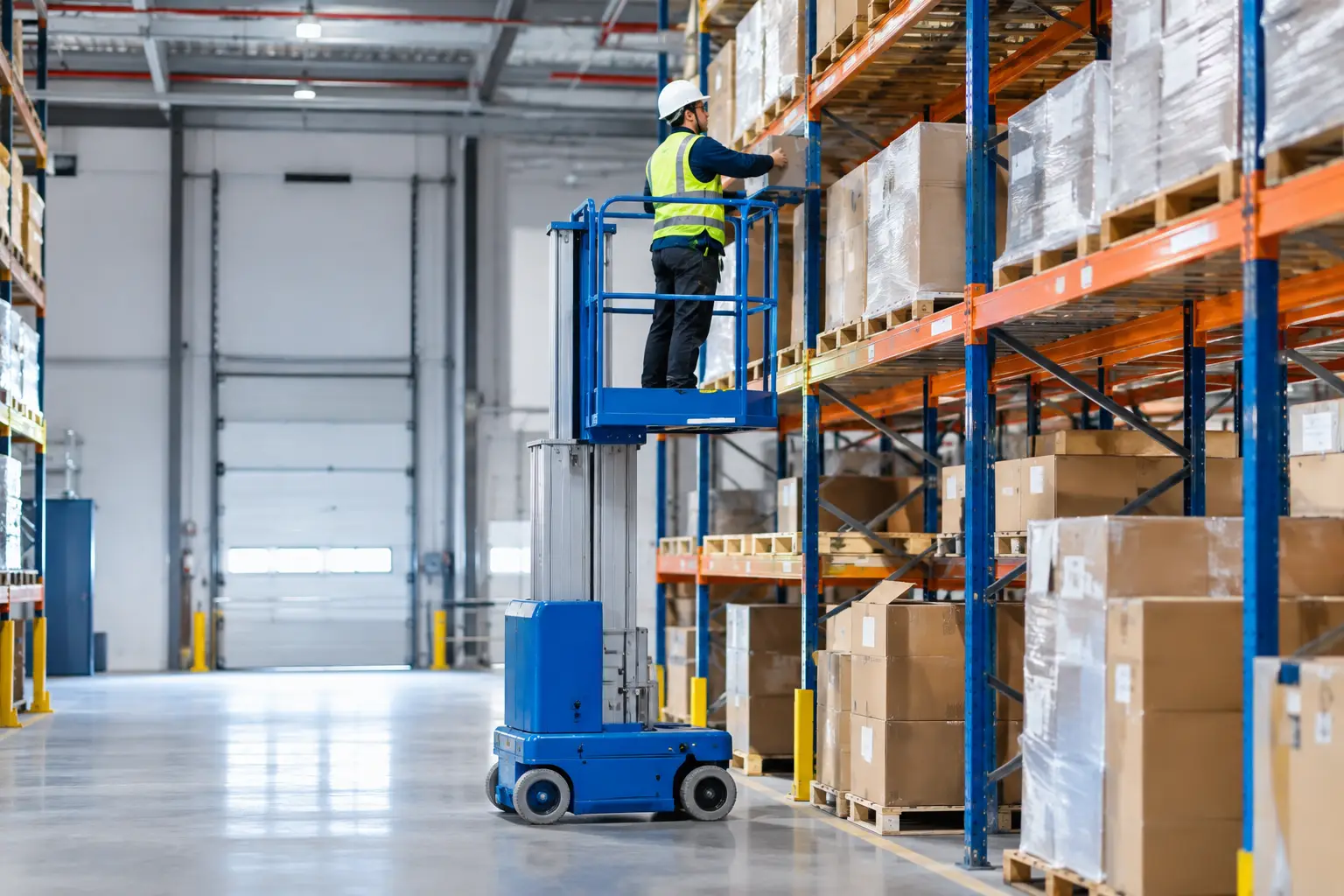
For narrow warehouse aisles, compact vertical mast lifts can be an excellent fit. Their small footprint, low stowed height and light overall weight make them useful for inspections, small repairs and stock-area maintenance where space is limited. Many can be driven at working height on suitable level floors, helping an operative cover a run of lights or services efficiently.
A vertical mast is not automatically the cheapest choice once the job is considered properly. Its platform is smaller than a scissor deck, so it may not suit bulky materials or two-person work. It is best used where access is constrained and the task is light, frequent and directly overhead.
Electric articulated booms for obstacles and offset reach
An electric articulated boom lift is the stronger choice when warehouse maintenance involves reaching up and over. It can position an operator beside a raised obstruction rather than below it, making it useful around mezzanines, conveyors, dock doors, plant rooms and racking ends.
The key dimensions are not limited to working height. Review horizontal outreach, up-and-over clearance, tail swing and platform rotation. In a busy warehouse, a compact zero-tail-swing design can make a major difference when turning close to stock, walls or pedestrian routes. Boom lifts offer flexibility, but their chassis and operating envelope generally require more clearance than a compact mast or narrow scissor.
Compact spider lifts for awkward access routes
Tracked spider lifts are worth considering where the building is difficult to enter or the access route is more demanding than the work area itself. Their narrow stowed width, low ground pressure and stabiliser set-up can suit restrictive gateways, uneven external approaches and sites with changes in level.
They are not the default answer for every internal warehouse. Outriggers need a suitable, assessed set-up area, and the team must allow space around the machine while it is working. Where access is exceptionally tight, however, a compact spider can reach places that a conventional self-propelled platform simply cannot.
Road-towable platforms for multi-site facilities teams
A road-towable access platform can make commercial sense for facilities teams maintaining several warehouses, depots or trade units. It can be moved between sites without a dedicated transport lorry and is often a sensible option for planned, occasional work.
That flexibility comes with a set-up requirement. The machine must be levelled and stabilised correctly, and towing capacity, operator competence and site access all need checking. For a platform used every day inside one large warehouse, a self-propelled electric machine is normally faster to deploy.
Measure the warehouse as it really operates
The smallest dimension usually decides the machine. Measure clear aisle width, doorway width and height, loading-bay thresholds, ramps, turning areas and the clearance beneath fire doors, ductwork and sprinklers. Account for racking guards, columns and pedestrian barriers that reduce the usable space.
Floor loading deserves the same attention. Obtain the slab specification where possible and assess any suspended floors, mezzanines, service pits, drainage channels and dock levellers separately. Machine weight is only part of the picture: wheel loads, outrigger loads and the load distribution in the working position all matter. A compact machine is often easier to deploy, but do not assume a lower gross weight removes the need for a floor assessment.
Warehouse traffic changes the decision too. A machine operating during a live shift needs defined exclusion zones, clear communication with forklift drivers and a safe charging or parking location. If the work can be completed during a planned shutdown, a larger platform may be viable. If it must happen between normal movements of stock, compactness and quick repositioning become more valuable.
Power, charging and condition are ownership decisions
For enclosed warehouse work, electric power is usually the sensible default. It reduces fumes, noise and ventilation concerns, and it suits the stop-start nature of maintenance work. Confirm the charging arrangement before purchase: battery type, charge time, charger supply, parking location and who will be responsible for routine battery care.
Diesel rough-terrain booms have a place where the route includes rough yards, gradients or external work, particularly when stabilisers are needed for demanding ground conditions. They are rarely the first choice for a clean, enclosed warehouse due to size, noise and exhaust emissions. A mixed indoor-outdoor operation may justify two different machine types rather than asking one platform to compromise on every task.
New and pre-owned equipment can both be good commercial choices. A newer machine may bring the latest features, warranty support and a known ownership history. A well-selected used lift can provide strong value where utilisation is lower or the specification is clear. In either case, inspect service history, battery condition, tyres, controls, safety devices, LOLER examination status and the availability of parts and support.
Buy for the work you will still be doing next year
Do not buy solely for the one awkward job currently causing a problem. Consider the maintenance plan for the next 12 to 24 months, the buildings the machine may need to visit and whether your team will use it often enough to justify ownership. If the work is regular, keeping the right platform on site can remove delays, hire availability issues and repeated delivery costs.
A clear brief makes the buying process faster: required working height, platform capacity, minimum aisle width, floor constraints, indoor or outdoor use, preferred power source and any transport limit. Pure Platforms can help compare new and pre-owned options, calculate delivery requirements and support finance or part-exchange discussions around that real operating brief.
The best warehouse lift is the one your operators can position confidently, your floor can support safely and your maintenance team can use without turning every routine task into a major operation.