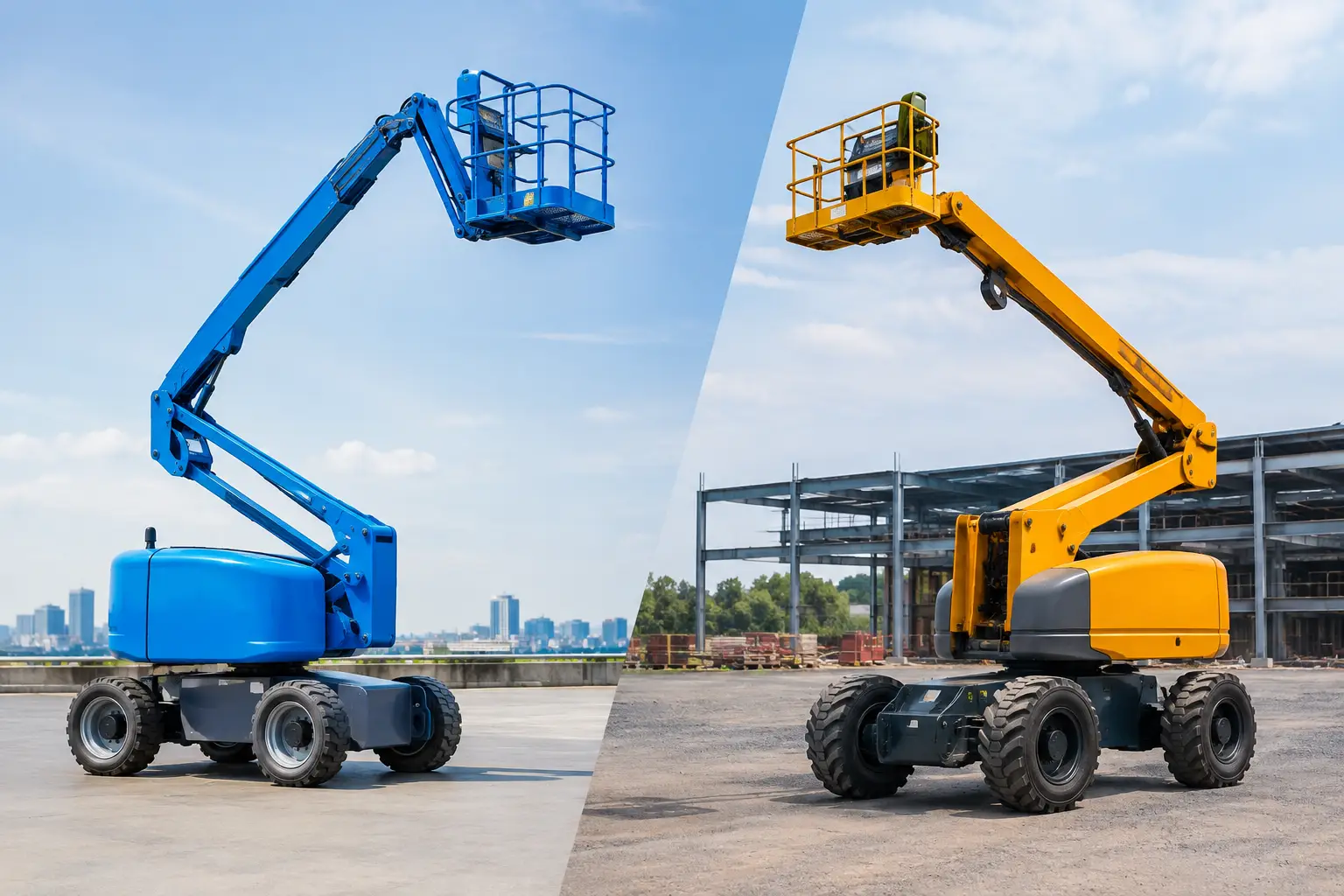
A boom lift that cannot get to the work area, complete a shift or meet a site’s emissions rules is not a saving, whatever the purchase price. The decision between battery versus diesel boom platforms starts with the job in front of you: where the machine will work, how often it will travel, what it must carry and whether charging or refuelling is genuinely practical.
For UK contractors, facilities teams and fleet buyers, battery power is becoming a serious option well beyond warehouse work. Diesel remains the working tool for many exposed, uneven and high-demand sites. Neither is automatically the right answer. The best machine is the one that delivers the required working envelope with the fewest operational compromises.
Battery versus diesel boom platforms: the practical difference
Battery boom platforms use electric motors powered by an onboard battery pack. They are quiet, produce no tailpipe emissions and are usually suited to firm, level surfaces. Many electric booms are compact enough for indoor industrial sites, retail units, airports, warehouses and building-maintenance work, where noise, ventilation and floor loading all matter.
Diesel boom platforms use an internal combustion engine and are generally designed for outdoor productivity. Rough-terrain models commonly offer greater ground clearance, four-wheel drive, oscillating axles and tyre options suited to mud, loose stone and uneven ground. Where access roads are unfinished, gradients are present or the platform needs to move repeatedly over difficult terrain, diesel has clear advantages.
The distinction is not only about fuel. It affects machine weight, transport planning, available working height, ground conditions, operator comfort and the way a job is scheduled. A platform that suits a clean factory floor may be entirely wrong for a sloping construction plot after a week of rain.
When a battery boom platform makes commercial sense
Battery power is strongest where access work happens indoors or close to occupied buildings. A quiet machine lets a team work earlier, later or alongside normal business activity without engine noise becoming the issue. Zero tailpipe emissions are equally valuable in enclosed spaces, food-production environments, hospitals, logistics centres and underground or poorly ventilated areas.
Electric drive also makes sense for planned maintenance. If a facilities team uses a boom for lighting, ductwork, inspections or fabric repairs over predictable periods, charging can be built into the working routine. Overnight charging is often enough for a normal shift, provided the machine is correctly specified and the battery is in good condition.
Running costs can be favourable too. Electricity is generally less expensive than diesel per operating hour, and electric drivetrains have fewer engine-related service items. There is no engine oil, fuel filter or exhaust after-treatment to manage. That does not remove maintenance altogether: batteries, chargers, hydraulic systems, tyres, bearings and safety devices still require proper inspection and care.
A battery boom can also be the better transport choice where low weight or compact dimensions are critical. However, buyers should never assume all electric models are light. Larger battery packs add weight, and the gross vehicle weight must still be checked against the trailer, lorry and towing arrangement before delivery is arranged.
Charging is a site-planning issue
Electric platforms work best when charging is planned, not hoped for. Confirm the available supply, charging location, cable management and time between shifts. A standard charging point may be adequate for occasional use but can become a limitation on intensive jobs or multi-shift work.
Cold weather, frequent driving, steep ramps and sustained use at height can reduce available runtime. For a machine that will be working continuously, ask for realistic duty-cycle guidance based on the intended use rather than relying on a best-case figure. A second charging opportunity during breaks may turn an unsuitable machine into a productive one.
Where diesel boom platforms still earn their place
Diesel remains difficult to beat on rough, remote and fast-moving sites. It gives operators the freedom to work away from fixed electrical supplies, refuel quickly and cover larger outdoor areas without planning the next charge cycle. That flexibility matters on construction projects, infrastructure work, steel erection, roofing, utilities and external maintenance.
A diesel rough-terrain boom is often the more capable choice where the route to the job is as demanding as the work itself. Four-wheel drive, higher ground clearance and levelling capability can keep a platform productive across rutted ground, loose surfaces and site gradients. These features must not be mistaken for permission to work outside the manufacturer’s limits. Ground assessment, slope limits, wind restrictions and safe travel procedures still apply.
Diesel also remains common at higher working heights and on applications needing regular outdoor travel. If the boom needs to be repositioned across a large site several times a day, diesel’s range and rapid refuelling can protect productive time.
The trade-off is obvious: engine noise, tailpipe emissions, fuel handling and more routine engine maintenance. Urban sites increasingly impose low-emission requirements, while some customers prohibit diesel operation near buildings or within restricted working zones. Even outdoors, neighbours, local authority conditions and early-morning working restrictions can influence the choice.
Look beyond the power source
Power type should not distract from the specification that makes the job possible. Start with working height and horizontal outreach, then check the platform capacity at the required outreach. A boom may reach the right height but offer less capacity when extended, which can affect whether two operatives and their tools can work together.
Next, consider the access route. Measure gates, internal doors, passageways and turning space. Check stowed height, overall width, transport length and machine weight. On confined projects, a compact articulated boom may reach around obstacles more effectively than a larger telescopic model, even if the latter has greater outreach on paper.
For outdoor work, inspect the ground honestly. A rough-terrain platform is not a cure for unsuitable bearing capacity or deep mud. If a route crosses soft ground, cellars, drainage runs or newly laid paving, ground protection and a proper assessment may be required. Stabilised boom platforms can offer excellent performance on challenging terrain, but the deployment area needs sufficient space and a safe, sound surface.
Also consider how the machine will be moved between jobs. A road-towable platform, compact tracked spider lift or smaller electric boom may reduce transport complexity for certain contractors. For a fleet moving larger self-propelled booms frequently, lorry capacity, loading arrangements and delivery cost become part of the ownership calculation.
Total cost is more than purchase price
Battery machines can reduce energy and routine engine-service costs, but their value depends on usage. An electric boom sitting unused for long periods can suffer from poor battery care if it is not stored and charged as recommended. On a used machine, battery age, charge behaviour and charger condition deserve close attention.
Diesel machines may have a lower barrier to continuous outdoor operation, but fuel spend, servicing and potential emissions-related restrictions need to be priced into the decision. A machine that is technically capable but regularly excluded from customer sites can become an expensive fleet asset.
For pre-owned equipment, condition can outweigh the badge or power source. Review service records, hour readings, inspection history, tyres, hydraulic operation, emergency controls and battery or engine performance. A proper demonstration should include drive functions, boom movements, platform controls and safety systems. Ask whether the machine’s previous work matches the intensity of the work you intend to give it.
Finance and part-exchange can also alter the calculation. Replacing an older diesel unit with a battery platform may make sense where a customer base is moving indoors or towards low-emission sites. Equally, retaining diesel capability may be the sensible move for a contractor whose work remains heavily outdoor and terrain-led. The right decision is based on utilisation, not fashion.
A straightforward way to choose
Before requesting quotations, set out the usual job type, maximum working height, required outreach, ground conditions, available charging, travel distance per shift and transport method. Then separate occasional requirements from daily requirements. Buying for the hardest job you might face once a year can leave you with an oversized platform for the other eleven months.
Where the work is mixed, a fleet approach may be stronger than trying to make one machine cover every application. An electric boom for indoor maintenance and a diesel rough-terrain boom for external projects can keep operators productive without forcing compromises at either end.
Pure Platforms can help compare new and pre-owned options against the actual site, transport and ownership requirements, including delivery, finance and part-exchange considerations. Bring the measurements, the ground conditions and the working pattern to the conversation. That is how a boom platform becomes a dependable working asset rather than another problem to manage.