A boom lift that reaches the headline working height but cannot get the basket to the actual work area is no bargain. When comparing articulating versus telescopic boom lifts, the key question is not simply, “How high does it go?” It is, “What is between the machine and the job?” Buildings, roofs, racking, branches, machinery, soft ground and restricted entrances all change the right answer.
Both machine types give operators productive, flexible access at height. Their boom geometry is different, though, and that affects clearance, outreach, set-up, transport and the way the machine works around a site. Choose the layout that suits the work envelope, not the one that happens to have the biggest number on the specification sheet.
Articulating versus telescopic boom lifts: the core difference
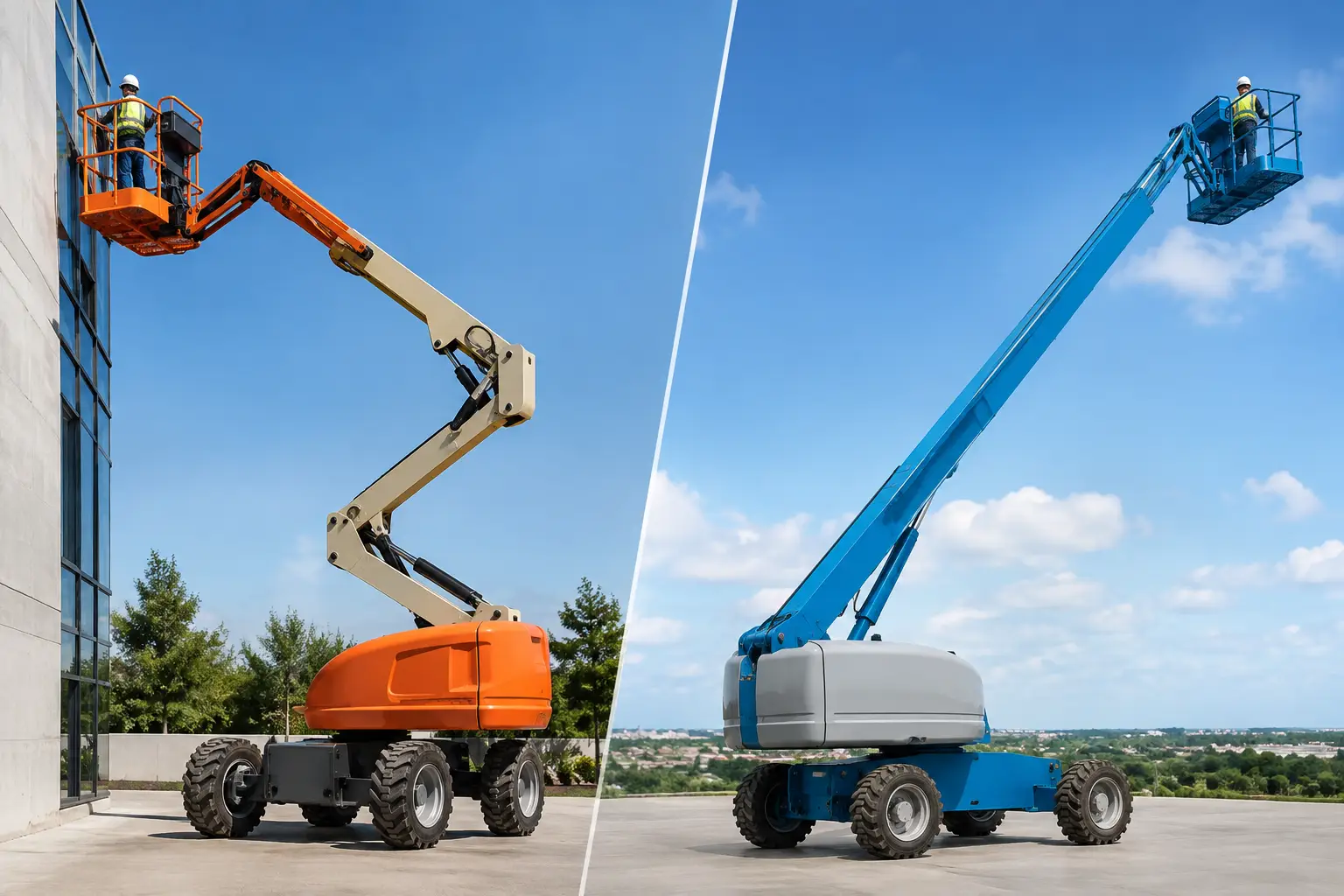
An articulating boom lift has multiple boom sections joined by pivot points. It is often called a knuckle boom because it can bend over, up and around obstacles. Many models combine a lower riser, articulated sections, telescopic extension and a jib, giving the platform several ways to approach the work.
A telescopic boom lift uses a straight main boom that extends outward in a direct line from the turret. It is commonly known as a straight boom. The design is built for strong horizontal outreach and a clear, direct route to elevation.
Neither is automatically better. An articulating boom is usually the more versatile choice where obstacles sit below or in front of the work point. A telescopic boom is generally the more efficient choice where access is open and maximum outreach is the priority.
When an articulating boom is the right tool
Articulating booms earn their place on congested sites. If a platform needs to rise beside a building, pass over a low roof or canopy, and then lower into position on the far side, a knuckle boom can make that movement possible. A straight boom may reach the same height but be unable to achieve the required approach angle.
This is particularly useful for building maintenance, facilities work, cladding repairs, steelwork, roofing details and industrial maintenance. Inside a plant, the ability to work over pipework, production equipment or stored materials can reduce the need to reposition machinery or erect alternative access equipment.
The advantage is best understood as up-and-over clearance. A typical articulating boom can lift the platform above an obstruction before extending towards the job. The exact clearance varies significantly by model, so compare the working envelope diagram rather than relying on the maximum platform height alone.
Articulating booms can also be a practical fit for sites with limited manoeuvring room. Compact electric models are well suited to smooth internal floors and emission-sensitive work, while diesel rough-terrain machines can tackle outdoor construction environments. For awkward, sloping or loose ground, a model with appropriate tyres, oscillating axle capability and, where specified, stabilisers can make a major difference to productivity.
There is a trade-off. More boom movement means more geometry to consider. On some jobs, the operator may need to raise, articulate and telescope in sequence to find the right position. Where there is no obstruction, this flexibility may add no real value over a simpler straight boom.
Typical articulating boom applications
An articulating boom is often the stronger option when the work involves:
- Reaching over roofs, canopies, walls, racking or machinery
- Accessing façade areas from a restricted set-back position
- Carrying out maintenance around industrial services and equipment
- Working in busy yards where materials or site structures block a direct path
- Positioning around tree branches or other irregular obstacles
Where telescopic boom lifts pull ahead
A telescopic boom lift is designed to cover ground quickly and directly. Its straight boom typically provides excellent horizontal outreach, making it a strong choice for broad façades, bridge work, external steel, inspection work and construction activity where the machine can be positioned in a clear area.
If the basket needs to reach a point high and far from the machine, with little in the way, a straight boom often offers the cleanest solution. Operators can make straightforward movements, and the working envelope is easier to visualise. This can be valuable on fast-moving projects where several similar access points need to be covered across a large site.
Telescopic booms are commonly found on demanding outdoor sites. Larger rough-terrain models offer four-wheel drive, substantial ground clearance and powerful diesel performance for uneven construction ground. Some specialist machines include stabilisers, allowing the boom to work with greater confidence where surface conditions are challenging, subject to the manufacturer’s limits and site assessment.
The limitation is obvious when a barrier appears in the line of travel. A straight boom cannot bend around a parapet, roof projection or process equipment. It may have the required outreach on paper but still need to be set farther back, closer in or at a different angle than the site allows.
Direct reach is not the same as useful reach
A straight boom’s published outreach figure is valuable, but it needs context. Outreach can reduce at different platform heights, and the basket may need to approach the task from above or below rather than at its maximum horizontal reach. Check the manufacturer’s envelope chart for the precise working position, including any limits created by platform capacity or jib position.
The same principle applies to articulating machines. Working height, platform height, outreach and up-and-over clearance should be reviewed together. A realistic site sketch and a few accurate measurements often prevent the wrong machine being sent to site.
Compare the full job, not just the boom
Working height and outreach are starting points. A professional purchase decision should also account for access to the work area, ground conditions, duty cycle and transport.
First, measure the narrowest point the machine must pass through. This could be a gateway, service road, yard entrance, internal opening or gap between stored materials. Overall width, stowed height, turning circle and tail swing all affect whether the boom can be placed where it needs to work.
Next, look at the surface. Electric slab booms work well on suitable finished floors, but they are not a substitute for a rough-terrain machine on loose aggregate, mud or steep gradients. On outdoor sites, consider gradeability, tyre type, four-wheel drive, axle configuration and ground bearing pressure. A machine that gets stuck before it reaches the work zone loses more time than it saves in reach.
Platform capacity matters too. A single operative with hand tools is very different from two operatives carrying materials. Higher-capacity models can be useful, but capacity may vary across the working envelope. Always verify the machine’s operating limits rather than assuming its maximum stated basket load applies in every position.
Finally, consider how the machine will arrive and move between jobs. Gross vehicle weight affects lorry selection, delivery cost and site logistics. For owner-operators and smaller contractors, a compact or lower-weight unit may be easier to plan around. For high-output projects, the larger machine may still represent better value if it removes repeated repositioning, secondary access equipment or lost labour time.
Safety and site planning come first
The right boom lift supports safer work, but it does not remove the need for proper planning. Before use, assess the ground, overhead hazards, wind exposure, exclusion zones, travel route and rescue arrangements. Confirm that operators are trained for the equipment category and that the machine is inspected, maintained and covered by the required thorough examination arrangements.
For outdoor boom work, wind is not a minor detail. The manufacturer’s permitted wind speed, the shape of the building and local gusts can all affect whether work can continue safely. Do not add signs, sheeting or other items that increase wind loading unless the manufacturer has expressly approved the arrangement.
On uneven ground, follow the specific machine guidance on levelling, gradient and stabiliser use. Auto-stabilisation is a useful feature on suitable models, but it is not permission to ignore voids, soft verges, underground services or poor bearing ground.
A practical way to choose between boom types
Start with the obstacle. If the basket must work over and beyond something, shortlist articulating booms first. If the route to the work is unobstructed and the job needs long, direct outreach, begin with telescopic models.
Then test that initial choice against the real site: can the machine physically enter, drive to the set-up area and operate within the stated ground and wind limits? Does its platform capacity suit the people, tools and materials? Can it be delivered efficiently? Only then does the maximum working height become meaningful.
For buyers weighing new against pre-owned equipment, condition and support should carry the same weight as the boom type. Service history, inspection status, battery condition on electric models, tyre wear, hydraulic performance and control operation all deserve a proper check. At Pure Platforms, matching the machine to the application, transport plan and ownership budget is part of getting the purchase right from the outset.
The best next step is to send over the required working height, horizontal distance, obstacle height, access width and a few site photographs. Those details turn a broad boom-lift comparison into a machine choice that will work hard from its first day on site.