A machine that is 100 mm too wide for an internal doorway, short on platform capacity once two operatives and materials are on board, or unable to complete a full shift on one charge soon becomes an expensive compromise. When searching for an electric scissor lift for sale, the right decision starts with the job site, not the headline working height or purchase price.
Electric scissor lifts are a practical choice for indoor construction, facilities maintenance, warehousing, fit-out, manufacturing and smooth, level external work. They provide a stable vertical working area, quiet operation and zero tailpipe emissions at the point of use. But electric does not automatically mean suitable for every site. Floor condition, duty cycle, access restrictions and transport arrangements all need checking before a machine joins the fleet.
What an Electric Scissor Lift Does Best
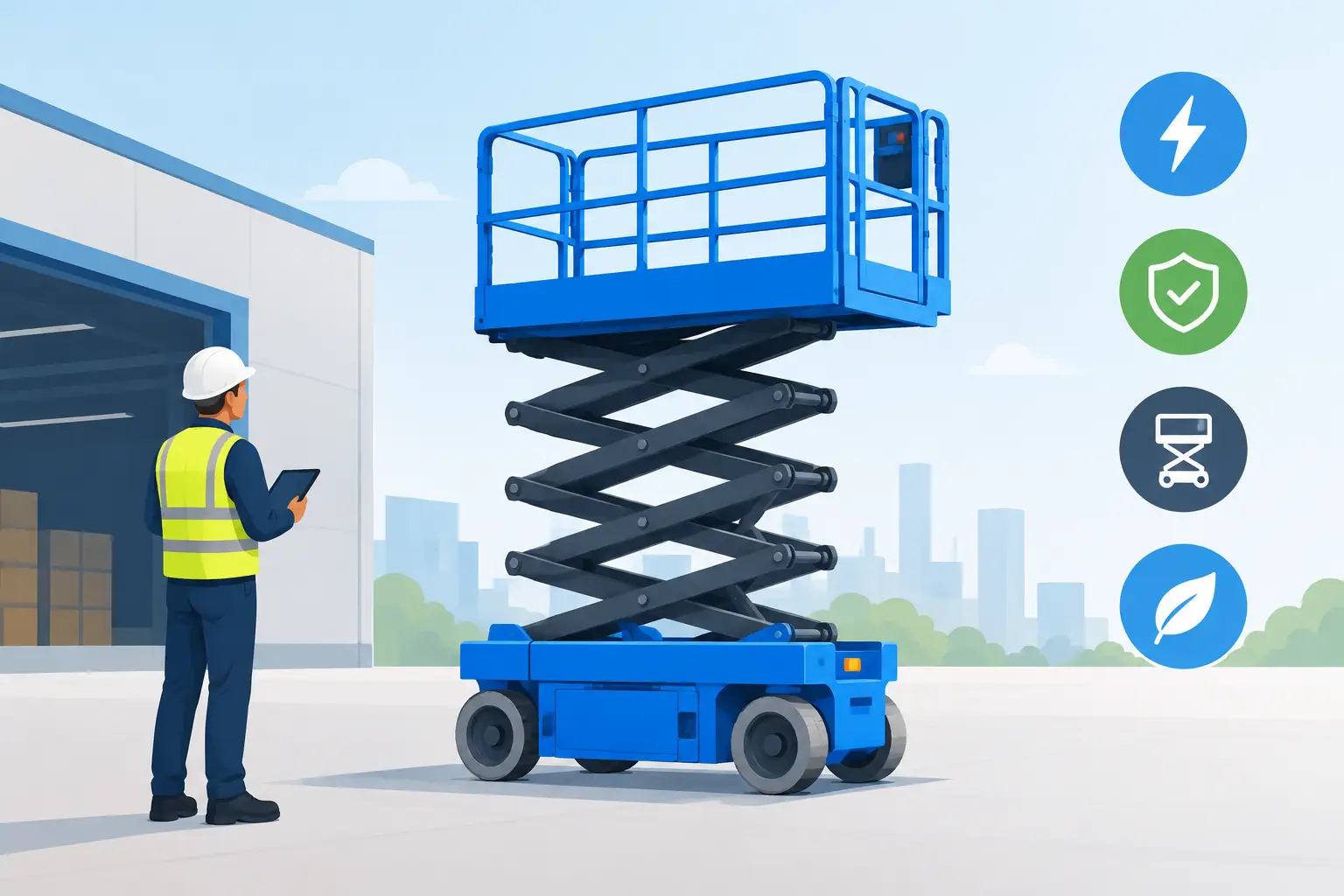
Unlike a boom lift, a scissor lift travels straight up and down. That makes it particularly effective where the work is directly above the machine: ceiling services, lighting, ducting, racking, cladding, fire systems and routine building maintenance are typical examples.
The platform is a major advantage. Operatives can take tools and materials up with them, subject to the rated capacity, without repeatedly returning to ground level. Many compact electric scissors also offer an extending deck, giving useful reach over obstructions or along a workface without moving the machine every few minutes.
For indoor work, electric drive brings obvious benefits. It reduces noise, avoids exhaust fumes and generally suits sensitive locations such as schools, hospitals, retail units and occupied commercial buildings. Non-marking tyres may also be essential where finished floors must be protected.
That said, an electric scissor is not a substitute for a rough-terrain machine on loose ground, slopes or heavily broken surfaces. If the route includes gravel, mud, poor slabs or significant gradients, a rough-terrain scissor or a stabilised boom may be the more productive option. Buying the wrong category to save on initial cost often creates delays every time the machine has to be repositioned or the ground needs preparing.
Choose the Right Electric Scissor Lift for Sale
Start with real working height
Working height normally includes a 2 m allowance for the operator, while platform height is the physical height of the deck. A 10 m working-height machine will usually have around 8 m of platform height. Confirm which figure is being quoted and measure the highest point that must be reached, including pipework, steelwork or ceiling voids.
Avoid buying with no margin at all. A machine that just reaches the task can become limiting as the project changes. Equally, there is little value in paying for unnecessary height if the machine will only operate beneath low ceilings or within a building where lift access is restricted.
Width can decide the purchase
For many buyers, width is the first serious filter. Check the narrowest doorway, corridor, goods lift, loading bay and site route, not simply the main entrance. Compact electric scissor lifts can be designed for narrow aisles and internal access, but guardrails, platform extensions and folded dimensions still need to be allowed for.
Also check overall height when stowed. A machine may fit through a doorway but fail to clear an overhead shutter, mezzanine beam or vehicle roof. These measurements should be part of the quotation discussion from the outset.
Capacity is more than the number of people
Platform capacity must cover everyone on the deck plus their tools, materials and any approved accessories. The published capacity may vary when the extension deck is deployed, so do not assume the full rating applies in every platform position.
Think about the work rather than the crew size alone. A two-person installation team carrying cable tray, fittings and power tools may need considerably more allowance than a maintenance engineer changing light fittings. Overloading is not a workaround for a machine that is too small. It creates a safety issue and can trigger platform overload cut-outs that stop the job.
Match battery performance to the shift
Battery condition matters on any pre-owned electric access platform. Ask about battery age, charging history, run time and whether the machine has been used on demanding applications with frequent drive cycles and extended elevated operation. A lift that appears tidy can still need a battery investment soon after delivery.
The charging arrangement should suit the site as well. Check the available power supply, charging time and whether the machine will have sufficient opportunity to recharge between shifts. For intensive operations, consider whether a newer battery system, battery monitoring or a different machine type will give better uptime.
Check the Ground, Gradeability and Site Rules
Standard electric scissor lifts are normally intended for firm, level surfaces. Even on warehouse floors, inspect joints, drains, ramps, dock levellers and local changes in level. The machine’s gradeability applies when stowed and should not be treated as permission to work elevated on a slope.
Look at the ground bearing capacity too. This is especially relevant on suspended slabs, raised floors, service yards and temporary surfaces. Machine weight, wheel loads and any concentration of load need to be suitable for the area where the platform will travel and work.
Site rules can influence the specification. Some locations require non-marking tyres, flashing beacons, motion alarms, secondary guarding, key management or particular inspection documentation. If the machine will be used in public-facing or occupied buildings, consider how it will be moved, charged and secured outside working hours.
New or Pre-Owned: Make the Commercial Choice
A new electric scissor lift can suit buyers who need a precise specification, warranty cover and predictable whole-life ownership from day one. It may also be the sensible route where a machine will see hard daily use or needs to meet a client’s particular fleet-age requirements.
Pre-owned equipment can offer strong value when the condition, service history and application are right. The key is to assess the actual machine rather than buying on age, paintwork or a low advertised figure. Hours, maintenance records, inspection status, battery health, charger operation, tyre condition and platform controls all deserve attention.
For either route, think beyond purchase price. Delivery, inspections, charging infrastructure, planned servicing, replacement batteries, insurance and eventual resale value belong in the calculation. If an existing machine is no longer right for the workload, a part-exchange valuation can make changing fleet more straightforward than carrying an underused asset.
Questions Worth Asking Before You Commit
A serious purchase conversation should establish whether the lift has the right working height, stowed dimensions, capacity and duty cycle for the work. It should also cover the intended operating surface, transport method and lead time to site.
For a used machine, ask when it was last inspected, what work it has previously carried out and whether any repairs, batteries or tyres are likely to be required in the near term. Request clarity on what is included with the sale, such as charger, manuals, keys and certification. If finance is part of the plan, get an accurate quotation based on the machine and term you actually want, rather than judging affordability from a generic monthly figure.
At Pure Platforms, the aim is to make those decisions practical: compare new and pre-owned options, check the details that affect your site, then arrange delivery around the job rather than leaving the machine choice to chance.
The best electric scissor lift is not necessarily the tallest or cheapest one available. It is the machine that clears the access route, carries the real load, completes the shift and keeps your team working safely at height without creating the next problem on site.