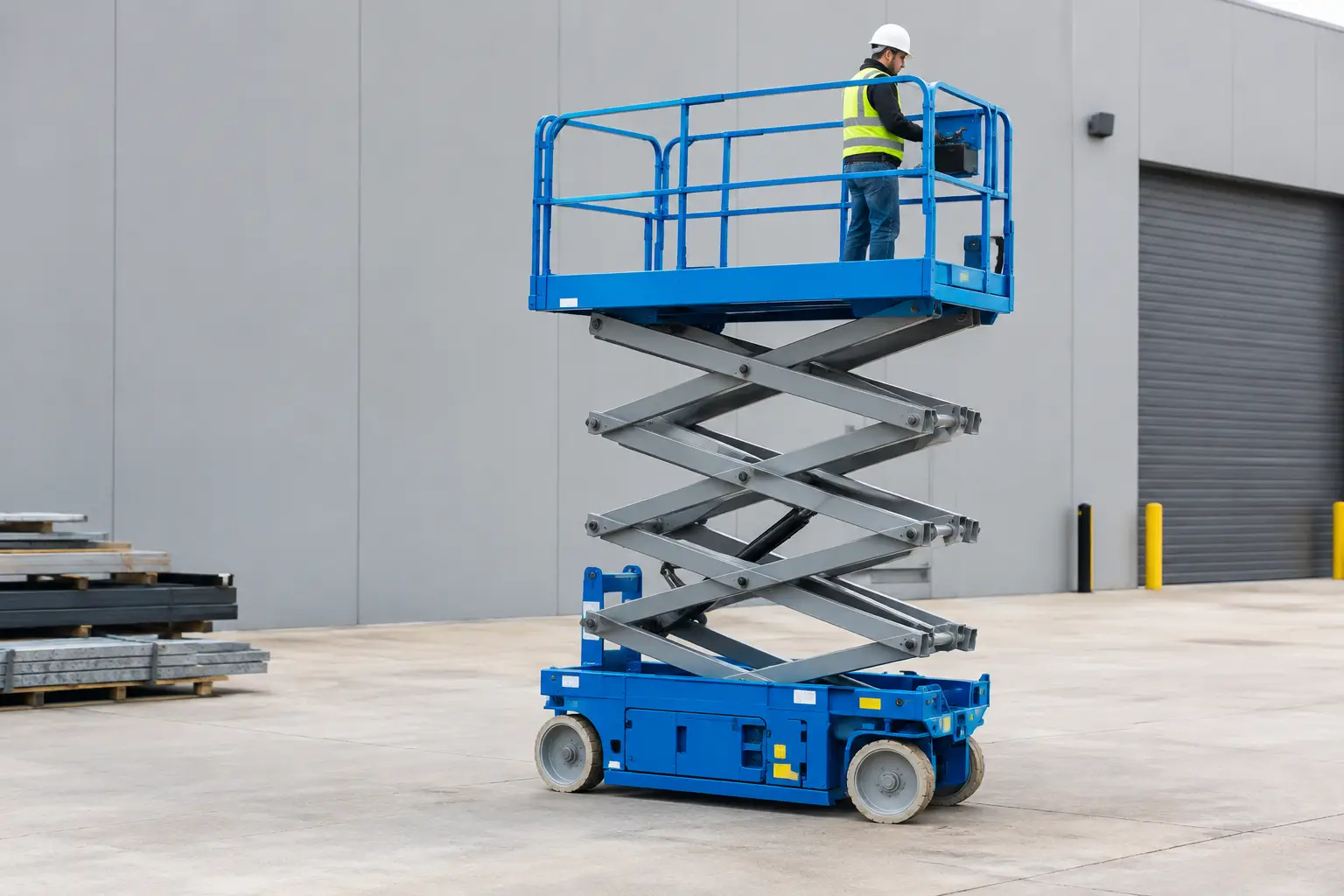
A scissor lift can have the right working height, safe working load and power source, yet still be the wrong machine if it cannot get through the gate, along the corridor or into the work area. Scissor lift width is often treated as a line on a specification sheet, but on a live site it dictates whether the job starts on time or the machine is left outside.
For contractors, facilities teams and hire fleets, the practical question is not simply, “How wide is the lift?” It is, “What is the narrowest point between the delivery vehicle and the point of work, and can the lift operate there safely?” Getting that answer before purchase protects productivity, avoids abortive transport costs and helps ensure the chosen platform earns its keep.
Why scissor lift width matters on site
A narrow electric scissor lift is built for access in restricted indoor spaces: warehouses, retail units, production lines, schools, hospitals and building-maintenance projects. Compact models can be around 0.76 m wide, allowing access through many standard doorways and between racking, subject to the actual clear opening and the machine specification.
That does not mean a narrower machine is automatically the better choice. A wider chassis can offer a larger platform, higher capacity, greater working height or better suitability for rough ground. Outdoor diesel and rough-terrain scissor lifts are commonly much wider because their design prioritises stability, tyre size, ground clearance and load-carrying capability.
The correct width is therefore a balance between access and output. A machine that fits through every doorway but lacks the deck space or capacity for materials may slow the work down. Equally, a larger unit may be ideal once positioned, but useless if it cannot pass the first pinch point.
Measure the full route, not just the entrance
The most common mistake is measuring one doorway and assuming the access route is suitable. The tightest restriction may be a side gate, a fire door, a service corridor, a loading-bay turn, a ramp edge or a lift threshold. Width also changes in practice when door leaves do not open fully, stock is stored along a walkway, or temporary site protection is installed.
Take measurements at the narrowest clear point with doors fully opened as they will be on the job. Compare this figure against the machine’s stated overall width, then leave sensible clearance for controlled travel. The amount of clearance required depends on the route, visibility, ground condition and operator competence, but a paper-thin fit is rarely a productive plan.
A useful access survey should account for five areas:
- Clear width at gates, doors, corridors and between fixed obstructions.
- Turns, particularly where a machine has to enter at an angle or reverse.
- Headroom at door frames, soffits, roller shutters and low-level services.
- Floor loading, thresholds, ramps and changes in surface level.
- The space needed to park, charge, deploy and work from the platform.
Remember that a scissor lift travels on its tyres or tracks, not along a perfectly measured line. Uneven floors, drain covers, loose materials and a poorly positioned doorway can all reduce usable clearance.
Doorways need more than a width check
A lift may be narrower than the opening but still awkward to pass through. Check the door-frame depth, handles, closers, kick plates and whether the door can be secured open. On older commercial premises, the nominal door size can be misleading once the frame and ironmongery are taken into account.
Turning into a doorway matters as much as going straight through it. If the approach is narrow, there may not be enough room to line the machine up squarely. This is particularly relevant with electric scissors that have a compact turning circle but still need clear space around their chassis to manoeuvre safely.
Platform width is not machine width
When comparing specifications, make sure everyone is talking about the same measurement. Overall machine width is the key figure for access. Platform width and platform length describe the usable working deck, while extension-deck dimensions indicate how much additional reach is available once the machine is in position.
A compact scissor can have a narrow chassis and still provide practical workspace through a roll-out deck extension. This is valuable for ceiling work, M&E installation and maintenance tasks where the operator needs to reach over fixed obstacles. However, an extension deck does not make a narrow machine into a high-capacity materials platform. Check the extension rating separately, especially if carrying ducting, cable tray, tools or multiple operatives.
Guardrails are another consideration. On some machines they may fold down for transport or access through restricted-height openings, but this does not change the safe operating configuration. Never assume a machine can be driven or elevated with rails altered unless the manufacturer’s instructions specifically allow it.
Indoor electric scissors versus rough-terrain models
For smooth, level internal floors, compact electric scissor lifts are usually the natural choice. Their narrow width, zero-emission operation at point of use and non-marking tyres suit finished environments where space is limited. Low-weight models can also be useful where floor loading or goods-lift capacity is a concern, although both must be checked against the site’s limits.
Rough-terrain scissor lifts are intended for a different type of work. Their wider stance, larger tyres and higher ground clearance suit external construction, cladding, steelwork and uneven ground. Many provide higher platform capacities and larger decks, but their width can make access through existing structures impossible without a planned route.
If the site combines narrow access with rough ground, the answer may not be a scissor lift at all. A tracked spider lift or stabilised boom can sometimes reach the work area more effectively, depending on terrain, outreach and the nature of the task. The right category should be selected around the job, rather than forcing one machine type into every application.
Width affects transport and delivery planning
The lift does not begin work when it reaches the gate. It first needs to be loaded, transported, unloaded and positioned without creating a site bottleneck. Confirm whether delivery is by lorry, trailer or another suitable arrangement, and make sure the unloading point has the required access, bearing capacity and space to manoeuvre.
For owner-operators moving equipment between jobs, a narrower scissor can make storage and loading simpler, but transport weight remains equally important. Do not select solely by width if the machine exceeds the towing, trailer or vehicle limits available to your business. Gross weight, tie-down points, ramp capacity and load distribution all need to be part of the decision.
On refurbishment sites, delivery timing can be decisive. A lift may need to enter before internal walls, doors, racking or other permanent restrictions are installed. Early planning can give you access to a more productive platform rather than leaving the team constrained by the smallest available route.
Checking width on a used scissor lift
With a pre-owned machine, verify the actual specification rather than relying only on an old advert or an assumed model variant. Options, tyre condition and modifications can affect practical dimensions. Compare the identification plate, manufacturer data and physical machine where possible.
Pay close attention to wheels and tyres. Excessive wear, incorrect tyre types or damaged wheels may affect both the overall width and the way the lift tracks through a narrow route. Check that steering, drive controls and brakes operate correctly, as precise low-speed control is essential where clearance is limited.
Also inspect platform extensions, guardrails and gates for damage or poor operation. In confined areas, bent rails or a sticking extension deck become more than an inconvenience: they can interrupt access and create unnecessary handling risk.
At Pure Platforms, the conversation should start with the route into the job as well as the height of the job. Providing doorway sizes, internal photos, ground details and the materials you need to carry makes it far easier to match a new or used platform to the real working environment.
Choose clearance, then choose capability
Start with the narrowest safe access point and work backwards. Establish the maximum overall machine width that can realistically travel the route, then compare the available scissor lifts for working height, platform capacity, deck size, power source, weight and terrain capability. This avoids being drawn to a headline height figure before the basic access question is answered.
Where the fit is close, arrange a proper assessment rather than relying on estimates. A few careful measurements before ordering are far cheaper than a delayed delivery, a frustrated crew and a machine that cannot reach its work area. The best scissor lift is the one that arrives, fits, performs and keeps the job moving.