A platform that looks right on a spec sheet can become the wrong machine the moment it reaches a narrow gate, a sloping compound or a soft-ground work area. This commercial access equipment buyers guide is built around the questions that matter on site: can the machine get in, set up safely, reach the work and keep earning its place in your fleet?
Buying access equipment is not simply a choice between working heights. The right decision combines access geometry, ground conditions, transport, operator needs and the expected cost of ownership. Get those details right before ordering, and the machine can remove bottlenecks for years.
Start with the work, not the platform
Write down the jobs the machine will complete most often. A facilities team carrying out internal maintenance has a very different requirement from an arborist working across steep, sensitive ground. Likewise, a roofing contractor may need outreach over an obstruction, while a hire fleet may place greater weight on simple controls, transport flexibility and broad customer appeal.
Working height is the first figure most buyers ask for, but it is only a starting point. Allow for the actual height of the task, the operator’s reach from the basket and the possibility that ground level is not perfectly flat. Selecting a machine with no practical margin can limit its usefulness from day one.
Then assess horizontal outreach and up-and-over capability. A boom may need to clear a conservatory, roof edge, machinery line or landscaping before the basket can be positioned safely at the work face. A scissor lift offers a large, stable platform for straight-up work, but it will not solve an obstruction problem. A compact spider lift may pass through a restricted entrance and then provide the outreach a larger machine cannot deliver from outside the site.
Build the site brief before comparing models
A clear site brief prevents expensive assumptions. Measure the narrowest gate, doorway, alleyway or side access the machine must pass through. Include turns, headroom and any surface changes, not just the width of the final opening.
For each regular site, record:
- access width and height, including gates, arches and internal doorways
- ground bearing conditions, slopes and areas prone to waterlogging
- the required working height, outreach and obstacles below the work area
- transport restrictions, including towing capacity, payload and parking space
- whether petrol, diesel, battery or mains power is permitted or practical.
Machine width and stowed height matter just as much as maximum working height. A tracked spider lift can be a strong answer where access is narrow and the ground is uneven, particularly when stabilisers allow it to level on challenging terrain. However, stabiliser footprint needs checking. A machine may fit through a 900 mm opening but require significantly more room once deployed.
On firm, open ground, a self-propelled rough-terrain boom with stabilisers can give a productive combination of drive capability, outreach and levelling support. The trade-off is size, weight and transport planning. If the machine will spend much of its life travelling between smaller jobs, a road-towable platform may reduce delivery dependence and improve response time, provided the towing vehicle and operator entitlement are suitable.
Choose the platform category for its real strengths
There is no universal best access platform. The best category is the one that suits the work pattern without adding unnecessary complexity.
Tracked spider lifts
Tracked spider lifts are designed for access where conventional machines struggle. Their compact dimensions, low ground pressure and stabilised set-up make them particularly useful for narrow spaces, landscaped areas, sloping sites and sensitive surfaces. Some models are light enough for transport on a suitable trailer, which can make them a practical choice for contractors covering varied sites.
Check the track width, basket capacity, outreach chart and stabiliser spread. Also consider whether hybrid or battery operation is needed for indoor work, low-emission locations or noise-sensitive hours.
Rough-terrain booms with stabilisers
These machines suit demanding external work where productivity, drive performance and reach are priorities. The ability to travel around a site and work from a stabilised position can be valuable on uneven ground. Models that are drive-able at full working height can also reduce repeated lowering and repositioning on suitable terrain.
The key checks are gradeability, tyre type, ground clearance, platform capacity and the operating limits with and without stabilisers. Do not assume rough-terrain capability makes any slope safe. Site assessment, manufacturer limits and operator competence still govern the job.
Road-towable access platforms
A towable lift is often a smart ownership option for maintenance businesses, roofers and contractors that need regular access but do not want to arrange a lorry delivery for every job. They can be compact in storage and quick to deploy on level, accessible locations.
Their limitations are equally clear. Set-up time, stabiliser positioning, towing arrangements and ground condition all need attention. They are not the automatic answer for rough, confined or frequently changing work areas.
Scissor lifts and conventional booms
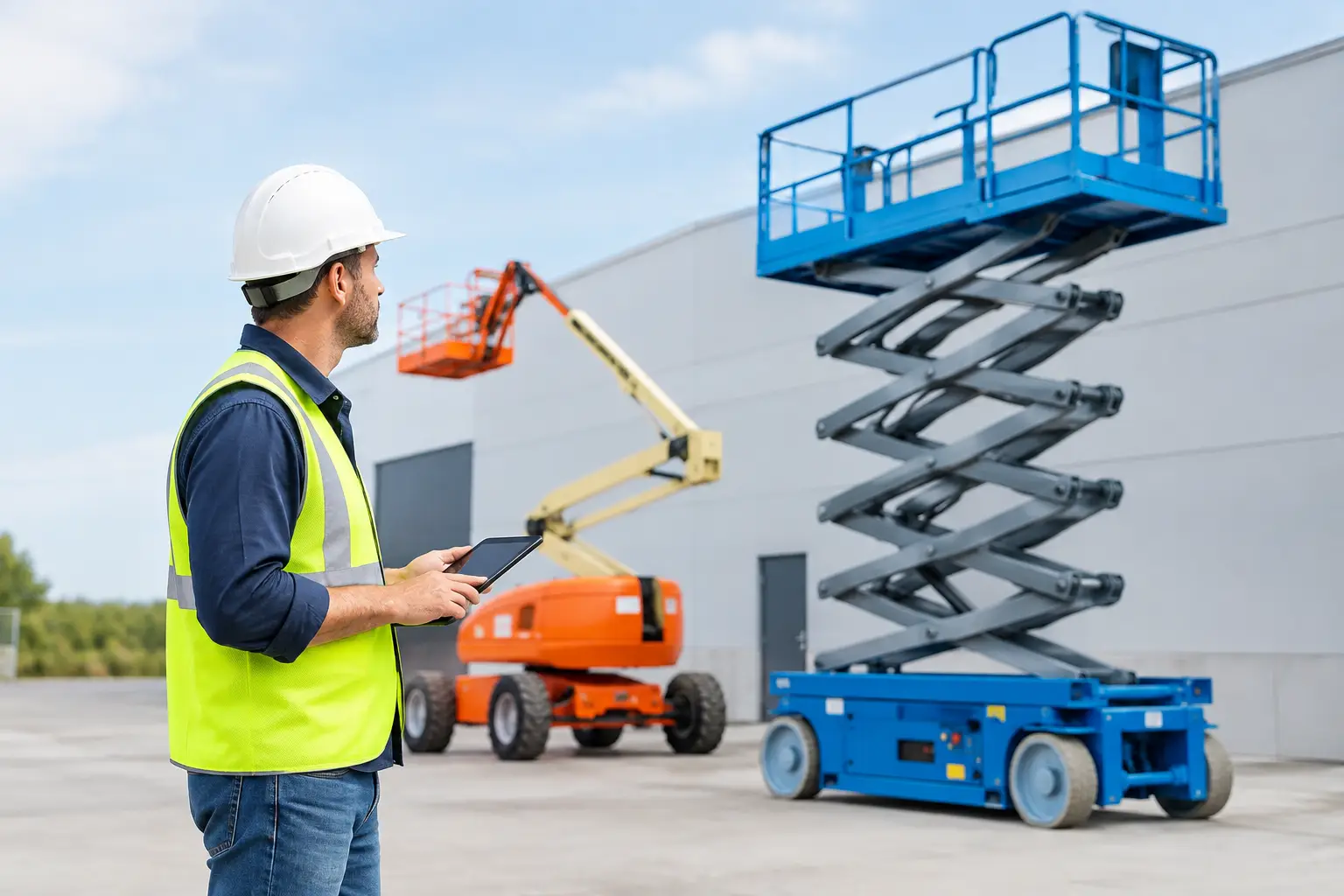
Scissor lifts work well where the task is largely vertical and where operators need room for tools or materials. Electric models are a familiar choice for warehouses, factories and facilities work on suitable floors. Conventional booms offer flexible positioning and can suit general construction, maintenance and industrial access where site access is less restrictive.
The decision comes down to whether you need basket space, vertical-only access, outreach or compact all-terrain performance. Buying a larger general-purpose machine can look sensible until it is unable to reach the jobs that prompted the purchase.
Check transport weight before you commit
Transport is a major cost and a common source of purchasing mistakes. Gross vehicle weight, trailer capacity, payload, ramp loading and securing points need to work as a complete system. A machine may be road-towable in principle but unsuitable for the vehicle available to your team.
For delivered equipment, ask for delivery-cost calculations based on your location and site access. Consider where the machine will be unloaded, whether a low-loader is required and if the delivery point has time restrictions. If you expect to move the platform regularly, calculate those costs over a year rather than treating delivery as a one-off line item.
Storage deserves the same scrutiny. Measure workshop doors, yard entrances and any covered storage area. Protecting a machine from avoidable weather exposure and unauthorised use helps preserve condition and resale value.
New or pre-owned: judge the whole ownership picture
A new machine offers clear specification, current safety features, warranty support and predictable early-life maintenance. It can be the right choice where uptime is critical, where you need a precise configuration or where the machine will support a long-term contract.
Pre-owned equipment can deliver excellent value, particularly for lower utilisation or a business building capability without tying up as much capital. The question is not simply how many hours are showing. Ask about service records, inspection history, previous use, battery condition where relevant, hydraulic leaks, structural repairs, tyre or track wear, control function and the availability of parts and technical support.
A low-hour machine that has been poorly stored or inconsistently maintained may cost more over time than a higher-hour example with a documented service history. Arrange a proper inspection and, where possible, see the platform operate through its full range. Verify that any stated working height, outreach and basket capacity match the specification plate and documentation.
Put lifecycle cost beside the purchase price
The cheapest purchase price is not always the lowest-cost decision. Build a straightforward ownership calculation covering finance, delivery, inspections, routine servicing, consumables, insurance, storage, operator familiarisation and expected resale value. For a specialist machine, include the cost of downtime if an unplanned repair takes it out of service during a busy period.
Finance can make a higher-specification platform viable when it is genuinely needed, but monthly cost should not replace due diligence. Compare the term, deposit, total payable and how the agreement sits with your expected ownership period. If you have a surplus platform, a part-exchange valuation may reduce the changeover cost and remove the time involved in selling privately.
Pure Platforms can support buyers with new and pre-owned options, machine sourcing, delivery calculations, finance quotations and part-exchange valuations. That matters when the right machine is not the first one visible in stock.
Make safety and usability part of the buying decision
A capable platform only adds value when it can be used confidently and correctly. Confirm that operators will have the appropriate familiarisation, that daily checks fit into the team’s routine and that the controls suit the work. Features such as auto-stabilisation can improve set-up consistency, but they do not replace planning, ground checks or safe operating practice.
Think about basket capacity in real terms. Include operators, tools, materials and any approved accessories. Check whether the platform needs power in the basket, non-marking tracks or tyres, a jib, rotating basket, or power options suited to enclosed areas. Small specification choices can determine whether a machine is used every week or left parked when the difficult jobs arrive.
The strongest purchase decision is usually the one made against real site measurements, real work patterns and a realistic ownership plan. Bring those details to the quotation stage, challenge assumptions early and choose a platform that gives your team room to work hard safely when conditions are far from ideal.