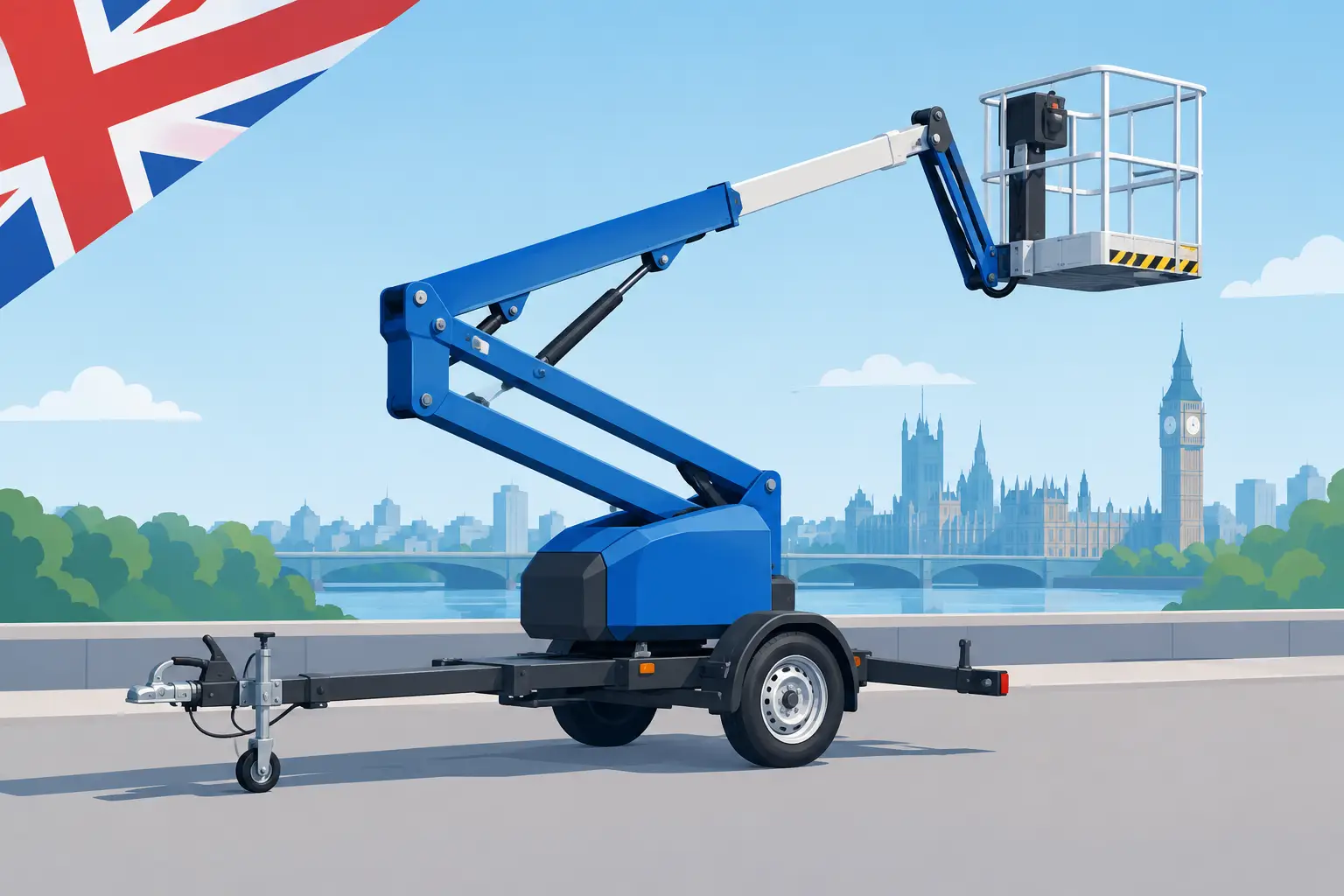
A road towable access platform for sale can remove a major cost and delay from working at height: getting the machine to site. For contractors moving between jobs, a towable platform can travel behind a suitable vehicle, be set up quickly and reach places where a larger self-propelled boom simply cannot get close. The right choice, however, is not just the tallest machine within budget. It needs to suit your towing vehicle, ground conditions, access route and the type of work your team completes every week.
Why choose a road towable access platform?
Road towable platforms are designed for businesses that need flexible access without dedicating a lorry, trailer fleet or delivery booking to every job. They are commonly used by roofing contractors, property-maintenance teams, facilities managers, tree-care businesses and hire fleets that cover a wide area.
Their biggest advantage is practical transport. Once folded, a compact towable platform can be collected from the yard, towed to site and positioned through domestic driveways, service yards or restricted compounds. That can make a real difference on smaller jobs where arranging a delivery vehicle would eat into the margin.
Most models use outriggers or stabilisers to level the machine before elevation. This gives a stable working base and allows the platform to operate safely where the ground is not perfectly flat. The trade-off is that setup space matters. A machine may fit through a narrow gate, but you must also allow room to deploy its stabilisers and swing the boom.
Towable machines are not the automatic answer for every application. If operators need to cover a large industrial site all day, travel repeatedly at height or work over very soft terrain, a self-propelled rough-terrain boom or tracked spider lift may be the more productive option. The best platform is the one that reduces handling and delay on your actual sites, rather than the one with the highest headline specification.
Start with the work, not the working height
Working height is usually the first figure buyers compare, and it matters. It should be based on the highest regular task, with a sensible allowance for the operator’s reach and safe positioning. Yet two platforms with the same maximum working height can perform very differently once they reach the job.
Check outreach and up-and-over capability
A platform has to get the basket to the work area, not merely rise beside it. Roof edges, conservatories, canopies, parked vehicles, perimeter walls and planted areas can all prevent close positioning. Horizontal outreach tells you how far the basket can reach from the chassis, while up-and-over clearance helps indicate whether the boom can work past an obstruction.
Consider the jobs your team does most often. For guttering, light cladding, building maintenance and tree work, useful outreach may deliver more value than an extra metre of vertical height. For straightforward façade work from a clear hardstanding area, a more compact machine may be the better commercial fit.
Measure the route in and the setup footprint
Machine width, overall length and towing weight should be checked before you request a quotation. Measure gates, alleyways, narrow entrances, turning points and any slope between the road and the working position. Do not rely on a site description such as ‘good access’ – a wheelie-bin store, low branch or tight turn can change the whole plan.
Also check the stabiliser spread in the position required for operation. Some machines offer variable or multi-position stabiliser setups, which can be valuable where space is restricted. There is still no substitute for confirming the available footprint on site.
Match the weight to the towing arrangement
Gross vehicle weight affects which towing vehicle is suitable, what licence entitlement may be needed and how easily the machine can be moved between contracts. Include the platform, trailer equipment and any accessories in your assessment, then check the towing limits of the vehicle you intend to use.
A heavier machine may provide greater reach or a larger basket capacity, but it can narrow your transport options. A lighter platform is easier to move, although lighter does not always mean more capable on uneven ground. This is where a proper specification comparison pays for itself.
Power options and site conditions
Towable access platforms are available with different power arrangements, and the right configuration depends on where the machine will work and how it will be used.
Battery power suits enclosed or noise-sensitive locations, provided charging can be managed between shifts. It can be a strong option for schools, hospitals, warehouses and property-maintenance work where exhaust emissions are unacceptable. Diesel or petrol-powered systems can be useful for remote locations and longer outdoor duty cycles, particularly where mains charging is unavailable. Hybrid options can give greater flexibility, although they add cost and should be chosen because the work genuinely requires both modes.
Ground condition deserves the same level of attention. Stabilisers can compensate for moderate slopes within the machine’s stated limits, but they do not turn unstable or soft ground into a safe setup area. Check for underground voids, drainage covers, fresh tarmac, cellars and services before deploying outriggers. Spread plates may be required to distribute load and protect the surface.
For regular work across mud, woodland tracks or unfinished construction sites, a road towable platform may still be viable where a suitable hardstanding can be found. If the machine must be taken directly across difficult terrain, a tracked spider lift or rough-terrain boom is often the more realistic route.
New or used: where should the budget go?
A new road towable access platform gives you a known starting point, current safety systems and manufacturer warranty support. It is often the sensible choice for a growing business that needs predictable availability, wants to standardise its fleet or plans to retain the machine for several years.
A pre-owned machine can offer excellent value when the condition, service history and specification match the work. The purchase price matters, but it is only one part of ownership cost. A lower-priced platform that needs tyres, batteries, hoses, inspections or control repairs shortly after delivery is not necessarily the better deal.
When reviewing a used platform, ask practical questions about its working history, recorded servicing, inspection status, battery condition where applicable, tyre wear, hydraulic leaks, basket controls and stabiliser operation. Check that safety decals, manuals and relevant records are present. A functional demonstration should include elevation, boom functions, emergency lowering and stabiliser setup, not just a quick start-up in the yard.
It is also worth looking at parts availability and after-sales support for the make and model. An uncommon machine can appear attractive on price, yet downtime becomes expensive if components are difficult to obtain. For many buyers, proven UK support is worth more than a small saving at the point of purchase.
The figures that affect day-to-day productivity
Beyond height and outreach, basket capacity affects what can be carried safely aloft. Tools, materials and two-person working arrangements quickly add weight, so make sure the rated capacity reflects the job rather than an idealised one-person task.
Controls also influence productivity. Proportional controls support precise positioning, while auto-levelling or auto-stabilisation can reduce setup time and help operators establish a stable working position consistently. These features do not replace competent operation, pre-use checks or a proper ground assessment, but they can make a meaningful difference across a busy schedule.
Consider the practical details as well: basket dimensions, gate entry, tow hitch type, lighting equipment, storage for harnesses and tools, charging requirements, and whether the platform can be stored securely at your premises. The machine should fit the workday from collection to return, not only the moment it is elevated.
Build the purchase around the full package
The best buying process starts with a clear description of your usual sites, access restrictions, preferred transport vehicle and required working envelope. From there, compare machines on operating value rather than headline height alone. Include delivery cost, lead time, finance options, warranty, servicing arrangements and the value of any machine you plan to part-exchange.
At Pure Platforms, the aim is to make that comparison straightforward – whether you need a new machine, a carefully selected pre-owned platform or help sourcing a specific model. The relationship should continue after the delivery date, because the right machine is one that keeps earning on site.
Before committing, take your three most common jobs and test every proposed platform against them. If it can be towed legally, pass through the access route, set up safely, reach the work and keep your operators productive, it is much more than a good-looking specification. It is equipment ready to work hard when the job demands it.