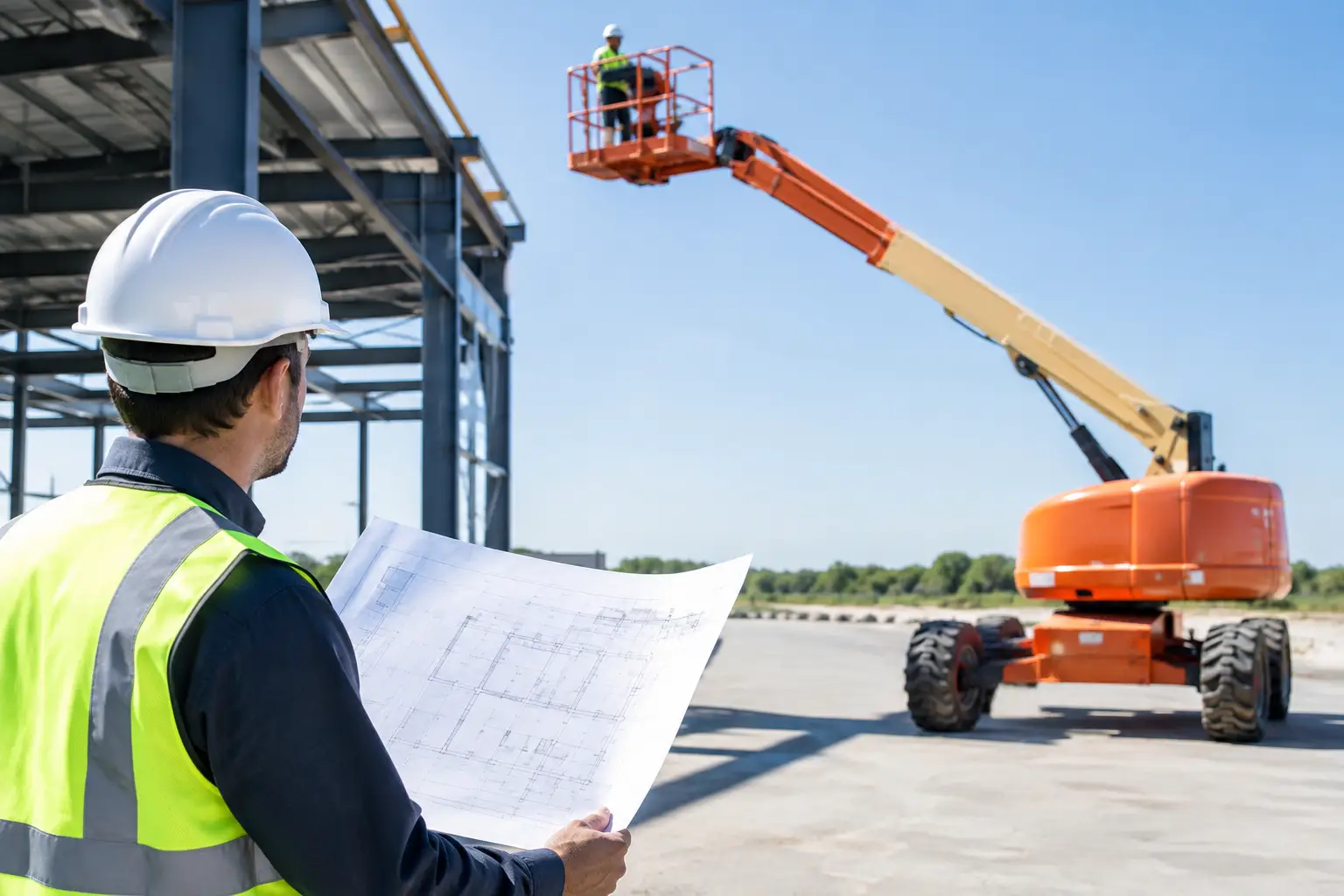
A boom that reaches the required working height is only useful if it can get to the job, position safely and move on without striking the building, roof structure or site obstacles. Boom lift clearance is therefore a planning issue, not a last-minute measurement. On tight commercial sites, a few centimetres of machine height, tail swing or basket projection can decide whether a job runs smoothly or requires a different access route.
For contractors, facilities teams and owner-operators, the right question is not simply, “How high does it go?” It is, “What space does the machine need at every stage of the work?” That includes delivery, unloading, travel, stabilisation where fitted, elevation and outreach.
What does boom lift clearance mean?
Boom lift clearance describes the space required around a machine for it to travel and operate without contact or unsafe encroachment. It is not one fixed figure on a specification sheet. The relevant clearance changes according to what the machine is doing.
A conventional self-propelled boom may need clear overhead height to pass through a loading bay, sufficient width between stored materials, and room behind the chassis when slewing. A rough-terrain boom with stabilisers also needs space for its outriggers, ideally on suitable bearing ground, before the boom can be used. A compact tracked spider lift can reduce the access requirement dramatically, but its deployed footprint and working envelope still need checking.
The main dimensions are machine transport height, stowed length and width, platform dimensions, tail swing, turning circle, stabiliser spread and the boom’s operating envelope. Ground conditions and slope matter too. A route that appears clear on a site drawing may become unsuitable once kerbs, drainage channels, soft verges or parked vehicles are accounted for.
Start with the access route, not the working height
The most common mistake is choosing a machine around maximum working height and outreach, then discovering that it cannot pass the entrance, negotiate the yard or reach the intended set-up position. Measure the full route before selecting equipment.
Begin at the delivery point. Check the gate opening, road restrictions, surface condition and whether the lorry has room to unload safely. A road-towable platform may be easier to bring onto some sites, while a self-propelled boom may require transport on a suitable vehicle and enough space for unloading. Delivery access is part of machine selection, particularly on city-centre, industrial-estate and live-site work.
Continue the survey from the gate to the work area. Record the narrowest width, lowest overhead point and tightest turn. Do not rely on nominal door sizes or assume a roller shutter opens fully. Consider downpipes, signs, bollards, racking, suspended services and temporary materials. If the route includes ramps, assess their gradient, width and transition angles against the machine’s stated capability.
For indoor work, ceiling-mounted services deserve special attention. Sprinkler pipework, lighting, cable trays and ducting often sit lower than the structural roof. A boom can clear the doorway but still be unable to travel safely beneath services at the required point.
Clearance changes when the boom is raised
Stowed dimensions only tell half the story. Once elevated, the platform follows an arc and the machine may slew, telescope or articulate around obstacles. This is where buyers need to distinguish between reach and usable reach.
A straight telescopic boom can offer strong horizontal outreach, but it may need a clearer line from chassis to workface. An articulating boom can reach up and over obstructions such as canopies, plant rooms or roof edges, although its movement through the air must still be planned. Neither type should be selected purely because a brochure figure looks impressive.
Check the manufacturer’s working envelope for the exact model under consideration. This shows where the basket can be positioned relative to the chassis and, crucially, where it cannot. Ask whether the intended task requires reaching over an obstacle, working below a soffit, moving across a façade, or maintaining a set distance from fragile materials and live services.
The basket itself also needs operating space. A platform positioned beside glazing, cladding or pipework can be restricted by guardrail clearance before the operative reaches the work. For maintenance jobs, allow for tools, materials and the movement needed to complete the task without leaning or overreaching.
Tail swing and slewing room
Tail swing is easily overlooked, especially on congested sites. As the turret rotates, the rear of some boom lifts projects beyond the chassis footprint. That can bring it into contact with walls, stored stock, passing vehicles or pedestrian routes.
Zero-tail-swing and compact models can be a practical advantage where space is tight, but they are not a substitute for a proper assessment. The basket and boom still create a moving envelope, and the operator needs a protected area in which to manoeuvre. If work is close to public areas or other trades, site segregation and communication should be part of the plan.
Stabilised boom lift clearance on uneven ground
Rough-terrain boom lifts with stabilisers bring valuable capability to sloping, soft or uneven ground. They can create a level working base where a conventional boom may not be appropriate. The trade-off is that the machine footprint expands when the stabilisers are deployed.
Measure the full stabiliser spread, not just the chassis width. Include room for the operator to set up safely and ensure the outriggers are not positioned over voids, covers, drainage runs or unsupported edges. The ground must be assessed for bearing capacity and condition, with suitable pads or spreader plates used where the manufacturer’s guidance and site assessment require them.
Auto-levelling or auto-stabilisation functions can speed up set-up, but they do not remove the need for competent planning. A machine cannot make unsuitable ground suitable. On a restricted site, stabiliser clearance can also affect traffic routes, emergency access and the space available for other contractors.
Five measurements worth taking before requesting a quote
A clear site brief helps match the machine to the task quickly. Before requesting a quotation, record these measurements and send photographs where possible:
- the narrowest gate, doorway or passage width;
- the lowest overhead obstruction on the full travel route;
- available turning space at corners and in the work area;
- the working height, horizontal outreach and any obstacle to be cleared; and
- the ground gradient, surface type and available area for stabilisers, where applicable.
Also state whether the platform must be driven at full working height, whether it will operate indoors or outdoors, and what power source is acceptable. Electric machines may suit clean internal work, while diesel rough-terrain equipment is often better suited to demanding external sites. It depends on the duty cycle, ventilation, surface and access restrictions, not simply the height of the job.
Allow a sensible margin, not a guess
Machine specifications should not be treated as permission to squeeze through an opening with no tolerance. Site dimensions vary, obstacles move, surfaces are not always level and operators need room to work safely. Leave a practical margin around travel routes and operating areas.
The size of that margin depends on the task. A straight run through a wide warehouse aisle is different from reversing around a blind corner between active work zones. Weather can alter the picture outdoors: rain may soften ground, wind may affect the task and temporary barriers may reduce the usable route. Review the plan on the day rather than assuming an earlier survey still reflects site conditions.
Clearance is also a reason to look beyond one machine category. A narrow tracked spider lift may access a rear garden, courtyard or internal route that a conventional boom cannot. A road-towable platform can be a sensible option where transport flexibility matters. Conversely, a larger self-propelled boom may deliver better productivity when there is open ground, repeated repositioning and substantial outreach requirements.
At Pure Platforms, the useful starting point is the job and the access, then the model. Share the key dimensions, photographs and site constraints early. A properly matched platform gives the operator room to work, protects the site and keeps the programme moving without an expensive change of plan at the gate.
Before committing to a machine, walk the route from delivery point to workface and imagine every movement it must make. That simple exercise usually reveals the clearance detail that matters most.